


Cannon: Difference between revisions
imported>MasterKenway No edit summary |
imported>Jasca Ducato mNo edit summary |
||
| Line 1: | Line 1: | ||
{{Era|ACB|ACR|AC3|AC4|Project Legacy|Bbook}} | {{Era|ACB|ACR|AC3|AC4|Project Legacy|Bbook}} | ||
{{WP-REAL|Cannon}} | {{WP-REAL|Cannon}} | ||
{{Quote|Soldiers have no respect for artillery. They expect a gun to work like magic. You need to feel her out, give her a little encouragement.|Monteriggioni's engineer to Ezio Auditore, 1500.|Assassin's Creed: Brotherhood}} | |||
[[File:Hell on Wheels 12.png|thumb|250px|right|Ezio lighting a cannon]] | [[File:Hell on Wheels 12.png|thumb|250px|right|Ezio lighting a cannon]] | ||
'''Cannons''' are projectile-based artillery, used since the late Medieval era, and popularly up until the early 18th century. They were often situated on stone walls, towers, [[Forts|fortresses]] or [[ships]]. | |||
'''Cannons''' are projectile-based | |||
==Ammunition== | ==Ammunition== | ||
[[File:The Ghost War Act 1 1.png|thumb|250px|Grapeshot laying waste to gunboats]] | [[File:The Ghost War Act 1 1.png|thumb|250px|Grapeshot laying waste to gunboats]] | ||
A variety of different forms of cannonball were invented during the weapon's period of general use. | |||
Beyond the typical {{Wiki|round shot}}, warships in particular also used {{Wiki|chain-shot}}, which consisted of two linked cannonballs designed to disable a ship's sails, allowing her to be boarded; {{Wiki|grapeshot}}, small, pack sackes of ballbearings or slugs similar to a shotgun shell, which were highly effective against a vessels crew; and {{Wiki|heated shot}}s, which were designed to set a ship on fire, and caused significant damage at close range.<ref name="AC3">''[[Assassin's Creed III]]''</ref> | |||
==History== | ==History== | ||
Revision as of 14:43, 8 January 2014
- "Soldiers have no respect for artillery. They expect a gun to work like magic. You need to feel her out, give her a little encouragement."
- ―Monteriggioni's engineer to Ezio Auditore, 1500.[src]

Cannons are projectile-based artillery, used since the late Medieval era, and popularly up until the early 18th century. They were often situated on stone walls, towers, fortresses or ships.
Ammunition

A variety of different forms of cannonball were invented during the weapon's period of general use.
Beyond the typical round shot, warships in particular also used chain-shot, which consisted of two linked cannonballs designed to disable a ship's sails, allowing her to be boarded; grapeshot, small, pack sackes of ballbearings or slugs similar to a shotgun shell, which were highly effective against a vessels crew; and heated shots, which were designed to set a ship on fire, and caused significant damage at close range.[1]
History
Renaissance Italy

Sometime in late 1499, Mario Auditore upgraded the arsenal of Monteriggioni by adding mounted cannons to the walls of the town. In anticipation of an attack from the Borgia, or from their long time enemies in Florence, Mario rigorously trained his men in the cannons' use.[2]
A few days after their installation, Ezio Auditore da Firenze and several of Monteriggioni's mercenaries used the cannons to repel the Borgia forces, after they had begun a siege on the town, destroying many of the French Army's cannons.[2]
Leonardo da Vinci incorporated cannons into his War Machines for Cesare Borgia's army, including the tank, bomber, and Naval Cannon; the Naval Cannon was a boat capable of launching heated shots at a ship's sails, causing the masts to topple.[2]
Ottoman Empire
Cannons were among the War Machines used by the Byzantines in their struggle for control of Constantinople with the Turkish Assassins. The Assassins eventually responded in kind by incorporating cannons into their barricades.[3]
Colonial America

Cannons were used by armies and navies during the struggles for control of North America during the 18th century. Cannons and mortars were placed in forts, and transported on carts to the fields of battle, where they bolstered the firepower of troops using muskets, neutralizing entire platoons at a time if aimed properly.[1]
Also introduced by this century were swivel guns, which were designed to fire beyond the normal range of a naval cannon. A single shot could blow up a ship after barrage had exposed its gunpowder supply, or detonate naval mines. There were also mortars, cannons which fired bombs upwards to fall and detonate on a close range target. Mortar fire was capable of stripping ships of all weaponry.[1][4]
Gallery
-
 Cannons used in the Defense of Camerino
 -
 Concept art of Ezio firing a cannon
 -
 Concept art of cannons used during the Battle of Bunker Hill
 -
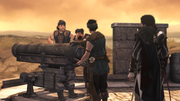 Mercenaries close by a cannon
 -
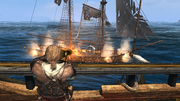 Edward Kenway using a swivel cannon
 -
 Haytham Kenway sabotaging a cannon
 -
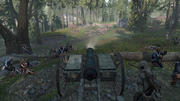 A cannon being used during the Battle of Monmouth


References
| |||||||||||||||||||||||||||||||||||||
| |||||||||||||||||||||||||||||||||||||
| |||||||||||||||||||||||||||||||||||||||||||