

Pompey: Difference between revisions
imported>Darman36 |
imported>Darman36 mNo edit summary |
||
| Line 8: | Line 8: | ||
| death = 28 September 48 BCE (aged 57)<br>[[Herakleion Nome]], [[Ptolemaic Kingdom]] | | death = 28 September 48 BCE (aged 57)<br>[[Herakleion Nome]], [[Ptolemaic Kingdom]] | ||
| species = [[Human]] | | species = [[Human]] | ||
| affiliates = [[Julius Caesar]] | | affiliates = [[Gaius Julius Caesar]] {{c|formerly}}<br>[[Roman Republic]]<br>[[Cleopatra]]}} | ||
'''Gnaeus Pompeius Magnus''' (106 – 48 BCE), also known as '''Pompey''' or '''Pompey the Great''', was a military and political leader of the late [[Roman Republic]]. He was also | '''Gnaeus Pompeius Magnus''' (106 – 48 BCE), also known as '''Pompey''' or '''Pompey the Great''', was a military and political leader of the late [[Roman Republic]]. He was also [[Gaius Julius Caesar]]'s son-in-law, having married his daughter {{Wiki|Julia (daughter of Caesar)|Julia}}. | ||
==Biography== | ==Biography== | ||
Revision as of 06:03, 26 September 2025
| This article is about the individual. You may be looking for the genetic memory. |
Gnaeus Pompeius Magnus (106 – 48 BCE), also known as Pompey or Pompey the Great, was a military and political leader of the late Roman Republic. He was also Gaius Julius Caesar's son-in-law, having married his daughter Julia.
Biography
Pompey was a close ally of Pharaoh Ptolemy XII Auletes during his exile from Egypt after being deposed in favor of his daughter Berenice IV. As a gift of the alliance, Pompey commissioned the shield "Remission",[1] and in 55 BCE, sent General Aulus Gabinius to lead an army to help the pharaoh restore his throne.[2] These Roman soldiers would later become the Gabiniani who settled down in Alexandria to protect the pharaohs.[3]
During Caesar's civil war, Caesar defeated Pompey at the Battle of Pharsalus in Greece as part of his wider Macedonian campaign,[4] causing him to flee. In 48 BCE in the Aegean Sea, Pompey was assisted by Aya and Phoxidas, who had been sent by Cleopatra to initiate an alliance. Pompey accepted the offer and declared that his fleet will make way for Egypt immediately.[5]
Shortly after his arrival in Egypt, Pompey was ambushed by Lucius Septimius and the Gabiniani sent by Ptolemy XIII, Cleopatra's younger brother. Pompey was slain and beheaded by Septimius, despite him having served the Roman general in 67 BCE in the Mediterranean Sea. The decapacitated corpse of Pompey was later found by Bayek and Aya, followed by Cleopatra and Apollodorus, who arrived too late to assist the general.[6]
Legacy
After his death, Pompey's head was brought back to Alexandria by Septimius. Ptolemy XIII hoped to use the head as means to gain favor from Julius Caesar, who had pursued Pompey to Egypt. The plan ultimately failed, as Julius Caesar later sided with Cleopatra against Ptolemy.[7]
Behind the scenes
Historically, Pompey died in Pelusium, a city located at the eastern extremes of the Nile Delta. In Origins however, he died in the Herakleion Nome. Also, it was said that Caesar planned in pardoning Pompey for his actions once he captured or surrendered to him, as a means of an alliance.
Gallery
-
 Pompey on his ship
 -
 Pompey considering the alliance
 -
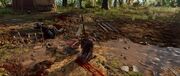 Pompey's decapitated corpse
 -
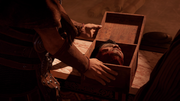 Caesar receives Pompey's head


Appearances
- Assassin's Creed: Origins (first appearance)
- Echoes of History (mentioned only)
References
- ↑ Assassin's Creed: Origins
- ↑ Echoes of History: Behind the Legends – Episode 2: Cleopatra
- ↑ Assassin's Creed Origins: Official Game Guide
- ↑
 Caesar's invasion of Macedonia on Wikipedia
- ↑ Assassin's Creed: Origins – Pompeius Magnus
- ↑ Assassin's Creed: Origins – Way of the Gabiniani
- ↑ Assassin's Creed: Origins – Aya: Blade of the Goddess