


British Army: Difference between revisions
imported>Kainzorus Prime |
imported>Slate Vesper mNo edit summary |
||
| Line 1: | Line 1: | ||
{{Era|AC3|AC3L|AC4|Forsaken}} | {{Era|AC3|AC3L|AC4|Forsaken}} | ||
{{WP-REAL}} | {{WP-REAL}} | ||
{{Quote|The enemy advances and you tremble. They've better numbers, you say. Better weapons. Better training.|[[Israel Putnam]] describing Continental reaction to the British regulars.}} | {{Quote|The enemy advances and you tremble. They've better numbers, you say. Better weapons. Better training.|[[Israel Putnam]] describing Continental reaction to the British regulars.|Assassin's Creed III}} | ||
{{Faction Infobox | {{Faction Infobox | ||
|image = ACIII-Britishsoldier-render.png | |image = ACIII-Britishsoldier-render.png | ||
| Line 9: | Line 9: | ||
*[[United States|British America]] (Industrial era) | *[[United States|British America]] (Industrial era) | ||
*[[France]] (First World War) | *[[France]] (First World War) | ||
*British Empire (Industrial - Modern era) | *British Empire (Industrial - [[Modern times|Modern era]]) | ||
|hideh = yes | |hideh = yes | ||
|hidea = yes}} | |hidea = yes}} | ||
| Line 16: | Line 16: | ||
The superior discipline, skill-at-arms, equipment, organization, brutality and reputation of the British Army were major sources of intimidation to the initially amateur soldiers of the [[Continental Army]] during the American Revolution. During the conflict, the British Army received military support from their {{Wiki|Hessian (soldiers)|Hessian}} allies, mainly in the form of [[Jägers]]. | The superior discipline, skill-at-arms, equipment, organization, brutality and reputation of the British Army were major sources of intimidation to the initially amateur soldiers of the [[Continental Army]] during the American Revolution. During the conflict, the British Army received military support from their {{Wiki|Hessian (soldiers)|Hessian}} allies, mainly in the form of [[Jägers]]. | ||
The soldiers of the British | The soldiers of the British Army, known as the Regulars, were often referred to as "Redcoats" or "Lobster-backs" by the general population during the [[American Revolution]], due to their distinctive red uniforms. While the facings of the uniform were known to vary by regiment, the red dye was maintained by most British troops, excluding the Horse Guards, bombardiers and riflemen. | ||
==Arms and tactics== | ==Arms and tactics== | ||
The British Infantry Regulars of the 18th century were armed with the standard British Army smoothbore [[Firearms|flintlock musket]], often known as the {{Wiki|Brown Bess}}, and a fifteen inch [[Bayonets|socket bayonet]] that could be locked onto the end of the musket barrel, which was often employed when receiving cavalry or, obviously, during a bayonet charge. The battle cry "Huzzah" often accompanied a bayonet charge, for intimidation. | The British Infantry Regulars of the 18th century were armed with the standard British Army smoothbore [[Firearms|flintlock musket]], often known as the {{Wiki|Brown Bess}}, and a fifteen inch [[Bayonets|socket bayonet]] that could be locked onto the end of the musket barrel, which was often employed when receiving cavalry or, obviously, during a bayonet charge. The battle cry "Huzzah" often accompanied a bayonet charge, for intimidation. Dragoons and other cavalry were armed with carbines and swords. | ||
[[File:ACIII-Soldier 13.png|thumb|250px|Haytham Kenway fighting several British soldiers]] | |||
[[File:ACIII- | |||
British soldiers were drilled extensively in the use of these primary weapons, until they could load and fire their muskets with their eyes closed. A well-trained infantryman could average around three shots per minute from his musket, whereas a sub-par soldier could accomplish perhaps two. British officers usually armed themselves with flintlock pistols and [[Swords and maces|sabers]], although it was not unknown for light infantry officers to carry their own musket or rifle as the war progressed. | British soldiers were drilled extensively in the use of these primary weapons, until they could load and fire their muskets with their eyes closed. A well-trained infantryman could average around three shots per minute from his musket, whereas a sub-par soldier could accomplish perhaps two. British officers usually armed themselves with flintlock pistols and [[Swords and maces|sabers]], although it was not unknown for light infantry officers to carry their own musket or rifle as the war progressed. | ||
When on patrol, British soldiers usually marched in a column of 6-9 men. These groups consisted of one commissioned [[Officers|Officer]], a [[Snitches|Drummer]], four Regulars, and four [[Grenadiers]]. These numbers changed over the course of the Revolutionary War. | When on patrol, British soldiers usually marched in a column of 6-9 men. These groups consisted of one commissioned [[Officers|Officer]], a [[Snitches|Drummer]], four Regulars, and four [[Grenadiers]]. These numbers changed over the course of the Revolutionary War. | ||
[[File: | [[File:Battle of Bunker Hill 3.png|thumb|left|250px|British regulars in [[Battle of Bunker Hill]] with [[John Pitcairn]] on [[Horsemen|horseback]]]] | ||
The British greatly emphasized mass line infantry fire and prized discipline. In this regard, punishment was strict for deserters and disobedience. Mass line infantry differed from, for example, the French firing patterns. The firing line allowed for the maximum number of muskets to be brought to bare on a target, and therefore the highest volume of fire. | The British greatly emphasized mass line infantry fire and prized discipline. In this regard, punishment was strict for deserters and disobedience. Mass line infantry differed from, for example, the French firing patterns. The firing line allowed for the maximum number of muskets to be brought to bare on a target, and therefore the highest volume of fire. | ||
The guerrilla warfare of the rebels was frowned upon by the British commanders, who considered it dishonorable, though the British | The guerrilla warfare of the rebels was frowned upon by the British commanders, who considered it dishonorable, though the British Army did deploy similarly-trained soldiers. Many of the rebels were in fact trained by the British as light infantry, or "light bobs", and such units continued to be employed by the British, though they were scarcely used in place of line fire. It was found, however, that such guerrilla warfare, over time, was highly effective against the line and file tactics of the day, though the Regulars were hard to match in pitched battles or over open ground. | ||
Historically however, despite this advantage, the rebels had difficuties facing British cavalry even with the latter's use being limited in the war. The British 16th and 17th Light Dragoons in particular became a terror to the Patriot forces as many veterans of the French and Indian War in the colonies were not experienced against standing up to a charge of green and red-coated horsemen with drawn swords smashing and cutting them to ribbons. Only the limitations of the eastern American terrain made them from playing a decisive role. | |||
Many pitched battles were focused around ranks of line infantry unleashing volleys of synchronized musket fire, and often in pursuit of an objective | Many pitched battles were focused around ranks of line infantry unleashing volleys of synchronized musket fire, and often in pursuit of an objective; many thousands of lives would be laid down for a small gain. The discipline of the British would allow soldiers to march past and over their fallen comrades and continue to fight for their objective, with a ferocity bred from poverty, as were the conditions in which many of the infantry were raised. Once the enemy lines faltered, British Dragoons and other cavalry would draw swords and charge to send the enemy to run. | ||
==Trivia== | ==Trivia== | ||
*Despite the British Army having withdrawn from {{Wiki|Colonial America}} in 1783, remnants of British Regulars could still be found around the [[Frontier]], [[Boston]] and [[New York City|New York]]. | *Despite the British Army having withdrawn from {{Wiki|Colonial America}} in 1783, remnants of British Regulars could still be found around the [[Frontier]], [[Boston]] and [[New York City|New York]]. | ||
*The Grenadiers resembled a {{Wiki|Pioneer (military)|pioneer}}, which was a military unit whose tasks are specifically for construction and engineering, rather than actual grenadiers, who were used as elite troops to storm enemy battlements and fortifications. | *The Grenadiers resembled a {{Wiki|Pioneer (military)|pioneer}}, which was a military unit whose tasks are specifically for construction and engineering, rather than actual grenadiers, who were used as elite troops to storm enemy battlements and fortifications. | ||
*British officer uniforms were based on the era's {{Wiki|Dragoon guards|Dragoons}}. Historically, however, Dragoons served as mounted heavy | *British officer uniforms were based on the era's {{Wiki|Dragoon guards|Dragoons}}. Historically, however, Dragoons served as mounted heavy cavalry, rather than footsoldiers. | ||
*In the ''[[The Tyranny of King Washington]]'', British military joined the rebellion against [[George Washington|King Washington]]. | *In the ''[[The Tyranny of King Washington]]'', the British military joined in the rebellion against [[George Washington|King Washington]], evidenced by many red-coated corpses strewn around the Frontier and other cities. | ||
==Gallery== | ==Gallery== | ||
| Line 50: | Line 48: | ||
Dangerous Secret by Max Qin.jpg|Illustration of British soldiers | Dangerous Secret by Max Qin.jpg|Illustration of British soldiers | ||
Concept art of a British Army encampment.jpg|Concept art of [[Ratonhnhaké:ton|Connor]] surveying a British army encampment | Concept art of a British Army encampment.jpg|Concept art of [[Ratonhnhaké:ton|Connor]] surveying a British army encampment | ||
AC3 British Leader.png|A British officer | |||
AC3 British Brute.png|A British grenadier | AC3 British Brute.png|A British grenadier | ||
AC3 REDCOATS.png|A contingent of British soldiers | |||
British Army camp in the Frontier.jpg|A British army camp in the Frontier | British Army camp in the Frontier.jpg|A British army camp in the Frontier | ||
ACIII-GI (2).jpg|Connor watching a British patrol | ACIII-GI (2).jpg|Connor watching a British patrol | ||
Revision as of 14:54, 29 June 2014
- "The enemy advances and you tremble. They've better numbers, you say. Better weapons. Better training."
- ―Israel Putnam describing Continental reaction to the British regulars.[src]
The British Army was a branch of the Armed Forces of the Kingdom of Great Britain, alongside the Royal Navy and, later, the Royal Air Force. It was formed in 1707 with the Act of Union and focused on land-based warfare. Following Great Britain's triumph over the Kingdom of France in the French and Indian War, which ended in 1763, the soldiers of the British Army occupied Colonial America during the events of the American Revolutionary War.
The superior discipline, skill-at-arms, equipment, organization, brutality and reputation of the British Army were major sources of intimidation to the initially amateur soldiers of the Continental Army during the American Revolution. During the conflict, the British Army received military support from their Hessian allies, mainly in the form of Jägers.
The soldiers of the British Army, known as the Regulars, were often referred to as "Redcoats" or "Lobster-backs" by the general population during the American Revolution, due to their distinctive red uniforms. While the facings of the uniform were known to vary by regiment, the red dye was maintained by most British troops, excluding the Horse Guards, bombardiers and riflemen.
Arms and tactics
The British Infantry Regulars of the 18th century were armed with the standard British Army smoothbore flintlock musket, often known as the Brown Bess, and a fifteen inch socket bayonet that could be locked onto the end of the musket barrel, which was often employed when receiving cavalry or, obviously, during a bayonet charge. The battle cry "Huzzah" often accompanied a bayonet charge, for intimidation. Dragoons and other cavalry were armed with carbines and swords.

British soldiers were drilled extensively in the use of these primary weapons, until they could load and fire their muskets with their eyes closed. A well-trained infantryman could average around three shots per minute from his musket, whereas a sub-par soldier could accomplish perhaps two. British officers usually armed themselves with flintlock pistols and sabers, although it was not unknown for light infantry officers to carry their own musket or rifle as the war progressed.
When on patrol, British soldiers usually marched in a column of 6-9 men. These groups consisted of one commissioned Officer, a Drummer, four Regulars, and four Grenadiers. These numbers changed over the course of the Revolutionary War.

The British greatly emphasized mass line infantry fire and prized discipline. In this regard, punishment was strict for deserters and disobedience. Mass line infantry differed from, for example, the French firing patterns. The firing line allowed for the maximum number of muskets to be brought to bare on a target, and therefore the highest volume of fire.
The guerrilla warfare of the rebels was frowned upon by the British commanders, who considered it dishonorable, though the British Army did deploy similarly-trained soldiers. Many of the rebels were in fact trained by the British as light infantry, or "light bobs", and such units continued to be employed by the British, though they were scarcely used in place of line fire. It was found, however, that such guerrilla warfare, over time, was highly effective against the line and file tactics of the day, though the Regulars were hard to match in pitched battles or over open ground.
Historically however, despite this advantage, the rebels had difficuties facing British cavalry even with the latter's use being limited in the war. The British 16th and 17th Light Dragoons in particular became a terror to the Patriot forces as many veterans of the French and Indian War in the colonies were not experienced against standing up to a charge of green and red-coated horsemen with drawn swords smashing and cutting them to ribbons. Only the limitations of the eastern American terrain made them from playing a decisive role.
Many pitched battles were focused around ranks of line infantry unleashing volleys of synchronized musket fire, and often in pursuit of an objective; many thousands of lives would be laid down for a small gain. The discipline of the British would allow soldiers to march past and over their fallen comrades and continue to fight for their objective, with a ferocity bred from poverty, as were the conditions in which many of the infantry were raised. Once the enemy lines faltered, British Dragoons and other cavalry would draw swords and charge to send the enemy to run.
Trivia
- Despite the British Army having withdrawn from Colonial America in 1783, remnants of British Regulars could still be found around the Frontier, Boston and New York.
- The Grenadiers resembled a pioneer, which was a military unit whose tasks are specifically for construction and engineering, rather than actual grenadiers, who were used as elite troops to storm enemy battlements and fortifications.
- British officer uniforms were based on the era's Dragoons. Historically, however, Dragoons served as mounted heavy cavalry, rather than footsoldiers.
- In the The Tyranny of King Washington, the British military joined in the rebellion against King Washington, evidenced by many red-coated corpses strewn around the Frontier and other cities.
Gallery
-
 Concept art of a British infantryman
 -
 Concept art of a British soldier
 -
 Concept art of a Jäger
 -
 Illustration of British soldiers
 -
 Concept art of Connor surveying a British army encampment
 -
 A British officer
 -
 A British grenadier
 -
 A contingent of British soldiers
 -
 A British army camp in the Frontier
 -
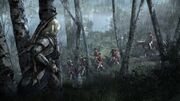 Connor watching a British patrol
 -
 Connor fighting three British soldiers
 -
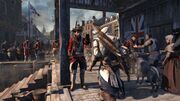 Connor being halted by a British soldier
 -
 Connor killing two British soldiers
 -
 In-game image of a British encampment


.jpg)
.jpg)
.jpg)


Reference
| |||||||||||||||||||||||||||||||||||||||||||