


Greek fire: Difference between revisions
imported>Gener4l Cl4ank4 No edit summary |
imported>Gener4l Cl4ank4 No edit summary |
||
| Line 1: | Line 1: | ||
{{Era|Technology|Weapons}}{{WP-REAL|Greek fire}} | {{Era|Technology|Weapons}}{{WP-REAL|Greek fire}} | ||
{{Spoilerhd| | {{Spoilerhd|28 August 2024|''[[Assassin's Creed: Forgotten Temple]]''}} | ||
[[File:Setting_sail_9.png|thumb|250px|Ezio using Greek fire]] | [[File:Setting_sail_9.png|thumb|250px|Ezio using Greek fire]] | ||
'''Greek fire''' was a powerful [[Byzantine Empire|Byzantine]] incendiary weapon that was a closely guarded military secret. Its true composition remains unknown to this day, despite multiple theories. Famously, it was reputed to burn more fiercely on contact with water, making it particularly valuable in naval warfare.<ref>{{WP|Greek fire}}</ref> | '''Greek fire''' was a powerful [[Byzantine Empire|Byzantine]] incendiary weapon that was a closely guarded military secret. Its true composition remains unknown to this day, despite multiple theories. Famously, it was reputed to burn more fiercely on contact with water, making it particularly valuable in naval warfare.<ref>{{WP|Greek fire}}</ref> | ||
| Line 7: | Line 7: | ||
==History== | ==History== | ||
===Early history=== | |||
Greek fire was first used by the Byzantine Emperor {{Wiki|Leo III the Isaurian|Leon III}}'s army, when enemy vessels laid siege to Constantinople in the year 717. In the battle, the napalm-like substance burned through the enemy fleet, forcing them to call off their attack and flee west.{{Cite|7 Apr 2021}} | Greek fire was first used by the Byzantine Emperor {{Wiki|Leo III the Isaurian|Leon III}}'s army, when enemy vessels laid siege to Constantinople in the year 717. In the battle, the napalm-like substance burned through the enemy fleet, forcing them to call off their attack and flee west.{{Cite|7 Apr 2021}} | ||
In 1511, the [[Italian Brotherhood of Assassins|Italian Assassin]] [[Ezio Auditore da Firenze|Ezio Auditore]] used Greek fire in order to destroy several ships preventing him from leaving the city.<ref name="Setting Sail">''[[Assassin's Creed: Revelations]]'' – [[Setting Sail]]</ref> The [[Ottoman Brotherhood of Assassins|Ottoman Assassins]] also mounted Greek fire weapons along the barricades they used to defend their dens from [[Templars|Templar]] attacks.<ref name="ACR" /> | In 1511, the [[Italian Brotherhood of Assassins|Italian Assassin]] [[Ezio Auditore da Firenze|Ezio Auditore]] used Greek fire in order to destroy several ships preventing him from leaving the city.<ref name="Setting Sail">''[[Assassin's Creed: Revelations]]'' – [[Setting Sail]]</ref> The [[Ottoman Brotherhood of Assassins|Ottoman Assassins]] also mounted Greek fire weapons along the barricades they used to defend their dens from [[Templars|Templar]] attacks.<ref name="ACR" /> | ||
===18th century=== | |||
[[File:ACFT - Yun producing Greek fire.png|left|thumb|180px|Yun producing Greek fire]] | [[File:ACFT - Yun producing Greek fire.png|left|thumb|180px|Yun producing Greek fire]] | ||
In 1725, the [[Chinese Brotherhood of Assassins|Chinese Assassins]] [[Xiao Han]], [[Liu Qing]], and [[Xue Yan]] carried [[bomb]]s filled with Greek fire, which they used while boarding the ''[[Fenghuang]]''. The engineer [[Yun Pyeong-Gyu]] recognized the substance from the stories he had heard about it and instructed the ship's crew to use sand instead of water to extinguish the flames.<ref name="FT 48">''[[Assassin's Creed: Forgotten Temple]]'' – [[Assassin's Creed: Forgotten Temple Episode 48|Episode 48]]</ref> | In 1725, the [[Chinese Brotherhood of Assassins|Chinese Assassins]] [[Xiao Han]], [[Liu Qing]], and [[Xue Yan]] carried [[bomb]]s filled with Greek fire, which they used while boarding the ''[[Fenghuang]]'', the flagship of the [[Zhang Wei Union]]. The engineer [[Yun Pyeong-Gyu]] recognized the substance from the stories he had heard about it and instructed the ship's crew to use sand instead of water to extinguish the flames.<ref name="FT 48">''[[Assassin's Creed: Forgotten Temple]]'' – [[Assassin's Creed: Forgotten Temple Episode 48|Episode 48]]</ref> | ||
After repelling the Chinese Assassins' attack, Yun was able to reproduce the formula for Greek fire, which the [[British Brotherhood of Assassins|British Assasasin]] [[Edward Kenway]] recognized from the Brotherhood's records. He then suggested making a stop at [[Java]] to acquire {{Wiki|petroleum}}, which would allow them to produce larger quantities of the substance.<ref name="FT 50">''[[Assassin's Creed: Forgotten Temple]]'' – [[Assassin's Creed: Forgotten Temple Episode 50|Episode 50]]</ref> | After repelling the Chinese Assassins' attack, Yun was able to reproduce the formula for Greek fire, which the [[British Brotherhood of Assassins|British Assasasin]] [[Edward Kenway]] recognized from the Brotherhood's records. He then suggested making a stop at [[Java]] to acquire {{Wiki|petroleum}}, which would allow them to produce larger quantities of the substance.<ref name="FT 50">''[[Assassin's Creed: Forgotten Temple]]'' – [[Assassin's Creed: Forgotten Temple Episode 50|Episode 50]]</ref> | ||
Fortunately for the | Fortunately for the Zhang Wei Union members, the trip to Java became unnecessary after Yun stumbled upon a warehouse filled with barrels of petroleum during the crew's imprisonment in [[Manila]]. Following the crew's escape, Yun had these barrels loaded onto the ''Fenghuang'', allowing the engineer to resume production of Greek fire.<ref name="FT 53">''[[Assassin's Creed: Forgotten Temple]]'' – [[Assassin's Creed: Forgotten Temple Episode 53|Episode 53]]</ref> [[Xialun Qing]] used her knowledge of alchemy to assist Yun, remaking that the process was similar to the distillation of alcohol.<ref name="FT 58">''[[Assassin's Creed: Forgotten Temple]]'' – [[Assassin's Creed: Forgotten Temple Episode 58|Episode 58]]</ref> | ||
==Trivia== | ==Trivia== | ||
Revision as of 22:07, 29 May 2024

|
He who increaseth knowledge, increaseth sorrow. This article contains spoilers, meaning it has information and facts concerning Assassin's Creed: Forgotten Temple. If you do not want to know about these events, it is recommended to read on with caution, or not at all. |

Greek fire was a powerful Byzantine incendiary weapon that was a closely guarded military secret. Its true composition remains unknown to this day, despite multiple theories. Famously, it was reputed to burn more fiercely on contact with water, making it particularly valuable in naval warfare.[1]
Greek fire was both used by ships, and in the struggles for control of Assassin Dens in Constantinople during the Ottoman Civil War.[2]
History
Early history
Greek fire was first used by the Byzantine Emperor Leon III's army, when enemy vessels laid siege to Constantinople in the year 717. In the battle, the napalm-like substance burned through the enemy fleet, forcing them to call off their attack and flee west. [citation needed]
In 1511, the Italian Assassin Ezio Auditore used Greek fire in order to destroy several ships preventing him from leaving the city.[3] The Ottoman Assassins also mounted Greek fire weapons along the barricades they used to defend their dens from Templar attacks.[2]
18th century

In 1725, the Chinese Assassins Xiao Han, Liu Qing, and Xue Yan carried bombs filled with Greek fire, which they used while boarding the Fenghuang, the flagship of the Zhang Wei Union. The engineer Yun Pyeong-Gyu recognized the substance from the stories he had heard about it and instructed the ship's crew to use sand instead of water to extinguish the flames.[4]
After repelling the Chinese Assassins' attack, Yun was able to reproduce the formula for Greek fire, which the British Assasasin Edward Kenway recognized from the Brotherhood's records. He then suggested making a stop at Java to acquire petroleum, which would allow them to produce larger quantities of the substance.[5]
Fortunately for the Zhang Wei Union members, the trip to Java became unnecessary after Yun stumbled upon a warehouse filled with barrels of petroleum during the crew's imprisonment in Manila. Following the crew's escape, Yun had these barrels loaded onto the Fenghuang, allowing the engineer to resume production of Greek fire.[6] Xialun Qing used her knowledge of alchemy to assist Yun, remaking that the process was similar to the distillation of alcohol.[7]
Trivia
- In the Assassin's Creed: Brotherhood novelization, the defenders used Greek fire during the 1507 Siege of Viana.[8]
- Greek fire is referenced in Assassin's Creed: Origins, during a side memory; in 47 BCE, the Medjay Bayek of Siwa is tasked by the architect Vitruvius to destroy the reserves of "a Greek Fire of sorts" manufactured by the Roman General Agrippa.[9]
- In Assassin's Creed: Odyssey's downloadable expansion Legacy of the First Blade: Shadow Heritage, a flamethrower weapon akin to Greek fire called Chimera's Breath was introduced.
- Historically, the secret of Greek Fire was already lost by the Ottoman era and was never used by them.
Gallery
-
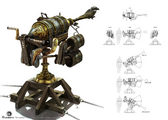 Concept art of the Greek fire cannon
 -
 Concept art of the Greek fire mechanism
 -
 Greek fire used during a Den Defense


.jpg)
Appearances
- Assassin's Creed: Brotherhood novel (first appearance)
- Assassin's Creed: Revelations
- Assassin's Creed: Origins
- Assassin's Creed: Forgotten Temple
References
- ↑
 Greek fire on Wikipedia
- ↑ 2.0 2.1 Assassin's Creed: Revelations
- ↑ Assassin's Creed: Revelations – Setting Sail
- ↑ Assassin's Creed: Forgotten Temple – Episode 48
- ↑ Assassin's Creed: Forgotten Temple – Episode 50
- ↑ Assassin's Creed: Forgotten Temple – Episode 53
- ↑ Assassin's Creed: Forgotten Temple – Episode 58
- ↑ Assassin's Creed: Brotherhood novel
- ↑ Assassin's Creed: Origins – Playing with Fire
| |||||||||||||||||||||||||||||||||||||