

Duat: Difference between revisions
imported>Lady Kyashira m Added concept art |
imported>Shirkahn mNo edit summary |
||
| Line 3: | Line 3: | ||
{{Spoilerhd}} | {{Spoilerhd}} | ||
{{Stub}} | {{Stub}} | ||
The '''Duat''', the ''Realm of the Dead'', was an aspect of the [[Egypt]]ian afterlife. It was in the Duat that the recently deceased had their | The '''Duat''', the ''Realm of the Dead'', was an aspect of the [[Egypt]]ian afterlife. It was in the Duat that the recently deceased had their heart weighed against a feather of [[wikipedia:Maat|Ma'at]] by [[Osiris]] or [[Anubis]] (depending on the historical period and region). Those whose hearts were deemed to be pure were allowed to pass on to the heavenly paradise of [[Aaru]] or to [[Aten (afterlife)|Aten]], depending on which religion the person followed; however, those whose hearts were deemed to be impure, [[wikipedia:Ammit|Ammit]], the "devourer of the dead", would consume the heart and the ones undergoing judgement would be denied from continuing their voyage into the afterlife. | ||
==History== | ==History== | ||
Around 38 BCE, the [[Mentor]] of the [[Hidden Ones]] in Egypt, [[Bayek]] of [[Siwa]], seemingly | Around 38 BCE, the [[Mentor]] of the [[Hidden Ones]] in Egypt, [[Bayek]] of [[Siwa]], seemingly traveled to the Duat in order to combat the disembodied spirit of [[Tutankhamun]], which had been returned to the world of the living thanks to the [[Curse of the Pharaohs]] that was plaguing the city of [[Thebes]]. | ||
==Gallery== | ==Gallery== | ||
Revision as of 19:37, 12 July 2018

|
He who increaseth knowledge, increaseth sorrow. This article contains spoilers, meaning it has information and facts concerning recent or upcoming releases from the Assassin's Creed series. If you do not want to know about these events, it is recommended to read on with caution, or not at all. |

The Duat, the Realm of the Dead, was an aspect of the Egyptian afterlife. It was in the Duat that the recently deceased had their heart weighed against a feather of Ma'at by Osiris or Anubis (depending on the historical period and region). Those whose hearts were deemed to be pure were allowed to pass on to the heavenly paradise of Aaru or to Aten, depending on which religion the person followed; however, those whose hearts were deemed to be impure, Ammit, the "devourer of the dead", would consume the heart and the ones undergoing judgement would be denied from continuing their voyage into the afterlife.
History
Around 38 BCE, the Mentor of the Hidden Ones in Egypt, Bayek of Siwa, seemingly traveled to the Duat in order to combat the disembodied spirit of Tutankhamun, which had been returned to the world of the living thanks to the Curse of the Pharaohs that was plaguing the city of Thebes.
Gallery
-
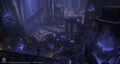 Concept art of the Duat

Trivia
- In Egyptian mythology Ra, the sun god battled the great serpent Apep every night within the Duat, in order to ensure the sun would rise again on the mortal realm the next morning.
Appearances
References