

Cyrenaica: Difference between revisions
imported>Lady Kyashira mNo edit summary |
imported>Blue-castle m fr |
||
| Line 57: | Line 57: | ||
{{Reflist}} | {{Reflist}} | ||
{{ACO}} | {{ACO}} | ||
[[fr:Cyrénaïque]] | |||
[[Category:Libya]] | [[Category:Libya]] | ||
[[Category:Former Greek colonies]] | [[Category:Former Greek colonies]] | ||
[[Category:Former kingdoms]] | [[Category:Former kingdoms]] | ||
[[Category:Valleys]] | [[Category:Valleys]] | ||
Revision as of 16:57, 19 July 2020

- "The mostly dense region of Libya around Cyrene and Apollonia, filled with Silphion plants and owned by Rome."
- ―Description about Cyrenaica.[src]
Cyrenaica (Greek: Kyrenaika) is the eastern coastal region of Libya. In antiquity, the region was a Greek colony founded by Battos I in the 7th century BCE, who established the city of Cyrene in the area.
By 49 BCE, control of the region was ceeded to the Roman Republic which, together with Krete, formed the province of Crete and Cyrenaica.
History
In 47 BCE, the Medjay Bayek of Siwa travelled to Cyrenaica in pursue of the Roman general Flavius Metellus, who had secured an Apple of Eden. Along the way, he met and helped the healer Praxilla, who directed him to Cyrene to seek out her friend Diocles.[1]
In the city, Diocles directed Bayek to the Roman Akropolis where Flavius was in, allowing Bayek to assassinate the Roman general and reclaim the Apple.[1]
Locations
Settlements
Military locations
Treasure locations
Papyrus locations
Gallery
-
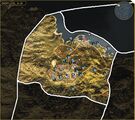 Map of Cyrenaica

Appearances
References