

Arib Al-Ma'muniyya: Difference between revisions
imported>Gener4l Cl4ank4 mNo edit summary |
imported>Gener4l Cl4ank4 |
||
| Line 14: | Line 14: | ||
==Biography == | ==Biography == | ||
{{Quote|I raised myself. I authored myself. I have written myself into history. You are banished from my pages, now be gone!|Arib standing up to her patron, 860s.|Assassin's Creed: Mirage|The Fox and the Hunter}} | {{Quote|I raised myself. I authored myself. I have written myself into history. You are banished from my pages, now be gone!|Arib standing up to her patron, 860s.|Assassin's Creed: Mirage|The Fox and the Hunter}} | ||
Arib's poetry was greatly appreciated by the [[Hidden Ones of Alamut|Alamut Hidden One]], who recommended her works to his fellow brotherhood members, including [[Abu Jafar Muhammad ibn Musa]]<ref name="Taking Flight">''Assassin's Creed: Mirage'' – [[Taking Flight]]</ref> and [[Basim Ibn Ishaq]].<ref name="Fire and Wisdom">''Assassin's Creed: Mirage'' – [[Fire and Wisdom]]</ref> It was also admired by several members of the [[Order of the Ancients]], who frequently quoted her literary works in their secret correspondence. This later led the Hidden Ones to suspect that Arib had ties to the Order.<ref name="Fiery Trail">''Assassin's Creed: Mirage'' – [[Follow the Fiery Trail]]</ref> | Arib's poetry was greatly appreciated by the [[Hidden Ones of Alamut|Alamut Hidden One]] [[Tabid Al-Nubi]], who recommended her works to his fellow brotherhood members, including [[Abu Jafar Muhammad ibn Musa]]<ref name="Taking Flight">''Assassin's Creed: Mirage'' – [[Taking Flight]]</ref> and [[Basim Ibn Ishaq]].<ref name="Fire and Wisdom">''Assassin's Creed: Mirage'' – [[Fire and Wisdom]]</ref> It was also admired by several members of the [[Order of the Ancients]], who frequently quoted her literary works in their secret correspondence. This later led the Hidden Ones to suspect that Arib had ties to the Order.<ref name="Fiery Trail">''Assassin's Creed: Mirage'' – [[Follow the Fiery Trail]]</ref> | ||
[[File:ACMir The Great Symposium 8.png|left|thumb|250px|Arib meeting Basim at the House of Wisdom]] | [[File:ACMir The Great Symposium 8.png|left|thumb|250px|Arib meeting Basim at the House of Wisdom]] | ||
Revision as of 20:39, 1 April 2024
ʿArīb al-Ma’mūnīya (Arabic: عريب المأمونية; c. 797 – c. 890), also known as Al-Tha'lab (English: The Fox),[1] was an Abbasid poetess, courtesan, singer, and composer who lived during the 9th century. Born into slavery, she rose to prominence and became one of the most famous artist in the Abbasid royal court,[2] living through the reigns of five Abbasid caliphs before earning her freedom.[3]
Arib had an intense rivalry with fellow qayna Shāriyah, whom she defeated in a song and poetry contest after revealing that her competitor had plagiarized verses from other popular women, a famous court event which the 10th century author Abu al-Faraj al-Isfahani later recorded in his work Kitab al-Aghani (Book of Songs).[4]
Biography
Arib's poetry was greatly appreciated by the Alamut Hidden One Tabid Al-Nubi, who recommended her works to his fellow brotherhood members, including Abu Jafar Muhammad ibn Musa[5] and Basim Ibn Ishaq.[6] It was also admired by several members of the Order of the Ancients, who frequently quoted her literary works in their secret correspondence. This later led the Hidden Ones to suspect that Arib had ties to the Order.[7]

In the 860s, Arib attended a symposium at the House of Wisdom, where she met and spoke to Basim, who was there on a mission to assassinate the scholar and Order member Fazil Fahim al-Kemsa. When Basim introduced himself as a lover of poetry, order and chaos, Arib claimed that she knew of only one poet with a love of chaos: Ali ibn Muhammad. She then excused herself as she went to admire the blooms in the House of Wisdom's gardens, hoping to find some inspiration for her poetry.[8]
Sometime following her meeting with Basim, Arib became a suspect in the Hidden One's investigation of the identity of "Al-Bahamut", the Ra's Al-Af'a of the Order.[9] Arriving at the poetess' residence in the Round City, Basim was denied entrance by Arib's patron, who believed Basim had been sent by the Order and refused to allow Arib to be "drawn" into any more of their schemes.[1]

After searching Arib's correspondence at the Postal Bureau, Basim came across a letter using cryptonyms similarly to those employed by the Order, and decided to give it to Arib in the hopes she would lead him to the letter's author. Attending one of the poetess' public recitals, Basim spoke to Arib about the letter before they were both confronted by her patron and several guards. When Arib stood up to the patron and ended her partnership with him, the man ordered his guards to capture her and to eliminate Basim.[1]
While Basim dealt with the guards, Arib left to meet with the letter's author, Sara, following a trail of rabbit paintings that led to her home. There, the two women discussed Arib's freedom, which had been heavily restricted by her patron, but now that she had cut all ties with him, she was free to pick her own enemies and friends. Arib then claimed that, although she would still have to obey certain people to avoid creating problems for herself, she would not be bound by anyone ever again. Basim secretly eavesdropped on the conversation and concluded that Arib had no ties to the Order.[1]
Gallery
-
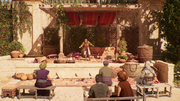 Arib performing at her recital
 -
 Arib talking to Basim about the letter
 -
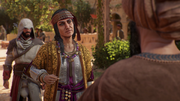 Arib standing up to her patron
 -
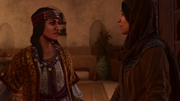 Arib talking to Sara


Appearances
- Assassin's Creed: Mirage (first appearance)
- Echoes of History (mentioned only)
References
- ↑ 1.0 1.1 1.2 1.3 Assassin's Creed: Mirage – The Fox and the Hunter
- ↑ Assassin's Creed: Mirage – Database: Arib Al-Ma'muniyya
- ↑ Assassin's Creed: Mirage – Database: Qiyan (Singing Girls)
- ↑ Assassin's Creed: Mirage – Database: Singing and Poetry
- ↑ Assassin's Creed: Mirage – Taking Flight
- ↑ Assassin's Creed: Mirage – Fire and Wisdom
- ↑ Assassin's Creed: Mirage – Follow the Fiery Trail
- ↑ Assassin's Creed: Mirage – The Great Symposium
- ↑ Assassin's Creed: Mirage – The Head of the Snake