Welcome to Assassin's Creed Wiki! Log in and join the community.


Siwa: Difference between revisions
Jump to navigation
Jump to search
imported>Lady Kyashira No edit summary |
imported>SkyGuy This is a fact. |
||
| Line 22: | Line 22: | ||
*''[[Assassin's Creed: Desert Oath]]'' {{1st}} | *''[[Assassin's Creed: Desert Oath]]'' {{1st}} | ||
*''[[Assassin's Creed: Origins]]'' | *''[[Assassin's Creed: Origins]]'' | ||
==Notes & Trivia== | |||
* Siwa's in-game name during Beyek's memories is anachronistic. During ancient Egypt, Siwa's name was '''Sekth-am'''. Early Arab geographers termed the place as '''Santariyyah''', and the modern name "Siwa" didn't appear until the 15th Century AD. | |||
==References== | ==References== | ||
Revision as of 20:33, 29 December 2017

- "Ah, Siwa. My home. A sacred oasis."
- ―Bayek describing Siwa.
Siwa is an oasis[1] and village in Egypt. In ancient times, it was renowned for its Oracle of Amun, which hailed Alexander the Great as Son of Zeus during his liberation of Egypt from Persian rule.[2]
Siwa also was the home of the Assassin Bayek during the reigns of the two last Pharaohs of Egypt, Ptolemy XIII and Cleopatra VII.
Far removed from the center of Egypt, Siwa was more insulated from the culture of the Greek Ptolemaic dynasty than other parts of the country. Consequently, its people continued to hold the Nubian military order of the Medjay in high esteem, heralding Bayek, the last Medjay, as a hero.[3]
Gallery
-
 Concept art of Siwa
 -
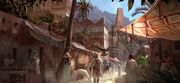 Concept art of Bayek at Siwa
 -
 Overview of Siwa


Appearances
- Assassin's Creed: Desert Oath (first appearance)
- Assassin's Creed: Origins
Notes & Trivia
- Siwa's in-game name during Beyek's memories is anachronistic. During ancient Egypt, Siwa's name was Sekth-am. Early Arab geographers termed the place as Santariyyah, and the modern name "Siwa" didn't appear until the 15th Century AD.
References