

Setna: Difference between revisions
imported>VilkaTheWolf |
imported>Lacrossedeamon I don't think its too speculative that Setna is Setna. He's wearing his pectoral. Take it to the talkpage if you disagree. |
||
| Line 1: | Line 1: | ||
{{Era|Individuals}} | {{Era|Individuals}} {{WP-REAL|Khaemweset}} | ||
{{Youmay|the son of Ramsses II|the [[Sétnae|member]] of the [[Children of Danu]], a druidic cult}} | {{Youmay|the son of Ramsses II|the [[Sétnae|member]] of the [[Children of Danu]], a druidic cult}} | ||
{{Character Infobox | {{Character Infobox | ||
| Line 7: | Line 7: | ||
|species = [[Human]] | |species = [[Human]] | ||
|affiliates = [[Ramesses II]]}} | |affiliates = [[Ramesses II]]}} | ||
'''Setna''' was a son of [[Ramesses II]] whose [[Ba]] roamed [[Heb Sed]] in an attempt to appease the spirit of his father. | '''Khaemweset''' (c. 1285 BCE - c. 1225 BCE), called '''Setna''', was a son of [[Ramesses II]] whose [[Ba]] roamed [[Heb Sed]] in an attempt to appease the spirit of his father. | ||
In 38 BCE, Setna's Ba was visited by the [[Hidden One]] [[Bayek]], who had entered Heb Sed in an attempt to lift the [[Curse of the Pharaohs]] that plagued [[Thebes]] in the living realm. | In 38 BCE, Setna's Ba was visited by the [[Hidden One]] [[Bayek]], who had entered Heb Sed in an attempt to lift the [[Curse of the Pharaohs]] that plagued [[Thebes]] in the living realm. | ||
| Line 14: | Line 14: | ||
As one of Ramesses the Great's many sons, even after death Setna found himself pressured to follow in his father's footsteps and become a warrior. When, in 38 BCE, his Ba was visited by Bayek of Siwa, Setna was preparing to confront a series of challenges laid out for him. Revealing to Bayek that, instead of a warrior, he sought to be a poet, Setna agreed to allow the Hidden One to complete the challenges on his behalf so that he might confront Ramesses with his post-death choices.<ref name="Follower or Leader">''[[Assassin's Creed: Origins]]'' – ''[[The Curse of the Pharaohs]]'' – [[Follower or Leader]]</ref> | As one of Ramesses the Great's many sons, even after death Setna found himself pressured to follow in his father's footsteps and become a warrior. When, in 38 BCE, his Ba was visited by Bayek of Siwa, Setna was preparing to confront a series of challenges laid out for him. Revealing to Bayek that, instead of a warrior, he sought to be a poet, Setna agreed to allow the Hidden One to complete the challenges on his behalf so that he might confront Ramesses with his post-death choices.<ref name="Follower or Leader">''[[Assassin's Creed: Origins]]'' – ''[[The Curse of the Pharaohs]]'' – [[Follower or Leader]]</ref> | ||
After the challenges were completed, Setna confronted his father and proclaimed his intention to become a poet - to this, Ramesses | After the challenges were completed, Setna confronted his father and proclaimed his intention to become a poet - to this, Ramesses acquiesced and granted his son's Ba leave of Heb Sed.<ref name="Follower or Leader" /> | ||
==Behind the scenes== | ==Behind the scenes== | ||
Setna is a | Setna is a historical figure introduced in the second ''[[Assassin's Creed: Origins]]'' expansion, ''[[The Curse of the Pharaohs]]''. | ||
Historically Khaemweset, later called Setna or Setne during the Hellenistic period, was the fourth and best known son of Ramesses II and is described as "the first Egyptologist" for his efforts in identifying and restoring historic buildings, tombs, and temples through the kingdom. As a child Setna received military training but later became the High Priest of Ptah in Memphis where he participated in {{wiki|Sed festival}}s. In the last few years of his life he was the Crown Prince but predeceased his father. | |||
==Gallery== | ==Gallery== | ||
Revision as of 10:19, 25 May 2024
| This article is about the son of Ramsses II. You may be looking for the member of the Children of Danu, a druidic cult. |
Khaemweset (c. 1285 BCE - c. 1225 BCE), called Setna, was a son of Ramesses II whose Ba roamed Heb Sed in an attempt to appease the spirit of his father.
In 38 BCE, Setna's Ba was visited by the Hidden One Bayek, who had entered Heb Sed in an attempt to lift the Curse of the Pharaohs that plagued Thebes in the living realm.
Post-mortem
As one of Ramesses the Great's many sons, even after death Setna found himself pressured to follow in his father's footsteps and become a warrior. When, in 38 BCE, his Ba was visited by Bayek of Siwa, Setna was preparing to confront a series of challenges laid out for him. Revealing to Bayek that, instead of a warrior, he sought to be a poet, Setna agreed to allow the Hidden One to complete the challenges on his behalf so that he might confront Ramesses with his post-death choices.[1]
After the challenges were completed, Setna confronted his father and proclaimed his intention to become a poet - to this, Ramesses acquiesced and granted his son's Ba leave of Heb Sed.[1]
Behind the scenes
Setna is a historical figure introduced in the second Assassin's Creed: Origins expansion, The Curse of the Pharaohs.
Historically Khaemweset, later called Setna or Setne during the Hellenistic period, was the fourth and best known son of Ramesses II and is described as "the first Egyptologist" for his efforts in identifying and restoring historic buildings, tombs, and temples through the kingdom. As a child Setna received military training but later became the High Priest of Ptah in Memphis where he participated in Sed festivals. In the last few years of his life he was the Crown Prince but predeceased his father.
Gallery
-
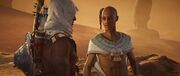 Setna speaking with Bayek.
 -
 Setna and Bayek at the Sanctum of Har-si-ese.
 -
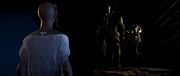 Setna confronting his father.


Appearances
References