

Ramesses II: Difference between revisions
imported>Jasca Ducato m Naming correction |
imported>GroverTedy123 No edit summary |
||
| Line 26: | Line 26: | ||
<gallery position="center" captionalign="center"> | <gallery position="center" captionalign="center"> | ||
ACO CotP Ramesses II Concept Art.jpg|Concept art of Ramesses II | ACO CotP Ramesses II Concept Art.jpg|Concept art of Ramesses II | ||
Rameses Throne.jpg|Model of Rameses' Throne | |||
Rameses Model.jpg|3D model's of Rameses the Great | |||
Bayek fighting Rameses.jpg|Concept art of [[Bayek]] fighting Rameses | |||
</gallery> | </gallery> | ||
Revision as of 18:53, 13 June 2018

|
He who increaseth knowledge, increaseth sorrow. This article contains spoilers, meaning it has information and facts concerning recent or upcoming releases from the Assassin's Creed series. If you do not want to know about these events, it is recommended to read on with caution, or not at all. |
Ramesses II (c. 1303 BCE – 1213 BCE), also known as Ramesses the Great, whose throne name was Ousirmaatre Setepenre, was a pharaoh of the Nineteenth Dynasty of Egypt, generally considered the greatest and one of the most famous of all pharaohs.[1]
Ramesses' rule was aided by the High Priests of Amun, who, several generations prior, were granted an Apple of Eden by Tutankhamun.
In 38 BCE Ramesses' spirit, alongside those of his predecessors, Akhenaten, Nefertiti, and Tutankhamun, were seemingly returned to the world of the living by the God's Wife of Amun, Isidora, who had possession of the Aten.[2]
In 2012, he was included in a mnemonic set in Abstergo Industries' Project Legacy.[3]
Gallery
-
 Concept art of Ramesses II
 -
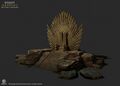 Model of Rameses' Throne
 -
 3D model's of Rameses the Great
 -
 Concept art of Bayek fighting Rameses


Trivia
- Ramesses II throne name, Ousirmaatre Setepenre translates as ""The justice of Ra is powerful – chosen of Ra." In the 1st century BCE, a light bow was named after the pharaoh's throne name.[1]
- Ramesses II is included in the "Obelisks" mnemonic set from the first chapter of the "Rome" pack as he was the original builder of four of the Obelisks in Rome, most notably the Flaminio Obelisk. It was moved from Heliopolis to the Circus Maximus in Rome on order of Emperor Augustus in 10 BCE. It was found and restored in 1587 by Pope Sixtus V, and re-erected in Piazza del Popolo.
Appearance
References