

Medunamun: Difference between revisions
imported>Sarasti the Serpent No edit summary |
imported>Sarasti the Serpent mNo edit summary |
||
| Line 9: | Line 9: | ||
| affiliates = [[Order of the Ancients]]}} | | affiliates = [[Order of the Ancients]]}} | ||
'''Medunamun '''(c. 103 BCE – 48 BCE), also known as '''The''' '''Ibis''', was an Egyptian member of the [[Order of the Ancients]] who was installed as the [[Oracle of Amun]] in [[Siwa]], [[Egypt]] by the [[Ptolemy XIII|Pharaoh Ptolemy XIII]] in 49 BCE. Since the purported impetus for his appointment was for Ptolemy to consolidate his hold over the remote, dissident town, Medunamun was derided as a false oracle by his enemies, including the [[Medjay]], [[Bayek]]. Medunamun's actual motives for seeking the mantle of Oracle were more clandestine however, as he cared neither for administration nor religious ritual; instead, Medunamun's true interest was in an [[Siwa Vault|Isu Vault]] that lay beneath the [[Temple of Amun]], and which he desperately sought to unlock. | '''Medunamun '''(c. 103 BCE – 48 BCE), also known as '''The''' '''Ibis''', was an Egyptian member of the [[Order of the Ancients]] who was installed as the [[Oracle of Amun]] in [[Siwa]], [[Egypt]] by the [[Ptolemy XIII|Pharaoh Ptolemy XIII]] in 49 BCE. Since the purported impetus for his appointment was for Ptolemy to consolidate his hold over the remote, dissident town, Medunamun was derided as a false oracle by his enemies, including the [[Medjay]], [[Bayek]]. Medunamun's actual motives for seeking the mantle of Oracle were more clandestine however, as he cared neither for administration nor religious ritual; instead, Medunamun's true interest was in an [[Siwa Vault|Isu Vault]] that lay beneath the [[Temple of Amun]], and which he desperately sought to unlock. | ||
Under Medunamun's injunctions, the villagers of Siwa were subjected to extortion, arbitrary detention, and were the victims of rampant atrocities committed by the town soldiers. Protests were met by violent reprisals, often against entire families, with whole neighborhoods being razed to the ground. For his part, Medunamun was loyal not to his pharaoh, but rather to his Order, and endeavoured only to unseal [[Siwa Vault|the vault]] beneath the Temple. The Ibis thus played a key role in the death of Bayek's son [[Khemu]] in 49 BCE during a botched interrogation of the Medjay. For his complicity in Khemu's demise and his abuses of power in Siwa, Medunamun was assassinated by Bayek in 48 BCE. | Under Medunamun's injunctions, the villagers of Siwa were subjected to extortion, arbitrary detention, and were the victims of rampant atrocities committed by the town soldiers. Protests were met by violent reprisals, often against entire families, with whole neighborhoods being razed to the ground. For his part, Medunamun was loyal not to his pharaoh, but rather to his Order, and endeavoured only to unseal [[Siwa Vault|the vault]] beneath the Temple. The Ibis thus played a key role in the death of Bayek's son [[Khemu]] in 49 BCE during a botched interrogation of the Medjay. For his complicity in Khemu's demise and his abuses of power in Siwa, Medunamun was assassinated by Bayek in 48 BCE. | ||
==Biography== | ==Biography== | ||
===Capturing the Medjay=== | ===Capturing the Medjay=== | ||
Revision as of 03:15, 7 January 2022
Medunamun (c. 103 BCE – 48 BCE), also known as The Ibis, was an Egyptian member of the Order of the Ancients who was installed as the Oracle of Amun in Siwa, Egypt by the Pharaoh Ptolemy XIII in 49 BCE. Since the purported impetus for his appointment was for Ptolemy to consolidate his hold over the remote, dissident town, Medunamun was derided as a false oracle by his enemies, including the Medjay, Bayek. Medunamun's actual motives for seeking the mantle of Oracle were more clandestine however, as he cared neither for administration nor religious ritual; instead, Medunamun's true interest was in an Isu Vault that lay beneath the Temple of Amun, and which he desperately sought to unlock.
Under Medunamun's injunctions, the villagers of Siwa were subjected to extortion, arbitrary detention, and were the victims of rampant atrocities committed by the town soldiers. Protests were met by violent reprisals, often against entire families, with whole neighborhoods being razed to the ground. For his part, Medunamun was loyal not to his pharaoh, but rather to his Order, and endeavoured only to unseal the vault beneath the Temple. The Ibis thus played a key role in the death of Bayek's son Khemu in 49 BCE during a botched interrogation of the Medjay. For his complicity in Khemu's demise and his abuses of power in Siwa, Medunamun was assassinated by Bayek in 48 BCE.
Biography
Capturing the Medjay

In 49 BCE, Medunamun, code-named "The Ibis", arrived in the remote Egyptian village of Siwa alongside fellow members of the Order of the Ancients Flavius Metellus, Lucius Septimius, Pothinus, and Rudjek, well aware that there was an Isu vault lying underneath the Temple of Amun. Dreaming of the power to inaugurate a New World Order under their rule, they hoped that with the Apple of Eden in their hands, they could unlock the gate to the vault and acquire the "power of the gods". Upon failing to open the gate or to persuade the priests to help them, they came to the conclusion that they must defer to the local Medjay, Bayek.[2]
In order to track down the Medjay, the Order had their soldiers catch the boy Chenzira, a friend of Bayek's son, Khemu. Convincing Chenzira and his mother Rebecca that they merely wished to speak with Bayek, the soldiers were led by Chenzira to Halma Point where they overwhelmed the Medjay and captured him. That night, they brought Bayek before an impatient Medunamun at the Temple of Amun. Medunamun in turn led the bound Bayek down to the Siwa Vault where five Order members held Khemu hostage. Medunamun himself showed Bayek the Apple, but the Medjay truly did not know the means by which the vault could be opened. In the midst of their interrogation, the group were alerted to the impending arrival of the Pharaoh, Ptolemy XIII.[2]
Medunamun and two others left to delay the Pharaoh, and when they returned, Bayek and Khemu still had not opened the vault. When Bayek broke free of his bindings and flew into a desperate rage at his captors, Flavius redirected Bayek's knife into Khemu's heart, killing him before knocking the anguished Medjay unconscious.[2]
False Oracle
After the incident, Medunamun and his allies presumed that Bayek was dead; in truth, the vengeful Medjay had left Siwa on a quest to hunt down every last one of them. In the meantime, through their influence over Ptolemy XIII, the Order was able to have Medunamun appointed as the new Oracle of Amun in Siwa. This played into both the interests of the Pharaoh and Medunamun himself: the former wanted to subjugate the deviant village while the latter, with the Temple of Amun as his new base, found himself in the best position to continue studying the vault and how it may be accessed.[3] He also forbid his priests from venturing into the depths of the Temple, calling it an offense for any but the gods to enter. [citation needed]

As Oracle of Amun, Medunamun was brutal in his exploitation of the villagers. Increased taxes, as mandated by Ptolemy, were a heavy burden on the poor farmers who, under the leadership of Teremun, rose in protest.[4] Villagers were routinely interrogated and subjected to arbitrary arrests, torture, and abuse. As a consequence for dissent, whole neighborhoods were burned down,[3] and in the words of the town's healer, Rabiah, scarcely a single local had not been beaten by soldiers at one point or another. Moreover, efforts were made to obstruct Rabiah's administration of healthcare, including a blockade of the town to prevent the arrival of medical supplies.[5]
While his soldiers abused their stations by oppressing the village denizens, Medunamun himself seemed to have little interest in daily administration and in fact rarely left the Temple of Amun at all, becoming increasingly consumed by an obsession with the Vault that lay beneath it. Medunamun's personal animus was predominantly let loose upon the temple priests, whom he savagely brutalized for information on the nature of the Isu Vault.
Death

With the return of Bayek to Siwa, the Ibis's tenure as Oracle of Amun came to end after only about a year. In 48 BCE, Medunamun was ambushed at the Temple of Amun by the Medjay, immediately suffering a mortal injury. Despite the approach of death, the Ibis still had the strength to clash blades with Bayek but eventually had his legs incapacitated. As he crawled towards a shaken Bayek, mocking him scornfully for his failure to save his son, he triggered the full magnitude of Bayek's rage. The Medjay beat him back with the Apple of Eden that was now in his hands, then proceeded to unleash a frenzied assault, pounding his face in with the relic until it was reduced to nothing but bloody, mashed tissue.[2]
Personality and characteristics
With a distinct, gravelly voice and a streak of sadism, Medunamun was, in both manner and disposition, a rather ghastly individual. The callous aspects of his persona came to the forefront in his final moments where, critically wounded and crippled, he continued to crawl menacingly at his killer, roaring and jeering in such a way so as to even distress his victorious foe.[2] His iron fist rule over Siwa was draconian yet simultaneously chaotic; terror was meted out liberally against the populace while the soldiers felt free to pillage and raze as they pleased.[3]
In spite of his aptitude for horror, Medunamun professed that his underlying motives were righteous. An archetypal Templar in mindset, his goal was to usher in a world under the dominion of the Order of the Ancients, the only individuals he believed could be trusted to be "strong and virtuous". Innocent casualties such as Khemu — in his eyes, merely one boy — were meager sacrifices for the world he dreamt of.[2]
In his strict adherence to ritual, Medunamun exhibited a religious zealotry so excessive that his devoutness could scarcely be doubted; yet far from being a fanatic, his faith was insincere. His piety was a mere mask, not only for his cruelty— a rather meagre one given his public reputation[3][4][5] — but also for deep-seated insecurities. Though highly intelligent, Medunamun was predisposed to cynicism, wracked by his failure to comprehend the essence of the world around him and the gods he lived beneath, especially in light of his role as an Oracle. His misgivings eventually gave way to a vile bitterness, which bore in him a yearning to shape reality into one conceived by way of his vision, and by extension, that of the Order of the Ancients.[1]
Legacy
After Medunamun's death, one of his followers, Menkhtu, took on his mantle as the "the Ibis", calling himself "The Ibis Reborn". Posing as the oracle, Menkhtu sought to continue his work and formed a sect from the remnants of the Order of the Ancients in Egypt. However in 46 BCE, he was eliminated by the Hidden Ones, an proto-Assassin organization founded by Bayek in 47 BCE.[6]
Behind the scenes
- Medunamun's name contains the name Amun, the god he supposedly served. Amun, whose name means "hidden one", personified the imperceptible elements of the universe; he later became the national god of Egypt, merging with Ra, under the New Kingdom.
- It is likely that Medunamun only acquired his name later in life, as mdw.n-jmn literally translates to "[he] who speaks to Amun". Given that he had only recently been installed as the Oracle of Amun at Siwa by the Pharaoh Ptolemy XIII, it is unlikely "Medunamun" was his birth name.
Gallery
-
 Sculpts of Medunamun
 -
 Renders of Medunamun
 -
 Promotional art of Medunamun
 -
 Medunamun's Order symbol
 -
 Medunamun unmasked
 -
 Medunamun facing Bayek
 -
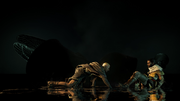 Medunamun taunting Bayek


Appearances
- Assassin's Creed: Origins (first appearance)
- Assassin's Creed: Rebellion – The Mask of the Ibis (mentioned only)
References
- ↑ 1.0 1.1 Assassin's Creed Origins: Official Game Guide
- ↑ 2.0 2.1 2.2 2.3 2.4 2.5 Assassin's Creed: Origins – The False Oracle
- ↑ 3.0 3.1 3.2 3.3 Assassin's Creed: Origins – The Oasis
- ↑ 4.0 4.1 Assassin's Creed: Origins – Family Reunion
- ↑ 5.0 5.1 Assassin's Creed: Origins – The Healer
- ↑ Assassin's Creed: Rebellion – The Mask of the Ibis
es:Medunamun fr:Medounamoun it:Medunamun pl:Medunamun pt-br:Medunamun ru:Медунамон zh:梅杜阿蒙