

Djinn: Difference between revisions
imported>CounterGalaxy-PSP No edit summary |
imported>Darman36 Isu lives do not apply to real-world mythos |
||
| Line 7: | Line 7: | ||
Stories of djinn's interactions with humans are replete throughout the {{wiki|Qur'an}} and works of folklore like ''[[One Thousand and One Nights]]''. Among these are accounts of djinn being captured and enslaved by humans.<ref name="el-Zein 2009" /> The [[Assassins|Assassin]] [[Altaïr Ibn-La'Ahad]] alluded to such tales in 1190 when he retorted to [[Ayman]], a man he was [[Interrogation|interrogating]], that he was not a "djinn for [him] to order around".<ref>''[[Assassin's Creed: Altaïr's Chronicles]]'' – [[The Hidden Party]]</ref> | Stories of djinn's interactions with humans are replete throughout the {{wiki|Qur'an}} and works of folklore like ''[[One Thousand and One Nights]]''. Among these are accounts of djinn being captured and enslaved by humans.<ref name="el-Zein 2009" /> The [[Assassins|Assassin]] [[Altaïr Ibn-La'Ahad]] alluded to such tales in 1190 when he retorted to [[Ayman]], a man he was [[Interrogation|interrogating]], that he was not a "djinn for [him] to order around".<ref>''[[Assassin's Creed: Altaïr's Chronicles]]'' – [[The Hidden Party]]</ref> | ||
Diseases and disorders of the mind have also been attributed to attacks by malicious djinn as though they were malevolent spirits taking possession of the body.<ref name="el-Zein 2009" /> In the 9th century, the twenty-six-year-old [[thief]] [[Basim Ibn Ishaq]] struggled with nightmarish visions of a djinn.<ref name="TheMasterThiefOfAnbar">''[[Assassin's Creed: Mirage]]'' – [[The Master Thief of Anbar]]</ref> | |||
==Gallery== | ==Gallery== | ||
Revision as of 23:29, 7 October 2023

|
He who increaseth knowledge, increaseth sorrow. This article contains spoilers, meaning it has information and facts concerning Assassin's Creed: Mirage. If you do not want to know about these events, it is recommended to read on with caution, or not at all. |

|
Where are the paintings? This article is in need of more images and/or better quality pictures from Assassin's Creed: Mirage in order to achieve a higher status. You can help the Assassin's Creed Wiki by uploading better images on this page. |

A jinn (جن), also romanized as djinn or anglicized as genie, is a class of sentient beings according to Arabian culture. In Islam, they are believed to be a third category of intelligent life alongside angels and humans, occupying the intermediate space between the spiritual and physical, for which reason they are invisible entities with the ability to shape-shift. Like humans, they have the free will to be either good or evil in contrast to angels, which are intrinsically perfect at the cost of free will. Unlike humans, who are thought to have been made of clay, djinn are said to have been created from "smokeless fire" and "scorching winds".[1]
Stories of djinn's interactions with humans are replete throughout the Qur'an and works of folklore like One Thousand and One Nights. Among these are accounts of djinn being captured and enslaved by humans.[1] The Assassin Altaïr Ibn-La'Ahad alluded to such tales in 1190 when he retorted to Ayman, a man he was interrogating, that he was not a "djinn for [him] to order around".[2]
Diseases and disorders of the mind have also been attributed to attacks by malicious djinn as though they were malevolent spirits taking possession of the body.[1] In the 9th century, the twenty-six-year-old thief Basim Ibn Ishaq struggled with nightmarish visions of a djinn.[3]
Gallery
-
 Concept art of a djinn in the Memory Corridor
 -
 Concept art of a djinn's face
 -
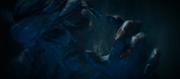 A djinn's face
 -
Basim face-to-face with a djinn


Appearances
- Assassin's Creed: Altaïr's Chronicles (first mentioned)
- Assassin's Creed: The Golden City (mentioned only)
- Assassin's Creed Roleplaying Game (indirect mention only)
- Assassin's Creed: Mirage (first appearance)
References
- ↑ 1.0 1.1 1.2 el-Zein, Amira (2009). Islam, Arabs, and Intelligent World of the Jinn. Syracuse, NY: Syracuse University Press.
- ↑ Assassin's Creed: Altaïr's Chronicles – The Hidden Party
- ↑ Assassin's Creed: Mirage – The Master Thief of Anbar