


Josiah Burgess: Difference between revisions
imported>Master Sima Yi Created page with "{{Era|AC4}} {{Spoilerhd}} {{Stub}} '''Josiah Burgess''' (1689 – 1719) was a pirate, and close friend and confidant of Benjamin Hornigold. He engaged in piracy..." |
No edit summary |
||
| (91 intermediate revisions by 40 users not shown) | |||
| Line 1: | Line 1: | ||
{{Era| | {{Era|Individuals|Templars}}{{WP-REAL}} | ||
{{ | {{Quote|And you're worse for it, Kenway! It were the Templars who took us in when all else went to shit! Not our king. Not our country. The Templars.|Burgess' last words, 1719.|Assassin's Creed IV: Black Flag|Trust Is Earned}} | ||
{{ | {{Character Infobox | ||
'''Josiah Burgess''' (1689 – 1719) was | | image = AC4 Josiah Burgess.png | ||
| birth = 1689<br>[[Kingdom of England]] | |||
| death = 19 June 1719 {{c|aged 30}}<br>[[Príncipe]], {{Wiki|Portuguese São Tomé and Príncipe|Overseas Province of São Tomé and Príncipe}}, [[Portuguese Empire]] | |||
| affiliates = *[[Republic of Pirates]] | |||
*[[Templars]] | |||
**[[West Indies Rite of the Templar Order|West Indies Rite]] | |||
| species = [[Human]] | |||
| database = [[Database: Josiah Burgess|Josiah Burgess]]<br>[[Database: Benjamin's Lackey 2|Benjamin's Lackey 2]]<br>[[Database: Josiah Burgess (Resynced)|Josiah Burgess (Resynced)]] | |||
}} | |||
'''Josiah Burgess''' (1689 – 1719) was an [[England|English]] [[Piracy|pirate]] based in [[Nassau]]. Like [[John Cockram]], he had a close relationship with [[Benjamin Hornigold]], one of the leaders of the small pirate republic. After accepting the [[George I of Great Britain|King]]'s pardon, he was recruited into the [[Templars|Templar Order]] as a [[Pirate Hunters|pirate hunter]], tracking down and eliminating his former allies. | |||
==Biography== | |||
{{Quote|We've sent two of our best men. Burgess and Cockram. Privateers with fast ships and firm hearts.|Woodes Rogers, on Burgess and Cockram, 1719.|Assassin's Creed IV: Black Flag|Imagine My Surprise}} | |||
Little is known of Burgess' life prior to his becoming a pirate. By 1718, he, along with Cockram and Hornigold, had become dissatisfied with the state of Nassau, feeling it had turned into an unbearable slum. As such, Burgess eagerly accepted the [[United Kingdom|British]] Crown's pardon, offered to him by [[Woodes Rogers]], and was then invited to join the Templars in their attempts to restore order in the region.<ref name="Parlay">''[[Assassin's Creed IV: Black Flag]]'' – [[We Demand a Parlay]]</ref> | |||
In 1719, he and Cockram were sent to [[Príncipe]], an island on the coast of west [[Africa]], to track down the [[Sages|Sage]] [[Bartholomew Roberts]]. Through their Templar connections, the pair secured an alliance with the [[Portugal|Portuguese]] based there. With the aid of the Portuguese, Burgess and Cockram found and ambushed the crew Roberts was part of, though Roberts himself slipped away.<ref name="Trust">''[[Assassin's Creed IV: Black Flag]]'' – [[Trust Is Earned]]</ref> | |||
== | As Burgess and Cockram prepared to leave to notify their Templar brethren, they were killed by [[Edward Kenway]], who had teamed up with Roberts in exchange for the location of the [[Observatory (Isu)|Observatory]]. In their final moments, Burgess and Cockram claimed the Templars had been like a family for them and called Edward out on his selfish motivations.<ref name="Trust" /> | ||
*''[[Assassin's Creed IV: Black Flag]]'' | |||
== Legacy == | |||
In 2013, during research for the [[Abstergo Entertainment]] feature film ''[[Devils of the Caribbean]]'', Burgess was deemed a "minor character" in Edward Kenway's story by Chief Creative Officer [[Melanie Lemay]]. To fix this, she suggested they make Burgess more interesting by giving him some strange secret and changing his date of death. Subsequently, the [[database]] entry for Burgess was changed to make his date of death as 1721, when historically he died in 1719.<ref name="Database">''[[Assassin's Creed IV: Black Flag]]'' – [[Database: Josiah Burgess]]</ref> | |||
The [[Initiates]] also included Burgess in their own database.<ref>''[[Assassin's Creed: Initiates]]'' – [[Database: Benjamin's Lackey 2]]</ref> | |||
In 2015, Burgess' last name was included on a list of known [[British Rite of the Templar Order|British Templars]] used by the Templar [[Isabelle Ardant]]. This list was later unveiled by the Assassins [[Rebecca Crane]] and [[Shaun Hastings]] when they infiltrated Ardant's office to plant a bug.<ref name="ACS">''[[Assassin's Creed: Syndicate]]'' – [[21st century conversations#Assassin's Creed: Syndicate|Modern day]]</ref> | |||
==Gallery== | |||
<gallery captionalign="center" position="center" widths="180"> | |||
Josiah Burgess - Concept Art.jpg|Concept art of Josiah Burgess | |||
AC4DB - Josiah Burgess.png|Database image of Burgess | |||
We Demand A Parlay 7.png|Burgess and the pirates of Nassau being told about the pardon | |||
Trust is Earned 6.png|Edward Kenway assassinating Cockram and Burgess | |||
Trust is Earned 7.png|Burgess and Cockram's final moments | |||
</gallery> | |||
==Behind the scenes== | |||
Josiah Burgess is a historical figure and character introduced in ''[[Assassin's Creed IV: Black Flag]]'', where he is voiced by [[Christopher Hatherall]]. Historically, he drowned off the coast of the [[The Bahamas|Bahamas]] in 1719 when his ship was lost at sea. | |||
In [[The Art of Assassin's Creed IV: Black Flag|development art]] for ''[[Assassin's Creed IV: Black Flag]]'', Burgess is shown with a red color scheme - similar to a [[British Army|Redcoat]] - like his friend Cockram, but has a blue and gold color scheme in the actual game. | |||
If engaged in combat he utilizes the move set of the Brute archetype. | |||
==Appearances== | |||
*''[[Assassin's Creed IV: Black Flag]]'' {{1st}} | |||
*''[[Assassin's Creed: Initiates]]'' {{Mdat}} | |||
*''[[Assassin's Creed: Syndicate]]'' {{Mo}} | |||
==References== | |||
{{Reflist}} | |||
{{ACIV}} | |||
{{DEFAULTSORT:Burgess, Josiah}} | {{DEFAULTSORT:Burgess, Josiah}} | ||
<!--[de:Josiah Burgress] | |||
[es:Josiah Burgess] | |||
[fr:Josiah Burgess] | |||
[it:Josiah Burgess] | |||
[pl:Josiah Burgess] | |||
[ru:Джосая Бёрджес] | |||
[zh:乔赛亚·伯吉斯]--> | |||
[[Category:1689 births]] | [[Category:1689 births]] | ||
[[Category:1719 deaths]] | [[Category:1719 deaths]] | ||
[[Category:Individuals]] | [[Category:Individuals]] | ||
[[Category:English people]] | |||
[[Category:Pirates]] | [[Category:Pirates]] | ||
[[Category:Privateers]] | |||
[[Category:Pirate captains]] | |||
[[Category:Pirate hunters]] | |||
[[Category:Flying Gang members]] | |||
[[Category:Templars]] | [[Category:Templars]] | ||
[[Category:Caribbean Templars]] | |||
Latest revision as of 07:32, 30 July 2026
Josiah Burgess (1689 – 1719) was an English pirate based in Nassau. Like John Cockram, he had a close relationship with Benjamin Hornigold, one of the leaders of the small pirate republic. After accepting the King's pardon, he was recruited into the Templar Order as a pirate hunter, tracking down and eliminating his former allies.
Biography[edit | edit source]
Little is known of Burgess' life prior to his becoming a pirate. By 1718, he, along with Cockram and Hornigold, had become dissatisfied with the state of Nassau, feeling it had turned into an unbearable slum. As such, Burgess eagerly accepted the British Crown's pardon, offered to him by Woodes Rogers, and was then invited to join the Templars in their attempts to restore order in the region.[1]
In 1719, he and Cockram were sent to Príncipe, an island on the coast of west Africa, to track down the Sage Bartholomew Roberts. Through their Templar connections, the pair secured an alliance with the Portuguese based there. With the aid of the Portuguese, Burgess and Cockram found and ambushed the crew Roberts was part of, though Roberts himself slipped away.[2]
As Burgess and Cockram prepared to leave to notify their Templar brethren, they were killed by Edward Kenway, who had teamed up with Roberts in exchange for the location of the Observatory. In their final moments, Burgess and Cockram claimed the Templars had been like a family for them and called Edward out on his selfish motivations.[2]
Legacy[edit | edit source]
In 2013, during research for the Abstergo Entertainment feature film Devils of the Caribbean, Burgess was deemed a "minor character" in Edward Kenway's story by Chief Creative Officer Melanie Lemay. To fix this, she suggested they make Burgess more interesting by giving him some strange secret and changing his date of death. Subsequently, the database entry for Burgess was changed to make his date of death as 1721, when historically he died in 1719.[3]
The Initiates also included Burgess in their own database.[4]
In 2015, Burgess' last name was included on a list of known British Templars used by the Templar Isabelle Ardant. This list was later unveiled by the Assassins Rebecca Crane and Shaun Hastings when they infiltrated Ardant's office to plant a bug.[5]
Gallery[edit | edit source]
-
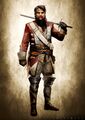 Concept art of Josiah Burgess
 -
 Database image of Burgess
 -
 Burgess and the pirates of Nassau being told about the pardon
 -
 Edward Kenway assassinating Cockram and Burgess
 -
 Burgess and Cockram's final moments


Behind the scenes[edit | edit source]
Josiah Burgess is a historical figure and character introduced in Assassin's Creed IV: Black Flag, where he is voiced by Christopher Hatherall. Historically, he drowned off the coast of the Bahamas in 1719 when his ship was lost at sea.
In development art for Assassin's Creed IV: Black Flag, Burgess is shown with a red color scheme - similar to a Redcoat - like his friend Cockram, but has a blue and gold color scheme in the actual game.
If engaged in combat he utilizes the move set of the Brute archetype.
Appearances[edit | edit source]
- Assassin's Creed IV: Black Flag (first appearance)
- Assassin's Creed: Initiates (mentioned in Database entry only)
- Assassin's Creed: Syndicate (mentioned only)
References[edit | edit source]