

Forbidden City: Difference between revisions
imported>Assassinist mNo edit summary |
m Text replacement - "{{wiki|" to "{{Wiki|" |
||
| (32 intermediate revisions by 16 users not shown) | |||
| Line 1: | Line 1: | ||
{{Era| | {{Era|Landmarks}}{{WP-REAL}} | ||
{{WP-REAL}} | {{Landmark Infobox | ||
|image = ACC China DB Forbidden City.png | |||
The '''Forbidden City''' | |description = Residence of the Imperial family of [[China]] | ||
|location = [[Beijing]], [[China]] | |||
|dateconstructed = 1406 – 1420 | |||
|functions = Imperial Palace | |||
|affiliation = [[Ming dynasty]]<br>[[Qing dynasty]] | |||
}} | |||
The '''Forbidden City''' is a former Imperial palace used during the [[Ming dynasty|Ming]] and [[Qing dynasty|Qing dynasties]], serving as the primary residence for the Emperor of [[China]] and his court. Located in [[Beijing]], it is now a {{Wiki|UNESCO}} site and a museum with an extensive collection of artwork and artifacts from the Ming and Qing periods. | |||
==Layout== | |||
The Forbidden City is a palace complex shaped as an immense rectangle with the main buildings positioned along a central axis. The rectangular perimeter is formed by a wall and its moat, and at each of the four corners is an enormous watchtower. It is partitioned between two zones: the outer court and an even more restrictive inner court.<ref name="Database">''[[Assassin's Creed Chronicles: China]]'' – [[Database: Forbidden City]]</ref> | |||
== | Its main gate is the {{Wiki|Meridian Gate}} situated at the southern end in front of {{Wiki|Tiananmen Square|Tian'anmen Square}}.<ref name="Database" /> From this gate, there is the first court and then another gate called the {{Wiki|Gate of Supreme Harmony}}, which leads to the most iconic area at the heart of the palace,<ref name="Database" /> the {{Wiki|Hall of Supreme Harmony}}.<ref name="Wikipedia">{{WP|Forbidden City}}</ref> Deeper into the palace is the Gate of Heavenly Purity, the primary entryway to the inner court, which can also be accessed by three other gates. With 980 buildings, legend has it that it contains 9,999 rooms. Symbolism played a role in this number and a substantial one in the naming, colours, decorations, architecture, and layout of the palace.<ref name="Database" /> | ||
==History== | |||
===Ming period=== | |||
The Forbidden City was built at the beginning of the 15th century to serve as the primary residence for the Ming dynasty's Imperial family and as the epicenter of government affairs. Heavily fortified, it was more than just a residence and was designed to offer them protection from those who would threaten their lives.<ref name="Database" /> Unknown to most of its residents, the Forbidden City was situated atop the ruins of an [[Beijing Temple|ancient]] [[Isu]] [[Temple (Isu)|site]].<ref name="Qixie">''[[Assassin's Creed: Blade of Shao Jun]]'' – [[Shao Jun and Qixie]]</ref> | |||
[[File:AC Blade of Shao Jun - Shao Jun and Zhang Qijie.png|thumb|250px|left|Shao Jun and Zhang Qijie sneaking through the palace]] | |||
Apart from the Emperor of China and his relatives, the Emperor's [[Concubine|concubines]] lived there as well, and they were strenuously guarded by the [[eunuch]]s to ensure that they could not bear offspring with other men.<ref name="Database" /> Some concubines who were children, like [[Shao Jun]] and [[Zhang Qijie]], were essentially raised in the Forbidden City, and most rarely ever left it.<ref name="Scroll 1">''[[Assassin's Creed Chronicles: China]]'' – [[Database: Scroll 1 (China)|Scroll 1]]</ref><ref name="Empress Zhang">''[[Assassin's Creed Chronicles: China]]'' – [[Database: Empress Zhang]]</ref> On one occasion in 1517, Shao Jun tried to help Qijie sneak out of the palace to see the outside world for the first time, but was unable to due to the latter's {{Wiki|Foot binding|foot bindings}} preventing her from climbing walls.<ref name="Qixie" /> | |||
During his reign, the [[Zhu Houzhao|Zhengde Emperor]] preferred a life of leisure outside the confines of the Forbidden City and spent little time in the Imperial capital<ref name="Zhengde">''[[Assassin's Creed Chronicles: China]]'' – [[Database: The Zhengde Emperor]]</ref> while his successor, the [[Zhu Houcong|Jiajing Emperor]], refused to live in it entirely so as to avoid his duties as ruler.<ref name="Jiajing">''[[Assassin's Creed Chronicles: China]]'' – [[Database: The Jiajing Emperor]]</ref> | |||
====Shadow war in the palace==== | |||
The Zhengde Emperor's negligence allowed the group of eunuchs known as the [[Eight Tigers]] to influence the government from behind-the-throne. As the leaders of the [[Shanghai Rite of the Templar Order|Chinese Rite]] of the [[Templars|Templar Order]], the Tigers were locked in a [[Assassin-Templar War|shadow conflict]] against the [[Chinese Brotherhood of Assassins|Chinese Assassins]] who were also based in the Forbidden City. Since the Zhengde Emperor had left behind no heirs, there was a brief interregnum as the government decided upon his successor.<ref name="Scroll 5">''[[Assassin's Creed Chronicles: China]]'' – [[Database: Scroll 5 (China)|Scroll 5]]</ref> Having recently identified the Assassin [[Mentor]] to be the official [[Wang Yangming]], the Tigers seized upon this moment of uncertainty to expunge the Assassins from the capital.<ref name="Scroll 6">''[[Assassin's Creed Chronicles: China]]'' – [[Database: Scroll 6 (China)|Scroll 6]]</ref> | |||
By chance, the concubine Shao Jun discovered this plot and alerted Yangming,<ref name="Scroll 6" /> who organized an attack first.<ref name="Scroll 7">''[[Assassin's Creed Chronicles: China]]'' – [[Database: Scroll 7 (China)|Scroll 7]]</ref> However, the Templars still prevailed and enacted their extensive and brutal purge, which saw countless Assassins, associates of the Brotherhood, and innocent sympathizers or dissidents executed via ''[[lingchi]]''. The surviving Assassins withdrew from the Forbidden City with their allies, including Shao Jun, who was subsequently recruited and trained as an Assassin.<ref name="Scroll 7" /> | |||
== | Several years later, the Templars exploited the [[Great Rites Controversy]] to hunt the remaining Assassins.<ref name="Scroll 9">''[[Assassin's Creed Chronicles: China]]'' – [[Database: Scroll 9 (China)|Scroll 9]]</ref><ref name="Scroll 10">''[[Assassin's Creed Chronicles: China]]'' – [[Database: Scroll 10 (China)|Scroll 10]]</ref> Before leaving Beijing, Shao Jun sneaked back into the Forbidden City to visit her childhood friend Zhang Qijie, hoping to help whisk her away to freedom. Because Qijie by then was rising in the concubinage hierarchy and saw an opportunity to even become Empress, she was unwilling to forsake her life in the palace, so Shao Jun could only bid her farewell.<ref name="Scroll 11">''[[Assassin's Creed Chronicles: China]]'' – [[Database: Scroll 11 (China)|Scroll 11]]</ref> | ||
[[File:An Old Friend China (6).jpg|thumb|250px|Shao Jun being led into a trap at the Imperial Palace]] | |||
In 1530, the Tigers [[Zhang Yong]] and [[Qiu Ju]] used Zhang Qijie, now Empress, to set a trap for Shao Jun in the Forbidden City. They had the Empress issue a secret message to Shao Jun alleging to have information on the whereabouts of Zhang Yong for her counter-hunt. The Assassin not only trusted her former best friend's word, but also returned out of fear that she would need to rescue concubines whose assistance to her could potentially have been discovered by the Templars.<ref name="An Old Friend">''[[Assassin's Creed Chronicles: China]]'' – [[An Old Friend]]</ref> | |||
Although Shao Jun fell right into the Templars' trap, she was able to defeat Qiu Ju by dropping several [[lantern]]s on him while Zhang Yong fled. This caused the chamber to catch fire,<ref name="Demon Fire">''[[Assassin's Creed Chronicles: China]]'' – [[Demon Fire]]</ref> though Shao Jun and Empress Zhang were both able to escape with their lives while Qiu Ju was crushed by a falling pillar. Once they were safe, Shao Jun tried to convince Qijie to leave the Forbidden City with her, but the Empress declined, as she believed her situation would improve once all of the Eight Tigers were eliminated and the Jiajing Emperor started listening to wiser council.<ref name="Arena">''[[Assassin's Creed: Blade of Shao Jun]]'' – [[To Each Her Own Arena]]</ref> | |||
===Post-Ming period=== | |||
The Forbidden City remained standing and in use throughout the Ming dynasty, and when the [[Qing dynasty|Qing]] conquered [[China]] and established their capital in Beijing, they appropriated it as their Imperial palace in turn. In the present-day, the palace has been designated as a UNESCO World Heritage Site and has been converted into a museum displaying artifacts collected from the Ming and Qing periods.<ref name="Database" /> | |||
==Behind the scenes== | |||
The Forbidden City features in the 2015 video game ''[[Assassin's Creed Chronicles: China]]'' as a playable level in a few memories. It later appeared in the game's 2019 manga adaptation, ''[[Assassin's Creed: Blade of Shao Jun]]'', although in this version, Shao Jun's fight against Qiu Ju takes place at the [[Inner Palace Flower Garden Villa]] rather than the Imperial Palace. | |||
The English name for the palace, the Forbidden City, is a {{Wiki|calque}} of its Chinese name Zǐjìnchéng (紫禁城, literally 'purple forbidden city'). | |||
==Gallery== | |||
<gallery captionalign="center" position="center" widths="180"> | |||
ACC China Environment Concept 2.jpg|Concept art | |||
An Old Friend China (2).jpg|The Forbidden City | |||
Demon Fire China Main.jpg|The Forbidden City | |||
Chronicles-China 3.jpg|Shao Jun dueling Qiu Ju inside the burning palace | |||
AC Blade of Shao Jun - Beijing.png|The Forbidden City in ''Blade of Shao Jun'' | |||
</gallery> | |||
==Appearances== | |||
*''[[Assassin's Creed Chronicles: China]]'' {{1st}} | |||
*''[[Assassin's Creed: Blade of Shao Jun]]'' | |||
*''[[Assassin's Creed: The Ming Storm]]'' {{Nc}} | |||
*''[[Assassin's Creed: Turbulence in the Ming Dynasty]]'' {{Nc}} | |||
== | ==References== | ||
{{Reflist}} | |||
{{ACC}} | |||
{{ACBoSJ}} | |||
{{ACMS}} | |||
[[Category:Palaces]] | [[Category:Palaces]] | ||
[[Category:Residences]] | |||
[[Category:Landmarks in Beijing]] | |||
[[Category:Landmarks in China]] | |||
<!--[fr:Cité interdite]--> | |||
Latest revision as of 22:48, 17 August 2026
The Forbidden City is a former Imperial palace used during the Ming and Qing dynasties, serving as the primary residence for the Emperor of China and his court. Located in Beijing, it is now a UNESCO site and a museum with an extensive collection of artwork and artifacts from the Ming and Qing periods.
Layout[edit | edit source]
The Forbidden City is a palace complex shaped as an immense rectangle with the main buildings positioned along a central axis. The rectangular perimeter is formed by a wall and its moat, and at each of the four corners is an enormous watchtower. It is partitioned between two zones: the outer court and an even more restrictive inner court.[1]
Its main gate is the Meridian Gate situated at the southern end in front of Tian'anmen Square.[1] From this gate, there is the first court and then another gate called the Gate of Supreme Harmony, which leads to the most iconic area at the heart of the palace,[1] the Hall of Supreme Harmony.[2] Deeper into the palace is the Gate of Heavenly Purity, the primary entryway to the inner court, which can also be accessed by three other gates. With 980 buildings, legend has it that it contains 9,999 rooms. Symbolism played a role in this number and a substantial one in the naming, colours, decorations, architecture, and layout of the palace.[1]
History[edit | edit source]
Ming period[edit | edit source]
The Forbidden City was built at the beginning of the 15th century to serve as the primary residence for the Ming dynasty's Imperial family and as the epicenter of government affairs. Heavily fortified, it was more than just a residence and was designed to offer them protection from those who would threaten their lives.[1] Unknown to most of its residents, the Forbidden City was situated atop the ruins of an ancient Isu site.[3]

Apart from the Emperor of China and his relatives, the Emperor's concubines lived there as well, and they were strenuously guarded by the eunuchs to ensure that they could not bear offspring with other men.[1] Some concubines who were children, like Shao Jun and Zhang Qijie, were essentially raised in the Forbidden City, and most rarely ever left it.[4][5] On one occasion in 1517, Shao Jun tried to help Qijie sneak out of the palace to see the outside world for the first time, but was unable to due to the latter's foot bindings preventing her from climbing walls.[3]
During his reign, the Zhengde Emperor preferred a life of leisure outside the confines of the Forbidden City and spent little time in the Imperial capital[6] while his successor, the Jiajing Emperor, refused to live in it entirely so as to avoid his duties as ruler.[7]
Shadow war in the palace[edit | edit source]
The Zhengde Emperor's negligence allowed the group of eunuchs known as the Eight Tigers to influence the government from behind-the-throne. As the leaders of the Chinese Rite of the Templar Order, the Tigers were locked in a shadow conflict against the Chinese Assassins who were also based in the Forbidden City. Since the Zhengde Emperor had left behind no heirs, there was a brief interregnum as the government decided upon his successor.[8] Having recently identified the Assassin Mentor to be the official Wang Yangming, the Tigers seized upon this moment of uncertainty to expunge the Assassins from the capital.[9]
By chance, the concubine Shao Jun discovered this plot and alerted Yangming,[9] who organized an attack first.[10] However, the Templars still prevailed and enacted their extensive and brutal purge, which saw countless Assassins, associates of the Brotherhood, and innocent sympathizers or dissidents executed via lingchi. The surviving Assassins withdrew from the Forbidden City with their allies, including Shao Jun, who was subsequently recruited and trained as an Assassin.[10]
Several years later, the Templars exploited the Great Rites Controversy to hunt the remaining Assassins.[11][12] Before leaving Beijing, Shao Jun sneaked back into the Forbidden City to visit her childhood friend Zhang Qijie, hoping to help whisk her away to freedom. Because Qijie by then was rising in the concubinage hierarchy and saw an opportunity to even become Empress, she was unwilling to forsake her life in the palace, so Shao Jun could only bid her farewell.[13]
.jpg)
In 1530, the Tigers Zhang Yong and Qiu Ju used Zhang Qijie, now Empress, to set a trap for Shao Jun in the Forbidden City. They had the Empress issue a secret message to Shao Jun alleging to have information on the whereabouts of Zhang Yong for her counter-hunt. The Assassin not only trusted her former best friend's word, but also returned out of fear that she would need to rescue concubines whose assistance to her could potentially have been discovered by the Templars.[14]
Although Shao Jun fell right into the Templars' trap, she was able to defeat Qiu Ju by dropping several lanterns on him while Zhang Yong fled. This caused the chamber to catch fire,[15] though Shao Jun and Empress Zhang were both able to escape with their lives while Qiu Ju was crushed by a falling pillar. Once they were safe, Shao Jun tried to convince Qijie to leave the Forbidden City with her, but the Empress declined, as she believed her situation would improve once all of the Eight Tigers were eliminated and the Jiajing Emperor started listening to wiser council.[16]
Post-Ming period[edit | edit source]
The Forbidden City remained standing and in use throughout the Ming dynasty, and when the Qing conquered China and established their capital in Beijing, they appropriated it as their Imperial palace in turn. In the present-day, the palace has been designated as a UNESCO World Heritage Site and has been converted into a museum displaying artifacts collected from the Ming and Qing periods.[1]
Behind the scenes[edit | edit source]
The Forbidden City features in the 2015 video game Assassin's Creed Chronicles: China as a playable level in a few memories. It later appeared in the game's 2019 manga adaptation, Assassin's Creed: Blade of Shao Jun, although in this version, Shao Jun's fight against Qiu Ju takes place at the Inner Palace Flower Garden Villa rather than the Imperial Palace.
The English name for the palace, the Forbidden City, is a calque of its Chinese name Zǐjìnchéng (紫禁城, literally 'purple forbidden city').
Gallery[edit | edit source]
-
 Concept art
 -
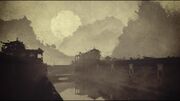 The Forbidden City
 -
 The Forbidden City
 -
 Shao Jun dueling Qiu Ju inside the burning palace
 -
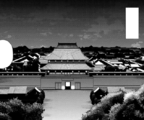 The Forbidden City in Blade of Shao Jun

.jpg)


Appearances[edit | edit source]
- Assassin's Creed Chronicles: China (first appearance)
- Assassin's Creed: Blade of Shao Jun
- Assassin's Creed: The Ming Storm (non-canon)
- Assassin's Creed: Turbulence in the Ming Dynasty (non-canon)
References[edit | edit source]
- ↑ 1.0 1.1 1.2 1.3 1.4 1.5 1.6 Assassin's Creed Chronicles: China – Database: Forbidden City
- ↑
 Forbidden City on Wikipedia
- ↑ 3.0 3.1 Assassin's Creed: Blade of Shao Jun – Shao Jun and Qixie
- ↑ Assassin's Creed Chronicles: China – Scroll 1
- ↑ Assassin's Creed Chronicles: China – Database: Empress Zhang
- ↑ Assassin's Creed Chronicles: China – Database: The Zhengde Emperor
- ↑ Assassin's Creed Chronicles: China – Database: The Jiajing Emperor
- ↑ Assassin's Creed Chronicles: China – Scroll 5
- ↑ 9.0 9.1 Assassin's Creed Chronicles: China – Scroll 6
- ↑ 10.0 10.1 Assassin's Creed Chronicles: China – Scroll 7
- ↑ Assassin's Creed Chronicles: China – Scroll 9
- ↑ Assassin's Creed Chronicles: China – Scroll 10
- ↑ Assassin's Creed Chronicles: China – Scroll 11
- ↑ Assassin's Creed Chronicles: China – An Old Friend
- ↑ Assassin's Creed Chronicles: China – Demon Fire
- ↑ Assassin's Creed: Blade of Shao Jun – To Each Her Own Arena
| |||||||||||||||||||||||||
| ||||||||||||||||||||||||||||