

Assassin bureau: Difference between revisions
imported>Lacrossedeamon split some of these up and ordered to be more time period/place; do the HQs in BOV count as bureaus? and we might need Cyf to look through this again as its getting blurry with guilds again |
imported>Darman36 |
||
| (6 intermediate revisions by 3 users not shown) | |||
| Line 26: | Line 26: | ||
====9th century==== | ====9th century==== | ||
[[File:ACMir Harbiyah Bureau 1.jpg|left|thumb|250px|The Hidden Ones bureau in Harbiyah, Baghdad]] | [[File:ACMir Harbiyah Bureau 1.jpg|left|thumb|250px|The Hidden Ones bureau in Harbiyah, Baghdad]] | ||
In the early 860s, the [[Hidden Ones of Alamut]] expanded their outreach from their [[Alamut|fortress]] into [[Baghdad]],<ref>''[[Assassin's Creed: Mirage]]'' – [[Baghdad Bound]]</ref> where they established a number of bureaus throughout the city to combat the Order of the Ancients' influence.<ref name="Branching Out">''[[Assassin's Creed: Mirage]]'' – [[Branching Out]]</ref> Initially maintaining only one bureau in the [[Harbiyah]] district, the Hidden Ones soon expanded to also have bureaus in the [[Abbasiyah]] and [[Karkh]] districts, as well as in Karkh's [[Sharqiyah]] sub-district.<ref name="Mirage">''[[Assassin's Creed: Mirage]]''</ref> | In the early 860s, the [[Hidden Ones of Alamut]] expanded their outreach from their [[Alamut|fortress]] into [[Baghdad]],<ref>''[[Assassin's Creed: Mirage]]'' – [[Baghdad Bound]]</ref> where they established a number of bureaus throughout the city to combat the Order of the Ancients' influence.<ref name="Branching Out">''[[Assassin's Creed: Mirage]]'' – [[Branching Out]]</ref> Initially maintaining only one bureau in the south of the [[Harbiyah]] district, the Hidden Ones soon expanded to also have bureaus in the [[Abbasiyah]] and [[Karkh]] districts, as well as in Karkh's [[Sharqiyah]] sub-district.<ref name="Mirage">''[[Assassin's Creed: Mirage]]''</ref> | ||
Each Baghdad bureau was led by a [[Rafiq]], who granted Hidden Ones permission to carry out assassinations by giving them a [[feather]] to dip in the target's blood, and featured a notice board where various [[Assassination contract|contracts]] were posted. The bureaus also included a workshop for one of the Banū Mūsā brothers—[[Abu Jafar Muhammad ibn Musa|Abu Jafar]], [[Ahmad ibn Musa|Ahmad]], and [[Al-Hasan ibn Musa|Al-Hasan]]—to work on their inventions and gadgets, which were given to the Hidden Ones to aid them during their missions.<ref name="Mirage" /> | Each Baghdad bureau was led by a [[Rafiq]], who granted Hidden Ones permission to carry out assassinations by giving them a [[feather]] to dip in the target's blood, and featured a notice board where various [[Assassination contract|contracts]] were posted. The bureaus also included a workshop for one of the Banū Mūsā brothers—[[Abu Jafar Muhammad ibn Musa|Abu Jafar]], [[Ahmad ibn Musa|Ahmad]], and [[Al-Hasan ibn Musa|Al-Hasan]]—to work on their inventions and gadgets, which were given to the Hidden Ones to aid them during their missions.<ref name="Mirage" /> | ||
| Line 35: | Line 35: | ||
In 873, Basim and [[Hytham]] established a [[Ravensthorpe bureau|bureau]] in the [[Norse people|Norse]] settlement of [[Ravensthorpe]] in England with the help of their ally, the [[shieldmaiden]] [[Eivor Varinsdottir]] of the [[Raven Clan]].<ref name="To Serve the Light">''[[Assassin's Creed: Valhalla]]'' – [[To Serve the Light...]]</ref> Because of Hytham's severe wounding in his attempt to assassinate [[Kjotve the Cruel]],<ref name="Cruel Destiny">''[[Assassin's Creed: Valhalla]]'' – [[A Cruel Destiny]]</ref> Basim assigned him to oversee and upkeep the bureau. Inside the office, Hytham kept numerous scrolls detailing missions and members of the Order of the Ancients. To combat the Order's reign in England, Hytham often received letters from a "[[Alfred the Great|Poor Fellow-Soldier]] of [[Jesus of Nazareth|Christ]]", who relayed information on key assassination targets in the cities of Lunden, Jorvik, and Wincestre.<ref name="Intel">''[[Assassin's Creed: Valhalla]]'' – [[More Intel]]</ref> | In 873, Basim and [[Hytham]] established a [[Ravensthorpe bureau|bureau]] in the [[Norse people|Norse]] settlement of [[Ravensthorpe]] in England with the help of their ally, the [[shieldmaiden]] [[Eivor Varinsdottir]] of the [[Raven Clan]].<ref name="To Serve the Light">''[[Assassin's Creed: Valhalla]]'' – [[To Serve the Light...]]</ref> Because of Hytham's severe wounding in his attempt to assassinate [[Kjotve the Cruel]],<ref name="Cruel Destiny">''[[Assassin's Creed: Valhalla]]'' – [[A Cruel Destiny]]</ref> Basim assigned him to oversee and upkeep the bureau. Inside the office, Hytham kept numerous scrolls detailing missions and members of the Order of the Ancients. To combat the Order's reign in England, Hytham often received letters from a "[[Alfred the Great|Poor Fellow-Soldier]] of [[Jesus of Nazareth|Christ]]", who relayed information on key assassination targets in the cities of Lunden, Jorvik, and Wincestre.<ref name="Intel">''[[Assassin's Creed: Valhalla]]'' – [[More Intel]]</ref> | ||
During the 870s, Eivor, at Hytham's request, explored the abandoned Hidden Ones bureaus in England and recovered pages of the Magas Codex, contracts for assassinations, and letters between the members of the bureaus.<ref name="A Brief History" /> After sailing to [[Francia]] in 885 to assist the second | Later, the Hidden Ones opened an additional bureau in Lunden. Disguised as a tavern called the [[Hawk's Nest]], it was run by the Hidden One [[Marcella]] of Rome.<ref name="ACV SotWH">''[[Assassin's Creed: Valhalla – Sword of the White Horse]]'' — Chapter 3</ref> Around the same time, [[Adelaïde]] was tasked with re-establishing the old [[Londinium bureau]], where she met and trained two potential Hidden One recruits: the [[Vikings|Viking]] [[Niels Gunnarsson]] and the young copyist monk [[Edward (monk)|Edward]].<ref name="ACV THC">''[[Assassin's Creed: Valhalla – The Hidden Codex]]''</ref> | ||
During the 870s, Eivor, at Hytham's request, explored the abandoned Hidden Ones bureaus in England and recovered pages of the Magas Codex, contracts for assassinations, and letters between the members of the bureaus.<ref name="A Brief History" /> After sailing to [[Francia]] in 885 to assist the second Viking [[Siege of Paris (885–886)|siege of Paris]], Eivor took time to visit all the ruined Gallic Hidden Ones bureaus and recovered the keys to the Paris office, where she found and claimed [[Charlemagne]]'s short [[sword]] [[Joyeuse]] from a [[treasure chest]] that had been secreted away. As she left the premises, she indirectly met the Frankish Hidden One [[Abbo Cernuus]] under the alias "AC" by way of a letter he left on the ground after she had entered the building.<ref name="Hidden" /> | |||
====Crusades==== | ====Crusades==== | ||
| Line 47: | Line 49: | ||
Some bureaus took the living area comforts a bit further, as the Acre bureau's walls were lined with books while the Damascus bureau contained a chess set and a board on which to play. When the city [[Soldier|guards]] were on alert, the bureau's roof was closed with a grated panel to prevent them from discovering the place and subsequently violating a tenet of [[the Creed]].<ref name="AC1" /> | Some bureaus took the living area comforts a bit further, as the Acre bureau's walls were lined with books while the Damascus bureau contained a chess set and a board on which to play. When the city [[Soldier|guards]] were on alert, the bureau's roof was closed with a grated panel to prevent them from discovering the place and subsequently violating a tenet of [[the Creed]].<ref name="AC1" /> | ||
[[File:AC1 Bureau Main Chamber.png|thumb| | [[File:AC1 Bureau Main Chamber.png|thumb|250px|The Bureau leader's chamber]] | ||
A bureau leader's chamber was adjacent to the main chamber. From behind a desk, each leader addressed those who would come to speak with them, while also studying and attending to the Assassin Order's operations in that respective city. Behind the desk were bookshelves and closets, where registries of missions were kept. The books and scrolls the leader had access to were also located in this area. Across the room, a raised walkway held weapons, books, and other items that could assist Assassins in their missions.<ref name="AC1" /> | A bureau leader's chamber was adjacent to the main chamber. From behind a desk, each leader addressed those who would come to speak with them, while also studying and attending to the Assassin Order's operations in that respective city. Behind the desk were bookshelves and closets, where registries of missions were kept. On top of the desk an {{Wiki|agarwood}} burner kept for fragrance. The books and scrolls the leader had access to were also located in this area. Across the room, a raised walkway held weapons, books, and other items that could assist Assassins in their missions.<ref name="AC1" /> | ||
===Renaissance=== | ===Renaissance=== | ||
| Line 75: | Line 77: | ||
===Russian Revolution=== | ===Russian Revolution=== | ||
[[File:ACC Russia - In Safe Hands (10).png|thumb|250px|Nikolai at the Moscow bureau]] | [[File:ACC Russia - In Safe Hands (10).png|thumb|250px|Nikolai at the Moscow bureau]] | ||
By 1918, the [[Russian Brotherhood of Assassins|Russian Brotherhood]] had a bureau in [[Moscow]]. That year, the Assassin [[Nikolai Orelov]] was sent to the bureau after his retrieval of a [[Precursor box]] and rescue of [[Anastasia Nikolaevna of Russia|Anastasia Nikolaevna]], in order to report back to the [[Russian Mentor|Mentor]]. While waiting in the bureau, Nikolai overheard a | By 1918, the [[Russian Brotherhood of Assassins|Russian Brotherhood]] had a bureau in [[Moscow]]. That year, the Assassin [[Nikolai Orelov]] was sent to the bureau after his retrieval of a [[Precursor box]] and rescue of [[Anastasia Nikolaevna of Russia|Anastasia Nikolaevna]], in order to report back to the [[Russian Mentor|Mentor]]. While waiting in the bureau, Nikolai overheard a discussion between two Assassins and learned about the Brotherhood's plans with Anastasia, prompting him to escape the building in order to rescue the girl from the experiments she was about to be subjected to.<ref name="Safe Hands">''[[Assassin's Creed Chronicles: Russia]]'' – [[In Safe Hands]]</ref> | ||
===Modern times=== | ===Modern times=== | ||
| Line 115: | Line 117: | ||
;Anglo-Saxon England | ;Anglo-Saxon England | ||
*[[Ravensthorpe bureau]]<ref name="To Serve the Light" /> | *[[Ravensthorpe bureau]]<ref name="To Serve the Light" /> | ||
*[[ | *[[Hawk's Nest]]<ref name="ACV SotWH" /> | ||
*[[Londinium bureau|Lunden bureau]]<ref name="ACV THC" /> | |||
;Crusader states | ;Crusader states | ||
*[[Damascus]] bureau<ref name="AC1" /> | *[[Damascus]] bureau<ref name="AC1" /> | ||
| Line 123: | Line 126: | ||
*[[Antioch]] bureau<ref name="The Silk Road" /> | *[[Antioch]] bureau<ref name="The Silk Road" /> | ||
;Renaissance Italy | ;Renaissance Italy | ||
*[[Venice headquarters]]<ref name="BOV" /> | |||
*[[Rome headquarters]]<ref name="BVR">''Assassin's Creed: Brotherhood of Venice'' – ''[[Roma (expansion pack)|Roma]]'' – [[All Roads Lead to Rome]]</ref> | |||
*Palmanova haven<ref name="Last Quest" /> | *Palmanova haven<ref name="Last Quest" /> | ||
*Pienza haven<ref name="Last Quest" /> | *Pienza haven<ref name="Last Quest" /> | ||
| Line 179: | Line 184: | ||
Majd Knowledge 1.png|Altaïr and [[Malik Al-Sayf]] at the Jerusalem bureau | Majd Knowledge 1.png|Altaïr and [[Malik Al-Sayf]] at the Jerusalem bureau | ||
A Governor No Longer 1.png|Edward, [[Anne Bonny]], and [[Antó]] at the Kingston bureau | A Governor No Longer 1.png|Edward, [[Anne Bonny]], and [[Antó]] at the Kingston bureau | ||
Oh Brother 4.png|Edward and [[Upton Travers]] at the Nassau bureau | |||
ACS Information Intercepted 3.png|The exterior of Henry Green's curiosity shop | |||
</gallery> | </gallery> | ||
| Line 194: | Line 201: | ||
**''[[The Hidden Ones (DLC)|The Hidden Ones]]'' | **''[[The Hidden Ones (DLC)|The Hidden Ones]]'' | ||
*''[[Assassin's Creed: Brotherhood of Venice]]'' | *''[[Assassin's Creed: Brotherhood of Venice]]'' | ||
**''[[Roma (expansion pack)|Roma]] | |||
*''[[Assassin's Creed: Valhalla]]'' | *''[[Assassin's Creed: Valhalla]]'' | ||
**''[[The Siege of Paris]]'' | **''[[The Siege of Paris]]'' | ||
*''[[Assassin's Creed: The Silk Road]]'' {{Mo}} | *''[[Assassin's Creed: The Silk Road]]'' {{Mo}} | ||
*''[[Assassin's Creed: Valhalla – Sword of the White Horse]]'' | |||
*''[[Assassin's Creed: The Last Quest of Leonardo da Vinci]]'' | *''[[Assassin's Creed: The Last Quest of Leonardo da Vinci]]'' | ||
*''[[Assassin's Creed: Valhalla – The Hidden Codex]]'' | |||
*''[[Assassin's Creed: Mirage]]'' | *''[[Assassin's Creed: Mirage]]'' | ||
Latest revision as of 15:53, 14 August 2025

An Assassin bureau, or Haven,[1] was a command center used by the Assassin Order, most often located within cities where they also served as safe houses. Their primary function was to act as bases of operation through which missions could be processed and overseen. Bureaus typically doubled as shops as well. More than mere fronts for the Assassins, these stores would trade in genuine merchandise such as silks,[2] carpets,[3] and pottery,[4] or offer services like tailoring,[5] generating income for the Brotherhood.
A tradition that dated back to at least the 1st century BCE, bureaus were an integral component of the Assassins' operational structure.[6] Throughout the ages, not all Assassin Guilds utilized the bureau as an administrative unit, at times relying on other organizational methods such as dens,[7] but the system remained in use into the 20th century.[5] It was indefinitely rendered obsolete after the Great Purge of 2000 which decimated the Assassins and forced them to rely almost exclusively on mobile cells.[5][6][8]
History[edit | edit source]
Ptolemaic Egypt[edit | edit source]

The first known bureau was founded in Memphis, Egypt,[9] sometime between 47 and 44 BCE, not long after the Medjay Bayek and his wife Aya co-founded the Hidden Ones.[10] By 43 BCE, Aya had established another bureau in Rome's Pantheon district.[9]
By 38 BCE, a third bureau was established in the Sinai by one of Bayek's first Hidden One recruits, Tahira.[11] The Sinai bureau had a secret exit that backed onto mountains.[12] Unfortunately, the bureau was destroyed by Roman soldiers in a fire attack,[13] and the Hidden Ones of Sinai fled to the mountains of the Arsinoe Nome,[14] where they set up a new bureau.[12]
At some point before 30 BCE, a bureau was established in Alexandria. This bureau would be immortalized as the location for the final synod of the Hidden Ones presided by Amunet as documented in The Magas Codex.[15]
Roman Empire[edit | edit source]

The Roman Hidden Ones that operated in the province of Britannia between the years 100 and 430 CE had six main bureaus. These were located in Ratae, Londinium, Venta Belgarum, Eboracum, Camulodunum, and the Temple of Ceres.[16] Another branch of Hidden Ones operated in Roman Gaul around the same time and had established four bureaus near the Seine, one in the cities of Champlieu, Diodurum, and Gisacum which were all centered around their main base in Lutetia itself.[17]
Shortly after the death of the Western Roman Emperor Honorius in 423 CE, magister Vitus wrote to the Hidden Ones stationed at Ratae, warning them that Britain would be imminently unstable due to the local tribes who harbored ill sentiments towards them having filled the power vacuum left by the departing Roman legions. Reasoning that it would be better to restart the branch later rather than suffer the loss of its members to unnecessary bloodshed, he ordered that the letter's recipient immediately evacuate and move their headquarters to the German city of Cologne and join forces with the local chapter.[18]
Within the year, word of the evacuation reached the Hidden Ones in Gaul who had experienced similar misunderstandings themselves with the local Gallic tribes. Seeing the situation was untenable, the magister known only as "C. C." wrote to the surrounding bureaus from Lutetia and ordered all Hidden Ones to hide the three keys necessary to unlock the Lutetia location, seal the rooms, and likewise abandon Gaul until such time had passed that they could safely return and resume their fight against tyrants and the Order of the Ancients for humanity's freedom. Before closing their letter, C. C. also informed the Hidden Ones that Vitus had extended an invitation from Cologne, adding that they too would join any who were willing to travel to Germania. While the majority of C. C.'s orders were carried out, a few Hidden Ones refused to abandon their posts and decided to stay in Gaul to continue their work on a more individual scale.[19]
Middle Ages[edit | edit source]
9th century[edit | edit source]

In the early 860s, the Hidden Ones of Alamut expanded their outreach from their fortress into Baghdad,[20] where they established a number of bureaus throughout the city to combat the Order of the Ancients' influence.[21] Initially maintaining only one bureau in the south of the Harbiyah district, the Hidden Ones soon expanded to also have bureaus in the Abbasiyah and Karkh districts, as well as in Karkh's Sharqiyah sub-district.[22]
Each Baghdad bureau was led by a Rafiq, who granted Hidden Ones permission to carry out assassinations by giving them a feather to dip in the target's blood, and featured a notice board where various contracts were posted. The bureaus also included a workshop for one of the Banū Mūsā brothers—Abu Jafar, Ahmad, and Al-Hasan—to work on their inventions and gadgets, which were given to the Hidden Ones to aid them during their missions.[22]
By 870, some earlier Hidden Ones bureaus still operated, like in Alexandria and Rome. In Constantinople, the bureau was led by the Alamut Hidden One Basim Ibn Ishaq, while the Frankish Hidden Ones established a new bureau in the Bon Berger, a tavern in Chinon. That year, a caravanserai bureau in Antioch was attacked by the Snake-Eaters, a group allied to the Ancients to control the Silk Road. Basim asked the help of the bureaus of Chinon, Alexandria, and Rome, but only the two firsts could send members. As they routed their enemies from the city, the Antioch bureau was rebuilt while the Frankish and Egyptian Hidden Ones eliminated the Snake-Eaters in Chang'an, where they established a bureau.[23]

In 873, Basim and Hytham established a bureau in the Norse settlement of Ravensthorpe in England with the help of their ally, the shieldmaiden Eivor Varinsdottir of the Raven Clan.[24] Because of Hytham's severe wounding in his attempt to assassinate Kjotve the Cruel,[25] Basim assigned him to oversee and upkeep the bureau. Inside the office, Hytham kept numerous scrolls detailing missions and members of the Order of the Ancients. To combat the Order's reign in England, Hytham often received letters from a "Poor Fellow-Soldier of Christ", who relayed information on key assassination targets in the cities of Lunden, Jorvik, and Wincestre.[26]
Later, the Hidden Ones opened an additional bureau in Lunden. Disguised as a tavern called the Hawk's Nest, it was run by the Hidden One Marcella of Rome.[27] Around the same time, Adelaïde was tasked with re-establishing the old Londinium bureau, where she met and trained two potential Hidden One recruits: the Viking Niels Gunnarsson and the young copyist monk Edward.[28]
During the 870s, Eivor, at Hytham's request, explored the abandoned Hidden Ones bureaus in England and recovered pages of the Magas Codex, contracts for assassinations, and letters between the members of the bureaus.[18] After sailing to Francia in 885 to assist the second Viking siege of Paris, Eivor took time to visit all the ruined Gallic Hidden Ones bureaus and recovered the keys to the Paris office, where she found and claimed Charlemagne's short sword Joyeuse from a treasure chest that had been secreted away. As she left the premises, she indirectly met the Frankish Hidden One Abbo Cernuus under the alias "AC" by way of a letter he left on the ground after she had entered the building.[19]
Crusades[edit | edit source]
Bureaus were widely used by the Levantine Brotherhood of Assassins, with some cities such as Acre, Damascus, Jerusalem,[29] and Tyre[30] having one per district. Bureaus acted as sanctuaries for members of the Assassin Order, where their users could physically and mentally prepare themselves for a mission, allowing them to restock on throwing knives, sleep, or to meditate. It also allowed Assassins a place to wait for the appropriate moment to strike or for the dust to settle after an assassination.[29]
Inside each bureau resided a leader, who held either the rank of Rafiq or higher. They would often give Assassins useful information on where to learn more about their targets. Once the strike had been planned and approved by the bureau leader, an Assassin was given a feather to soak in the blood of their target as proof of their success.[29]These bureaus all had a similar construction. The exterior of the building was typically quite discreet, resembling that of common construction, although they did not have any obvious windows or doors. The entrance was usually located on the roof.[29]

A main chamber served as the entrance hall to the bureau, and was a small living area comprised of two fountains, potted plants, and several pillows and carpets. This place was intended as a location for Assassins to rest before and after assassinations. The walls were decorated with hanging carpets and the Assassin insignia, while the ceiling was grated with an opening that acted as an entrance into the Bureau.[29]
Some bureaus took the living area comforts a bit further, as the Acre bureau's walls were lined with books while the Damascus bureau contained a chess set and a board on which to play. When the city guards were on alert, the bureau's roof was closed with a grated panel to prevent them from discovering the place and subsequently violating a tenet of the Creed.[29]

A bureau leader's chamber was adjacent to the main chamber. From behind a desk, each leader addressed those who would come to speak with them, while also studying and attending to the Assassin Order's operations in that respective city. Behind the desk were bookshelves and closets, where registries of missions were kept. On top of the desk an agarwood burner kept for fragrance. The books and scrolls the leader had access to were also located in this area. Across the room, a raised walkway held weapons, books, and other items that could assist Assassins in their missions.[29]
Renaissance[edit | edit source]
Before Hülegü Khan ordered the destruction of Masyaf[31] in retaliation for their part in assassinating his grandfather Genghis Khan,[32] the Levantine Assassins' Mentor Altaïr Ibn-La'Ahad sent brothers Maffeo and Niccolò Polo to establish new guilds and bureaus around the Mediterranean Sea such as Italy and Constantinople where Assassin presence had waned.[31]
In 1512, a team of Assassins established a new bureau in Venice after taking control of an old Templar stronghold.[33] In 1519, Ezio Auditore da Firenze led a group of Assassins to found new bureaus in Europe and beyond following clues left by Leonardo da Vinci.[1]
Golden Age of Piracy[edit | edit source]

During the early 18th century, the West Indies Brotherhood had bureaus spread throughout the major cities in the Caribbean, which varied in size and appearance. The bureaus in Havana and Kingston held at least one building and had a surrounding courtyard or walls; the Nassau bureau consisted of a small collection of buildings; and the Cayman Islands' "ghost" bureau had no defined buildings or areas to speak of.[34]
After killing the Assassin turncoat Duncan Walpole in 1715,[35] Edward Kenway recovered and subsequently sold a map detailing the four bureaus' locations to the local branch of Templars operating in the region,[36] unwittingly putting the Assassins stationed there in danger. Edward eventually traveled to the four bureaus and made amends for disclosing their locations;[37] in doing so, he assisted the bureau Masters in various ways, in return for a collection of keys that would grant him access to a set of Templar Armor.[38]
Seven Years' War[edit | edit source]

The Colonial Assassins during the mid-18th century primarily operated out of the Davenport Homestead, but they also maintained a number of bureaus throughout the British and French Colonies, namely in New York, Albany, Lac Eternel, Two Bends, and Halifax. Because the Colonial Brotherhood worked closely with the local criminal gangs, who supplied them with information and manpower, these bureaus doubled as gang headquarters.[39]
During the Seven Years' War, the Assassin-turned-Templar Shay Cormac cleared all of the Brotherhood's gang headquarters with the assistance of the British Army, to put a stop to the gangs' activities and cripple the Assassins' information network.[39]
Victorian era[edit | edit source]

In the mid-19th century, the British Brotherhood had a bureau in the Whitechapel district of London, which was headed by the only Assassin left in the city, Henry Green. Because of the Templars' strong presence in London at the time, the bureau was disguised as a curiosity shop to avoid detection by the Blighters, a gang allied with the Templars. From the bureau, Henry maintained contact with his allies in the city,[40] as well as the British Assassin Council, whom he petitioned for help against the Templar threat.[41]
Following the arrival of the twin Assassins Jacob and Evie Frye in London in 1868, they helped Henry eliminate the Templar presence in Whitechapel and claimed Rexford Kaylock's train hideout, which became the Assassins' new base of operations.[42]
Russian Revolution[edit | edit source]
.png)
By 1918, the Russian Brotherhood had a bureau in Moscow. That year, the Assassin Nikolai Orelov was sent to the bureau after his retrieval of a Precursor box and rescue of Anastasia Nikolaevna, in order to report back to the Mentor. While waiting in the bureau, Nikolai overheard a discussion between two Assassins and learned about the Brotherhood's plans with Anastasia, prompting him to escape the building in order to rescue the girl from the experiments she was about to be subjected to.[43]
Modern times[edit | edit source]
By the year 2000, an Assassin bureau disguised as a dry-cleaners was located in Philadelphia, United States, and used photographs of feathers, coupled with the codeword "Rafiq", as proof of identity. Thanks to information from the Assassin turncoat Daniel Cross, the Templars learned about the bureau's existence and security measures, and were able to breach it, massacring all the Assassins inside.[5] Countless other bureaus across the world were targeted by the Templars, forcing the Assassins to abandon their safehouses and abolish the system of bureaus altogether.[6]
List of known bureaus[edit | edit source]
- Egypt
- Imperial Rome
- Roman Gaul
- Roman Germania
- Sub-Roman Britain
- Camulodunum bureau[18]
- Eboracum bureau[18]
- Londinium bureau[18]
- Ratae bureau[18]
- Temple of Ceres bureau[18]
- Venta Belgarum bureau[18]
- Abbasid Caliphate
- Abbasiyah bureau (Baghdad)[22]
- Harbiyah bureau (Baghdad)[22]
- Karkh bureau (Baghdad)[22]
- Sharqiyah bureau (Baghdad)[22]
- Byzantine Empire
- Constantinople bureau[23]
- Carolingian Empire
- Tang Empire
- Anglo-Saxon England
- Crusader states
- Renaissance Italy
- Venice headquarters[33]
- Rome headquarters[44]
- Palmanova haven[1]
- Pienza haven[1]
- Ancien Régime France
- Venetian Heptanese
- Kythera Island haven[1]
- Ottoman Empire
- Umayyad Caliphate
- Timgad haven[1]
- Tudor England
- West Indies
- Colonial America
- Victorian England
- Whitechapel bureau (London)[40]
- Soviet Russia
Gallery[edit | edit source]
-
 Concept art of a Roman Hidden Ones bureau in Britan
 -
 The Memphis bureau in 1877
 -
 Aya and other Hidden Ones at the Rome bureau
 -
 The Hidden Ones Klymsa bureau
 -
 The main chamber of the Klysma bureau
 -
 The Hidden Ones Arsinoe bureau
 -
 The Hidden Ones bureau in Abbasiyah
 -
 The Hidden Ones bureau in Karkh
 -
 The Hidden Ones bureau in Sharqiyah
 -
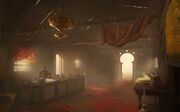 Concept art of the Ravensthorpe bureau
 -
 The abandoned Hidden Ones bureau in Eboracum, later York
 -
 The abandoned Hidden Ones bureau in Lunden
 -
 The abandoned Hidden Ones bureau at the Temple of Ceres
 -
 Concept art of the Damascus bureau
 -
 Altaïr and the Damascus bureau leader
 -
 Altaïr and Jabal at the Acre bureau
 -
 Altaïr and Malik Al-Sayf at the Jerusalem bureau
 -
 Edward, Anne Bonny, and Antó at the Kingston bureau
 -
 Edward and Upton Travers at the Nassau bureau
 -
 The exterior of Henry Green's curiosity shop


Appearances[edit | edit source]
- Assassin's Creed (first appearance)
- Assassin's Creed: Altaïr's Chronicles
- Assassin's Creed: The Secret Crusade
- Assassin's Creed IV: Black Flag
- Assassin's Creed: Identity (mentioned in Database entry only)
- Assassin's Creed: Rogue
- Assassin's Creed: Syndicate
- Assassin's Creed: Underworld
- Assassin's Creed Chronicles: Russia
- Assassin's Creed: Origins
- Assassin's Creed: Brotherhood of Venice
- Assassin's Creed: Valhalla
- Assassin's Creed: The Silk Road (mentioned only)
- Assassin's Creed: Valhalla – Sword of the White Horse
- Assassin's Creed: The Last Quest of Leonardo da Vinci
- Assassin's Creed: Valhalla – The Hidden Codex
- Assassin's Creed: Mirage
References[edit | edit source]
| ||||||||||||||||||||||||||||
| |||||||||||||||||||||||||