Ubisoft

|
Ezio, my friend! How may I be of service? This article is in desperate need of a revamp. Please improve it in any way necessary in order for it to achieve a higher standard of quality in accordance with our Manual of Style. |
| This article is about the real world company. You may be looking for its fictional counterpart. |
Ubisoft Entertainment SA, formerly Ubi Soft Entertainment SA, is a French computer and video game publisher and developer headquartered in the Parisian commune of Montreuil.[1] The company has facilities in over 20 countries,[2] with notable studios in Montreal and Quebec City, Canada.
Its main subsidiary Ubisoft Montreal was responsible for developing and publishing the Assassin's Creed series until 2014, from which point Ubisoft Quebec took over.[3] Other subsidiaries have also contributed to the franchise in smaller ways; Gameloft was founded in December 1999[4] and was responsible for developing mobile adaptations of Assassin's Creed games until the French investing firm Vivendi initiated an aggressive 9-month takeover in October 2015,[5][6] while Ubiworkshop was formed in late 2009 and primarily focused on short media like films[7] and comics before branching out into fan apparel and accessories around late 2014.[8]
History[edit | edit source]
The Guillemot family's five sons Claude, Michel, Yves, Gérard, and Christian originally founded "Ubi Soft" as a computer game publisher in 1986[1] in Britanny, France,[9] with the company name being a portmanteau of "ubiquitous software".[10] As CEO, Yves made deals with Electronic Arts, Sierra On-Line, Inc, and MicroProse to distribute their games in France. By 1990, Ubisoft began expanding to other markets, including the United States, the United Kingdom, and Germany. From there, Ubisoft became a publicly traded company in 1996 and continued to expand to offices around the globe, opening locations in Shanghai and Montreal.[1]
On 20 December 2004, Electronic Arts paid the Dutch investment firm Talpa Beheer BV between $85M–$100M to acquire their nearly 20% stake in Ubisoft,[11] an action that Yves referred to as "hostile".[12] In response, on 3 March 2005, Ubisoft acquired the private French adventure game publisher MC2-Microïds' studio in Montreal and subsumed the 50-member team into Ubisoft Montreal, intending to use MC2's titles like Still Life and Amerzone to stave off Electronic Arts' growing market share.[13]
On 11 November 2008, Ubisoft acquired the Swedish game developer Massive Entertainment after Vivendi deemed it surplus material following its own purchase of Activision Blizzard.[14]
On 14 October 2025, an internal memo to Ubisoft staff announced that Vice President Executive Producer Marc-Alexis Côté had left the company after a decade[15] just as Ubisoft and the Chinese conglomerate Tencent[16] were in the midst of launching[17] their jointly-owned subsidiary,[16] Vantage Studios.[17] Co-headed through nepotism by Ubisoft CEO Yves Guillemot's immediate family—his cousin[18] and Ubisoft Montreal co-founder Christophe Derennes,[19][20] and his son and Ubisoft's Owlient studio co-lead[21] Charles—Vantage would help develop Assassin's Creed, Far Cry, and Tom Clancy's Rainbow Six,[19] with Christophe handling production departments and Charles directing the three series' stories and features.[20] Although Derennes and Charles had offered Côté a leadership position in the new company before its debut,[22] he turned it down,[15] elaborating in a LinkedIn post written just a day after his departure that the advertised job "did not carry the same scope, mandate, or continuity" as his recent work. For this act of refusal, Ubisoft executives decided to replace his oversight of Assassin's Creed with "someone closer to its new organizational structure" and requested he step aside.[23]
Assassin's Creed developers[edit | edit source]
Annecy[edit | edit source]
Ubisoft Annecy developed the series' early multiplayer element,[24] and were among the 10 teams that developed Assassin's Creed: Unity.[25]
Blue Byte[edit | edit source]
Ubisoft acquired the German game studio Blue Byte on 7 March 2001,[26] and the studio has since developed Assassin's Creed: Identity, released in 2014 for iOS and in 2016 for Android.[27] In 2017, the studio was rebranded as Ubisoft Blue Byte.[28]
Bordeaux[edit | edit source]
Ubisoft Bordeaux contributed to Assassin's Creed: Valhalla's development,[29] and were the main team behind Valhalla's first downloadable expansion, Wrath of the Druids. They later led the development of Assassin's Creed: Mirage, released in 2023 and originally envisioned as another Valhalla expansion.[30] The studio also led the development of Assassin's Creed: Shadows' downloadable expansion Claws of Awaji and Mirage's downloadable expansion Valley of Memory, both released in 2025.[31]
Bucharest[edit | edit source]
Ubisoft Bucharest assisted in the development of the multiplayer modes of Assassin's Creed: Brotherhood, [citation needed] Assassin's Creed: Revelations,[24] Assassin's Creed IV: Black Flag, and Unity, [citation needed] and also contributed to the main campaigns of Assassin's Creed: Rogue,[32] Valhalla,[29] and Mirage. [citation needed]
Chengdu[edit | edit source]
Ubisoft Chengdu contributed to Unity,[25] Rogue,[32] and Valhalla.[29]
Da Nang[edit | edit source]
Ubisoft Da Nang was established in September 2019 in Da Nang, Vietnam. It was responsible for the development of the browser-based platformer Assassin's Creed: Freerunners. [citation needed]
Kyiv[edit | edit source]
Ubisoft Kyiv contributed to Black Flag, [citation needed] Unity,[25] and Valhalla.[29]
Milan[edit | edit source]
Ubisoft Milan contributed to Black Flag [citation needed] and Rogue,[32] and developed the HD version of Assassin's Creed III: Liberation, released in 2014. [citation needed]
Montpellier[edit | edit source]
Ubisoft Montpellier contributed to Black Flag, [citation needed] Unity,[25] and Valhalla,[29] and developed Unity's downloadable expansion Dead Kings and Assassin's Creed: Syndicate's downloadable expansion Jack the Ripper. [citation needed]
Montreal[edit | edit source]
Ubisoft Montreal, which opened on 25 April 1997, is Ubisoft's oldest studio.[33] It operated as the company's flagship studio and was the lead developer of the main Assassin's Creed titles since the saga's inception, until that position was assumed by Ubisoft Quebec in 2014.[3] Since then, the Montreal studio has contributed to the development of additional games in the series, and was the lead developer of Assassin's Creed: Origins, [citation needed] Valhalla,[29] and the upcoming Assassin's Creed: Codename Hexe.[34]
Paris[edit | edit source]
Ubisoft Paris developed the 2013 mobile game Assassin's Creed: Pirates. [citation needed]
Philippines[edit | edit source]
Ubisoft Philippines contributed to Origins and Assassin's Creed: Odyssey. They co-developed Assassin's Creed III Remastered and handled the Nintendo Switch port. [citation needed] Their contributions to Valhalla[29] included creating the region of Snotinghamscire, the naval and raid animations, and designing many of the axes and shields.[35] They also contributed to Mirage. [citation needed]
Quebec[edit | edit source]
Ubisoft Quebec, which opened on 2 June 2005,[36] has contributed to Brotherhood,[3] Revelations,[3] Assassin's Creed III,[24] Black Flag, [citation needed] Unity,[25] Rogue,[32] and Valhalla.[29] They also developed the Assassin's Creed III downloadable expansion The Tyranny of King Washington.[3] A 15-member team developed Black Flag for the Wii U and contributed to its downloadable expansion Freedom Cry.[37] Beginning in 2014, the Quebec studio replaced Ubisoft Montreal as the lead developer of the main Assassin's Creed titles,[3] and oversaw the production of Syndicate, Odyssey, and Shadows. [citation needed]
Shanghai[edit | edit source]
Ubisoft Shanghai contributed to Unity[25] and Valhalla.[29]
Singapore[edit | edit source]
Ubisoft Singapore contributed to Assassin's Creed II, Brotherhood, Revelations,[38] Assassin's Creed III,[24] Black Flag, [citation needed] Unity,[25] Rogue,[32] Syndicate, Origins, Odyssey, [citation needed] and Valhalla.[29] They were responsible for the platforming and naval missions throughout the series, and in 2026 led the development of Assassin's Creed: Black Flag Resynced.[39]
Sofia[edit | edit source]
Ubisoft Sofia was the lead developer of Assassin's Creed III: Liberation [citation needed] and Rogue,[32] and also contributed to Black Flag, Origins, Odyssey, [citation needed] and Valhalla.[29]
Toronto[edit | edit source]
Ubisoft Toronto, which opened on 6 July 2009, was initially led by CEO Yannis Mallat, who had moved from the Montreal studio.[40] That September, Mallat was replaced by Jade Raymond, who served as a Producer of the series' first entry, Assassin's Creed, and Executive Producer of Assassin's Creed II.[41] In 2014, the studio contributed to Unity.[25] With its founding press release stating that it intended to have 800 staff by 2019,[40] it came very close to matching that goal, having hired more than 700 people by May 2018.[42]
Ubisoft Massive[edit | edit source]
Ubisoft Massive contributed to Revelations.[24]
Ubisoft Film & Television[edit | edit source]
Ubisoft Film & Television, previously known as Ubisoft Motion Pictures, was founded on 2 May 2011.[43] It produced the Assassin's Creed film,[44] and is set to produce the upcoming Netflix series.[45]
Ubisoft Publishing[edit | edit source]
Ubisoft Publishing is the company that has published Assassin's Creed: Heresy and Assassin's Creed: The Essential Guide.[46]
Former studios[edit | edit source]
Halifax[edit | edit source]
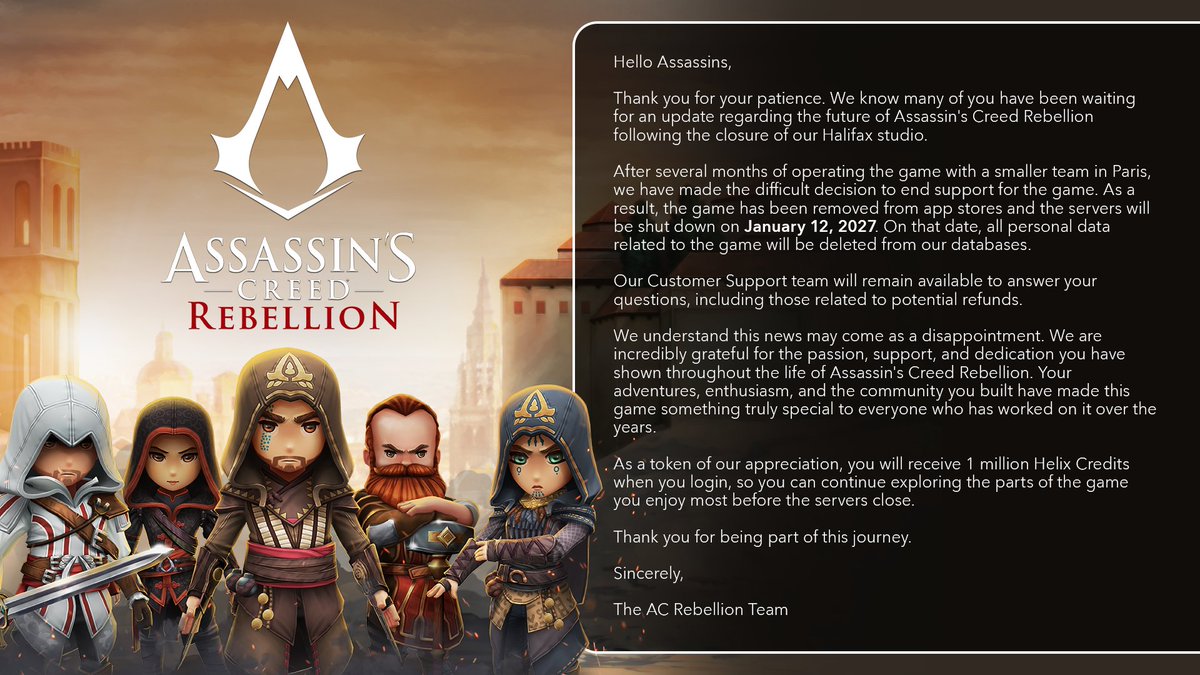
Officially established in 2015, Ubisoft Halifax focused on mobile games, releasing Assassin's Creed: Rebellion in 2018,[2] and working on Tom Clancy's Rainbow Six Mobile. On 20 June 2025, 60 members of its 70-strong staff filed to unionize under the media union Communications Workers of America's local Canadian chapter[47] Game and Workers Guild of Canada (CWA Canada Local 30111),[48], a process that was finalized by mid-December.[49] However, three weeks after the collective agreement, Ubisoft abruptly closed the studio and shuttered service for Rebellion, claiming that it was part of a previously agreed-upon, company-wide endeavor to "streamline operations, improve efficiency, and reduce costs", despite no past record of such plans ever having been announced.[50]
The shutdown initially left the fate of both mobile games unclear, especially since Rainbow Six Mobile was expected to release in February 2026 and already had esports teams lined up to compete on it.[51] In response to the shutdown's sudden and suspicious timing, CWA Canada vowed to fight Ubisoft in court and "pursue every legal recourse" to ensure that workers' rights were not infringed upon and challenging it "to show us that this had nothing to do with the employees joining a union",[52] eventually going on to win their case against Ubisoft by reaching an undisclosed settlement in mid-April.[48][53] While Rainbow Six Mobile launched on time and would have various online events for players,[54] support for Rebellion was transferred in March to a much smaller group in the Paris studio[55] that continued operations until they ultimately decided on 30 September to end Rebellion's support and shut down the servers on 12 January 2027.[56]
San Francisco[edit | edit source]
Established in 2009, the San Francisco studio did not work on any of Ubisoft's larger franchises but instead developed unique titles like the music video game Rocksmith, the role-playing game South Park: The Stick of Truth, and its sequel South Park: The Fractured but Whole.[57] It worked alongside the Osaka studio to develop the first-person shooter XDefiant, but following insufficient player enrollment or spending through microtransactions, Ubisoft closed the studio in February 2025.[58]
Osaka[edit | edit source]
The Osaka studio also worked on Shadows.[59] It worked alongside the San Francisco studio to develop the first-person shooter XDefiant, but following insufficient player enrollment or spending through microtransactions, Ubisoft closed the studio in February 2025.[58]