

Charles Vane

|
He who increaseth knowledge, increaseth sorrow. This article contains spoilers, meaning it has information and facts concerning recent or upcoming releases from the Assassin's Creed series. If you do not want to know about these events, it is recommended to read on with caution, or not at all. |

Charles Vane (c.1680 – 1721) was an English pirate captain who sailed the West Indies on his brigantine, the Ranger, making a name for himself by targeting English, Spanish and French industry ships from 1716 until 1719.
After arriving in Nassau in 1717, where he and Jack Rackham informed Edward Kenway of a large prize in a nearby fort, Vane became a leading member of Nassau's pirate community.
He was present when Woodes Rogers arrived in Nassau to offer its residents the King's pardon, absolving them of their crimes if they chose to give up piracy. In contrast to Benjamin Hornigold, Vane was not keen on taking the pardon, and worked with Kenway to orchestrate an escape from the barricaded Nassau.
When Edward Thatch announced his retirement, Vane tried to talk him out of it, but failed in his attempt.
After Thatch's death, Vane decided to help Edward find the Observatory. They tailed the Royal African Pearl, a slave ship belonging to the Royal African Company, hoping to find information on the Sage Bartholomew Roberts. However, the Ranger was demasted and left to drift.
Following the Royal African Pearls eventual capture, Jack Rackham and the Rangers surviving crew mutinied against Vane, commandeering the Jackdaw and leaving Edward and Vane marooned near Isla Providencia.
During their time on the island, Vane's behavior became increasingly erratic - he took to hiding in the jungle, only emerging to steal food Edward had gathered. Growing frustrated with Vane's actions, Edward pursued the man, and Vane fiercely retaliated with an arsenal of recovered weaponry. Due to Vane's increasingly deadly antics, Edward was forced to neutralize him. However, he avoided killing Vane, instead abandoning the man on the island while he made his own escape.
Vane was later found by British soldiers and taken to Port Royal, where he was imprisoned and eventually executed in 1721.
Gallery
-
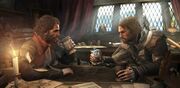 Edward Kenway showing a blood vial to Charles Vane
 -
 Concept art of Charles Vane


References