


Assassin bureau: Difference between revisions
imported>Ficboy |
imported>Soranin Revamped it a bit |
||
| Line 1: | Line 1: | ||
{{Era|Locations|Assassins|Good}} | {{Era|Locations|Hidden Ones|Assassins|Good}} | ||
{{Update|''[[Assassin's Creed: The Fall | {{Update|''[[Assassin's Creed: The Fall]]''}} | ||
{{Quote|Be sure to visit the city's Assassin Bureau when you arrive. I'll dispatch a bird to inform the Rafiq of your arrival. Speak with him, you'll find he has much to offer.|Al Mualim.|Assassin's Creed|Knowledge (Masun)}} | |||
{{Quote| | |||
[[File:AC1 Assassin bureau.png|thumb|250px|Altaïr in an Assassin bureau in Damascus]] | [[File:AC1 Assassin bureau.png|thumb|250px|Altaïr in an Assassin bureau in Damascus]] | ||
A '''bureau''', later called an '''Assassin bureau''', was a command center used by the [[Hidden Ones]] and by the [[Assassins|Assassin Order]], most often located within cities where they also served as safe houses. Their primary function was to act as bases of operation through which missions could be processed and overseen. | |||
A tradition that dated back to at least the 1st century BCE, bureaus were an integral component of the Assassins' operational structure | A tradition that dated back to at least the 1st century BCE, bureaus were an integral component of the Assassins' operational structure. Throughout the ages, not all [[Assassin Guild]]s utilized the bureau as an administrative unit, at times relying on other organizational methods such as [[Assassin Dens|Dens]], but the system remained in use into the 20th century. It was rendered obsolete only in the [[Great Purge]] of 2000 which decimated the Assassin population and forced them to rely almost exclusively on mobile [[Assassin cell|cells]]. | ||
== | ==History== | ||
===Ptolemaic Egypt=== | |||
[[File:ACO Hidden Ones Bureau.jpg|thumb|250px|left|The Hidden Ones bureau in Memphis]] | |||
The first Egyptian bureau was founded in [[Memphis]], [[Egypt]] sometime in 44 BCE after the creation of the [[Hidden Ones]] by [[Bayek]] and [[Amunet|Aya]]. <ref name="ACO">''[[Assassin's Creed: Origins]]''</ref> By 43 BCE, Aya had established a bureau in [[Pantheon]] district of [[Rome]].<ref name ="Birth of the Creed">''Assassin's Creed: Origins'' - [[Birth of the Creed]]</ref> | |||
Sometime between 44 BCE and 38 BCE, a bureau was established in [[Sinai]] by one of Bayek's first Hidden Ones, [[Tahira]]. The Sinai bureau had a secret exit that backed onto mountains. Unfortunately, the Sinai bureau was destroyed by fire and the Hidden Ones of Sinai fled to the mountains of the [[Arsinoe Nome]], where they made a new bureau.<ref name="THO">''Assassin's Creed: Origins'' – ''[[The Hidden Ones (DLC)|The Hidden Ones]]''</ref> | |||
At some point before 30 BCE, a bureau was established in [[Alexandria]]. This bureau would be immortalized as the location for the final {{Wiki|synod}} of the Hidden Ones presided by [[Amunet]] as documented in [[The Magas Codex]].<ref name="MagasCodex1">''[[Assassin's Creed: Valhalla]]'' – [[The Magas Codex]] I of VI</ref> | |||
[[ | |||
The | |||
The | ===Roman Empire=== | ||
The [[Roman Empire|Roman]] branch of the Hidden Ones that operated in the province of [[England|Britannia]] between the years 100 and 430 CE had six main bureaus operating in the Roman period. These were located in [[Leicestershire]], [[London]], [[Winchester]], [[York]], [[Essex]] and [[Gloucestershire]].<ref name="English Locales of Note">''Assassin's Creed: Valhalla'' – [[Layla Hassan's personal files#Files|Layla Hassan's personal files]]: English Locales of Note</ref> | |||
Shortly after the death of [[Roman Empire|Emperor]] [[Honorius]] in 423 CE, ''magister'' [[Vitus]] wrote to the Hidden Ones stationed at [[Leicester]], warning them that Britain would be imminently unstable due to the local tribes who harbored ill sentiments towards them, having filled the power vacuum left by the departing Roman legions. Reasoning that it would be better to restart the branch later than to suffer the loss of its members to unnecessary bloodshed, he ordered that the letter's recipient immediately evacuate and move their headquarters to the [[Germany|German]] city of [[Cologne]] and join forces with the [[German Brotherhood of Assassins|local chapter]].<ref name="ABriefHistory">''Assassin's Creed: Valhalla'' – [[A Brief History of the Hidden Ones]]</ref> | |||
Circa 873, [[Vikings|Viking]] [[shieldmaiden]] [[Eivor Varinsdottir]] of the [[Raven Clan]] entered these bureaus and recovered pages of the Magas Codex, contracts for assassinations, and letters between the members of the bureaus.<ref name="ABriefHistory"/> | |||
=== | ===Viking Age=== | ||
[[ | In 873, [[Basim Ibn Ishaq]] and [[Hytham]] established a [[Ravensthorpe bureau|bureau]] in the English village of [[Ravensthorpe]] with the help of Eivor.<ref name= "Serve the Light">''Assassin's Creed: Valhalla'' – [[To Serve the Light...]]</ref> Because of Hytham's severe wounding in his attempt to assassinate [[Kjotve the Cruel]],<ref>''Assassin's Creed: Valhalla'' – [[A Cruel Destiny]]</ref> Basim assigned him to oversee and upkeep the bureau. Inside the office, Hytham kept numerous scrolls detailing missions and members of the [[Order of the Ancients]]. To combat the Order's reign in England, Hytham often received letters from a "[[Alfred the Great|Poor Fellow-Soldier]] of [[Jesus of Nazareth|Christ]]", who relayed information on key targets in the cities of Lunden, Jorvik, and Wincestre.<ref>''Assassin's Creed: Valhalla'' – [[More Intel]]</ref> | ||
===Third Crusade=== | |||
Bureaus were widely used by the [[Levantine Brotherhood of Assassins]], with some cities in the [[Levant]] such as [[Acre]], [[Damascus]] and [[Jerusalem]] having one per district. Bureaus acted as sanctuaries for members of the Assassin Order, where their users could physically and mentally prepare themselves for a mission, allowing them to restock on weapons, sleep or meditate. It also allowed Assassins a place to wait for the appropriate moment to strike, or for the dust to settle after an assassination. Bureaus typically doubled as shops as well; more than mere fronts for the Assassins, these stores usually traded in genuine merchandise such as silks, carpets, and pottery, generating income for the Brotherhood. <ref name="AC">''[[Assassin's Creed]]''</ref> | |||
Inside each bureau resided a leader, who held either the rank of [[Rafiq]] or higher. They would often give Assassins useful information on where to learn more about [[assassination targets]]. Once the strike had been planned and approved by the bureau leader, an Assassin was given a [[Feathers|feather]] to soak in the blood of their target as proof of their success.<ref name="AC" /> | |||
[[File:AC1 Bureau Side Chamber.png|thumb|250px|left|A Third Crusade bureau's main chamber]] | |||
These bureaus all had a similar construction. The exterior of the building was typically quite discreet, resembling that of common construction, although they did not have any obvious windows or doors. The entrance was usually located on the roof, like the Memphis bureau of the Hidden Ones.<ref name="AC" /> | |||
A main chamber served as the entrance hall to the bureau, and was a small living area comprised of two fountains, potted plants and several pillows and carpets. This place was intended as a location for Assassins to rest before and after assassinations. The walls were decorated with hanging carpets and the [[Assassin insignia]], while the ceiling was grated with an opening that acted as an entrance into the Bureau. When the city guards were on alert, the opening was closed with a grated panel.<ref name="AC" /> | |||
[[File:AC1 Bureau Main Chamber.png|thumb|225px|The Bureau leader's chamber]] | |||
A bureau leader's chamber was adjacent to the main chamber. From behind a desk, each leader addressed those who would come to speak with them, while also studying and attending to the Assassin Order's operations in that respective city. Behind the desk were bookshelves and closets, where registries of missions were kept. The books and scrolls the leader had access to were also located in this area. Across the room, a raised walkway held weapons, books, and other items that could assist Assassins in their missions.<ref name="AC" /> | |||
=== | ===Golden Age of Piracy=== | ||
[[File:AC4 Assassin Bureau.png|thumb|left|250px|The Assassin bureau in Havana]] | |||
During the early 18th century, the bureaus spread throughout the major cities in the [[Caribbean|West Indies]] varied in size and description; the bureaus in Havana and Kingston held at least one building and had a surrounding courtyard or walls, the Nassau bureau consisted of a small collection of buildings, and the Cayman 'ghost' bureau had no defined buildings or areas to speak of.<ref name="AC4">''[[Assassin's Creed IV: Black Flag]]''</ref> | |||
After killing the traitorous [[Duncan Walpole]] in 1715, [[Edward Kenway]] recovered and subsequently sold a map detailing the four bureaus' locations to the [[Templars]] operating in the region, unwittingly putting the Assassins stationed there in danger. Edward eventually traveled to the four bureaus and made amends for disclosing their locations; in doing so, he assisted the bureau [[Master Assassin|Masters]] in various ways, in return for a collection of keys that would grant him access to a set of [[Assassin's Creed IV: Black Flag outfits#Templar armor|Templar Armor]].<ref>''Assassin's Creed IV: Black Flag'' – [[This Old Cove]]</ref> | |||
== | ==List of known bureaus== | ||
;Ptolemaic Egypt / Roman Republic | |||
*Alexandria bureau<ref name="MagasCodex1"/> | |||
*[[Hidden Ones Arsinoe bureau|Arsinoe bureau]]<ref name="THO"/> | |||
*[[Hidden Ones Klysma bureau|Klysma bureau]]<ref name="THO"/> | |||
*[[Memphis bureau]]<ref name="ACO"/> | |||
*Rome bureau<ref name ="Birth of the Creed"/> | |||
=== | ;Roman Empire | ||
[[ | *[[Camulodunum bureau]]<ref name="ABriefHistory"/> | ||
*[[Cologne bureau]]<ref name="ABriefHistory"/> | |||
*[[Eboracum bureau]]<ref name="ABriefHistory"/> | |||
*[[Londinium bureau]]<ref name="ABriefHistory"/> | |||
*[[Ratae bureau]]<ref name="ABriefHistory"/> | |||
*[[Temple of Ceres bureau]]<ref name="ABriefHistory"/> | |||
*[[Venta Belgarum bureau]]<ref name="ABriefHistory"/> | |||
;Viking Age | |||
*[[Ravensthorpe bureau]]<ref name= "Serve the Light"/> | |||
;Third Crusade | |||
*Acre bureau<ref name="AC"/> | |||
* | *Damascus bureau<ref name="AC"/> | ||
* | *Jerusalem bureau<ref name="AC"/> | ||
*Jerusalem bureau | |||
*Tyre bureau<ref>''[[Assassin's Creed: Altaïr's Chronicles]]''</ref> | *Tyre bureau<ref>''[[Assassin's Creed: Altaïr's Chronicles]]''</ref> | ||
*Cayman bureau | ;Golden Age of Piracy | ||
*Havana bureau | *Cayman bureau<ref name="AC4" /> | ||
*Kingston bureau | *Havana bureau<ref name="AC4" /> | ||
*Nassau bureau | *Kingston bureau<ref name="AC4" /> | ||
*Nassau bureau<ref name="AC4" /> | |||
==Trivia== | ==Trivia== | ||
| Line 89: | Line 85: | ||
==Gallery== | ==Gallery== | ||
<gallery position="center" widths="180" captionalign="center"> | <gallery position="center" widths="180" captionalign="center"> | ||
ACO Hidden Ones Bureau in 1877.png|The Memphis bureau in 1877 | |||
FallofanEmpireRiseofAnother22.jpg|Aya and other Hidden Ones at the Rome bureau | |||
ACO - Hidden Ones Klysma bureau 1.png|The Klysma bureau | |||
ACO - Hidden Ones Klysma bureau 2.png|The main room of the Klysma bureau with the rooftop entrance. | |||
ACO - Hidden Ones Klysma bureau 3.png|The planning room of the Klysma bureau | |||
ACO - Hidden Ones Klysma bureau 4.png|The communications room of the Klysma bureau | |||
ACO Hidden Ones bureau in Arsinoe 1.jpg|Hidden Ones Arsinoe bureau | |||
ACO Hidden Ones bureau in Arsinoe 2.jpg|Interior of the Arsinoe bureau | |||
ACO THO Hidden Ones Gathering.png|The Hidden Ones in the Arsinoe bureau | |||
ACV - Ravensthorpe Hidden Ones bureau.jpg |Concept art of the bureau in Ravensthorpe | |||
AC bureau concept.png|Concept art of the bureau in Damascus | AC bureau concept.png|Concept art of the bureau in Damascus | ||
Garnier Knowledge 1.png|Altaïr and Jamal at the Acre bureau | |||
Majd Knowledge 1.png|Altaïr and Malik at the Jerusalem bureau | |||
Abu'l Knowledge 1.png|Altaïr and the [[Damascus bureau leader|bureau leader]] at the Damascus bureau | |||
William Knowledge 2.png|Altaïr and Jamal at the Acre bureau | |||
Majd Knowledge 2.png |Altaïr and Malik at the Jerusalem bureau | |||
Abu'l Knowledge 2.png|Altaïr and bureau leader at the Damascus bureau | |||
</gallery> | </gallery> | ||
| Line 102: | Line 114: | ||
{{Reflist}} | {{Reflist}} | ||
{{AC}} | {{AC}} | ||
{{Assassins nav}} | |||
[[nl:Assassijnenbureau]] | [[nl:Assassijnenbureau]] | ||
[[ru:Бюро Ассассинов]] | [[ru:Бюро Ассассинов]] | ||
Revision as of 04:57, 13 April 2021

|
Patience, brothers. Soon we will reveal the secrets of Assassin's Creed: The Fall. This article has been identified as being out of date. Please update the article to reflect recent releases and then remove this template once done. |

A bureau, later called an Assassin bureau, was a command center used by the Hidden Ones and by the Assassin Order, most often located within cities where they also served as safe houses. Their primary function was to act as bases of operation through which missions could be processed and overseen.
A tradition that dated back to at least the 1st century BCE, bureaus were an integral component of the Assassins' operational structure. Throughout the ages, not all Assassin Guilds utilized the bureau as an administrative unit, at times relying on other organizational methods such as Dens, but the system remained in use into the 20th century. It was rendered obsolete only in the Great Purge of 2000 which decimated the Assassin population and forced them to rely almost exclusively on mobile cells.
History
Ptolemaic Egypt

The first Egyptian bureau was founded in Memphis, Egypt sometime in 44 BCE after the creation of the Hidden Ones by Bayek and Aya. [1] By 43 BCE, Aya had established a bureau in Pantheon district of Rome.[2]
Sometime between 44 BCE and 38 BCE, a bureau was established in Sinai by one of Bayek's first Hidden Ones, Tahira. The Sinai bureau had a secret exit that backed onto mountains. Unfortunately, the Sinai bureau was destroyed by fire and the Hidden Ones of Sinai fled to the mountains of the Arsinoe Nome, where they made a new bureau.[3]
At some point before 30 BCE, a bureau was established in Alexandria. This bureau would be immortalized as the location for the final synod of the Hidden Ones presided by Amunet as documented in The Magas Codex.[4]
Roman Empire
The Roman branch of the Hidden Ones that operated in the province of Britannia between the years 100 and 430 CE had six main bureaus operating in the Roman period. These were located in Leicestershire, London, Winchester, York, Essex and Gloucestershire.[5]
Shortly after the death of Emperor Honorius in 423 CE, magister Vitus wrote to the Hidden Ones stationed at Leicester, warning them that Britain would be imminently unstable due to the local tribes who harbored ill sentiments towards them, having filled the power vacuum left by the departing Roman legions. Reasoning that it would be better to restart the branch later than to suffer the loss of its members to unnecessary bloodshed, he ordered that the letter's recipient immediately evacuate and move their headquarters to the German city of Cologne and join forces with the local chapter.[6]
Circa 873, Viking shieldmaiden Eivor Varinsdottir of the Raven Clan entered these bureaus and recovered pages of the Magas Codex, contracts for assassinations, and letters between the members of the bureaus.[6]
Viking Age
In 873, Basim Ibn Ishaq and Hytham established a bureau in the English village of Ravensthorpe with the help of Eivor.[7] Because of Hytham's severe wounding in his attempt to assassinate Kjotve the Cruel,[8] Basim assigned him to oversee and upkeep the bureau. Inside the office, Hytham kept numerous scrolls detailing missions and members of the Order of the Ancients. To combat the Order's reign in England, Hytham often received letters from a "Poor Fellow-Soldier of Christ", who relayed information on key targets in the cities of Lunden, Jorvik, and Wincestre.[9]
Third Crusade
Bureaus were widely used by the Levantine Brotherhood of Assassins, with some cities in the Levant such as Acre, Damascus and Jerusalem having one per district. Bureaus acted as sanctuaries for members of the Assassin Order, where their users could physically and mentally prepare themselves for a mission, allowing them to restock on weapons, sleep or meditate. It also allowed Assassins a place to wait for the appropriate moment to strike, or for the dust to settle after an assassination. Bureaus typically doubled as shops as well; more than mere fronts for the Assassins, these stores usually traded in genuine merchandise such as silks, carpets, and pottery, generating income for the Brotherhood. [10]
Inside each bureau resided a leader, who held either the rank of Rafiq or higher. They would often give Assassins useful information on where to learn more about assassination targets. Once the strike had been planned and approved by the bureau leader, an Assassin was given a feather to soak in the blood of their target as proof of their success.[10]

These bureaus all had a similar construction. The exterior of the building was typically quite discreet, resembling that of common construction, although they did not have any obvious windows or doors. The entrance was usually located on the roof, like the Memphis bureau of the Hidden Ones.[10]
A main chamber served as the entrance hall to the bureau, and was a small living area comprised of two fountains, potted plants and several pillows and carpets. This place was intended as a location for Assassins to rest before and after assassinations. The walls were decorated with hanging carpets and the Assassin insignia, while the ceiling was grated with an opening that acted as an entrance into the Bureau. When the city guards were on alert, the opening was closed with a grated panel.[10]

A bureau leader's chamber was adjacent to the main chamber. From behind a desk, each leader addressed those who would come to speak with them, while also studying and attending to the Assassin Order's operations in that respective city. Behind the desk were bookshelves and closets, where registries of missions were kept. The books and scrolls the leader had access to were also located in this area. Across the room, a raised walkway held weapons, books, and other items that could assist Assassins in their missions.[10]
Golden Age of Piracy

During the early 18th century, the bureaus spread throughout the major cities in the West Indies varied in size and description; the bureaus in Havana and Kingston held at least one building and had a surrounding courtyard or walls, the Nassau bureau consisted of a small collection of buildings, and the Cayman 'ghost' bureau had no defined buildings or areas to speak of.[11]
After killing the traitorous Duncan Walpole in 1715, Edward Kenway recovered and subsequently sold a map detailing the four bureaus' locations to the Templars operating in the region, unwittingly putting the Assassins stationed there in danger. Edward eventually traveled to the four bureaus and made amends for disclosing their locations; in doing so, he assisted the bureau Masters in various ways, in return for a collection of keys that would grant him access to a set of Templar Armor.[12]
List of known bureaus
- Ptolemaic Egypt / Roman Republic
- Alexandria bureau[4]
- Arsinoe bureau[3]
- Klysma bureau[3]
- Memphis bureau[1]
- Rome bureau[2]
- Roman Empire
- Camulodunum bureau[6]
- Cologne bureau[6]
- Eboracum bureau[6]
- Londinium bureau[6]
- Ratae bureau[6]
- Temple of Ceres bureau[6]
- Venta Belgarum bureau[6]
- Viking Age
- Third Crusade
- Golden Age of Piracy
Trivia
- Altaïr Ibn-La'Ahad could return to a bureau any time to restock on throwing knives.
- A bureau's entrance would be closed when social status was exposed to prevent guards from discovering the Bureau and subsequently violating a tenet of the Creed.
- During the Third Crusade, the Acre bureau was lined with books, while the Damascus bureau was lined with pottery.
- Accompanying this, there was also a chess board inside the Assassin bureau of Damascus.
Gallery
-
 The Memphis bureau in 1877
 -
Aya and other Hidden Ones at the Rome bureau
-
 The Klysma bureau
 -
 The main room of the Klysma bureau with the rooftop entrance.
 -
 The planning room of the Klysma bureau
 -
 The communications room of the Klysma bureau
 -
 Hidden Ones Arsinoe bureau
 -
 Interior of the Arsinoe bureau
 -
 The Hidden Ones in the Arsinoe bureau
 -
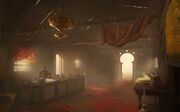 Concept art of the bureau in Ravensthorpe
 -
 Concept art of the bureau in Damascus
 -
 Altaïr and Jamal at the Acre bureau
 -
 Altaïr and Malik at the Jerusalem bureau
 -
 Altaïr and the bureau leader at the Damascus bureau
 -
 Altaïr and Jamal at the Acre bureau
 -
 Altaïr and Malik at the Jerusalem bureau
 -
 Altaïr and bureau leader at the Damascus bureau


Appearances
- Assassin's Creed (first appearance)
- Assassin's Creed IV: Black Flag
- Assassin's Creed: Origins
- Assassin's Creed: Valhalla
References
- ↑ 1.0 1.1 Assassin's Creed: Origins
- ↑ 2.0 2.1 Assassin's Creed: Origins - Birth of the Creed
- ↑ 3.0 3.1 3.2 Assassin's Creed: Origins – The Hidden Ones
- ↑ 4.0 4.1 Assassin's Creed: Valhalla – The Magas Codex I of VI
- ↑ Assassin's Creed: Valhalla – Layla Hassan's personal files: English Locales of Note
- ↑ 6.0 6.1 6.2 6.3 6.4 6.5 6.6 6.7 6.8 Assassin's Creed: Valhalla – A Brief History of the Hidden Ones
- ↑ 7.0 7.1 Assassin's Creed: Valhalla – To Serve the Light...
- ↑ Assassin's Creed: Valhalla – A Cruel Destiny
- ↑ Assassin's Creed: Valhalla – More Intel
- ↑ 10.0 10.1 10.2 10.3 10.4 10.5 10.6 10.7 Assassin's Creed
- ↑ 11.0 11.1 11.2 11.3 11.4 Assassin's Creed IV: Black Flag
- ↑ Assassin's Creed IV: Black Flag – This Old Cove
- ↑ Assassin's Creed: Altaïr's Chronicles
| ||||||||||||||||||||||||||||


