


Arno Dorian: Difference between revisions
imported>Roger Murtaugh Added template. |
imported>Cococrash11 No edit summary |
||
| Line 2: | Line 2: | ||
{{Spoilerhd}} | {{Spoilerhd}} | ||
{{Youmay|the French-Austrian Assassin|[[Arno|the Tuscan waterway]]}} | {{Youmay|the French-Austrian Assassin|[[Arno|the Tuscan waterway]]}} | ||
{{Quote|The Creed of the Assassin Brotherhood teaches us that nothing is forbidden to us. Once, I thought that meant we were free to do as we would. To pursue our ideals, no matter the cost. I understand now. Not a grant of permission. The Creed is a warning. Ideals too easily give way to dogma. Dogma becomes fanaticism. No higher power sits in judgment of us. No supreme being watches to punish us for our sins. In the end, only we ourselves can guard against our obsessions. Only we can decide whether the road we walk carries too high a toll. We believe ourselves redeemers, avengers, saviors. We make war on those who oppose us, and they in turn make war on us. We dream of leaving our stamp upon the word... even as we give our lives in a conflict that will be recorded in no history book. All that we do, all that we are, begins and ends with ourselves.|Arno Dorian regarding The Creed.|Assassin's Creed: Unity}} | |||
{{Character Infobox | {{Character Infobox | ||
|image = ACU Arno Dorian render.png | |image = ACU Arno Dorian render.png | ||
Revision as of 04:38, 14 November 2014

|
He who increaseth knowledge, increaseth sorrow. This article contains spoilers, meaning it has information and facts concerning recent or upcoming releases from the Assassin's Creed series. If you do not want to know about these events, it is recommended to read on with caution, or not at all. |
| This article is about the French-Austrian Assassin. You may be looking for the Tuscan waterway. |
- "The Creed of the Assassin Brotherhood teaches us that nothing is forbidden to us. Once, I thought that meant we were free to do as we would. To pursue our ideals, no matter the cost. I understand now. Not a grant of permission. The Creed is a warning. Ideals too easily give way to dogma. Dogma becomes fanaticism. No higher power sits in judgment of us. No supreme being watches to punish us for our sins. In the end, only we ourselves can guard against our obsessions. Only we can decide whether the road we walk carries too high a toll. We believe ourselves redeemers, avengers, saviors. We make war on those who oppose us, and they in turn make war on us. We dream of leaving our stamp upon the word... even as we give our lives in a conflict that will be recorded in no history book. All that we do, all that we are, begins and ends with ourselves."
- ―Arno Dorian regarding The Creed.[src]
Arno Victor Dorian[2] (1768 – unknown) was a French-Austrian Master Assassin active during the time of the French Revolution.[3]
An orphan who blamed himself for the death of his adoptive father, Arno sought redemption by joining the Assassins in 1789 and working to expose the true instigators of the Revolution, whilst also avenging him in the process.[4][5]
Biography
Born to an Austrian mother and French Assassin Charles Dorian, Arno was raised in a noble household in Versailles. Due to his upbringing, he was well educated, having access to tutors and various books.
However, in 1776, when Arno was eight, his father was murdered. He was subsequently adopted by François de la Serre, the Grand Master of the French Templars, out of respect for his enemy. He raised Arno alongside his own daughter, Élise. Wishing not to corrupt the memory of Arno's biological father and bring his pupil to the Templar Order, François kept his Templar involvement a secret from the young boy.[6]
Thirteen years later, Arno found himself in no end of trouble, having lost his father's watch in a card game and stole it back. When his angry pursuers chased him back to the de la Serre mansion, François attempted to mediate the situation, assigning Arno to assist his butler, Olivier, with whatever chores he would assign, which was cleaning the horses for François' carriage ride to meet Élise. But as soon as François set off, his servant, Perrault, tried catching up to him, revealing to have a letter of great importance, which Arno volunteered to deliver. Unfortunately, the same men who accosted him before he could reach François. Though he bested his attackers, he was forced to flee when guards found him. Returning to the mansion, Arno decided to slip the letter under the door to François' office.
Arno later infiltrated a palace party held in Élise's honour, due to not being invited, and managed to steal a romantic moment with her, before being forced to sneak out when the guards come knocking. Unfortunately, Arno came upon two men mortally wounding François. One of the attackers, Charles Gabriel Sivert, called out to the guard, who immediately assume Arno was responsible for François' murder and throw into the Bastille.
After his first night in prison, Arno discovered that one of his fellow cellmates, Pierre Bellec, stole his watch and briefly dueled him for it, before drawing attention to mysterious drawings in the cell corner. Bellec then dragged him to the corner, realizing he possessed Eagle Vision. Once Arno introduced himself, Bellec revealed that his father was an Assassin, before returning the watch. and spent two months training Arno in combat.
One day, the Bastille comes under attack from a civil uprising, compelling Arno and Bellec to escape. Before parting ways, Bellec gave Arno a medallion, saying it would lead him to the Assassins, and took a leap of faith. Arno did likewise when a group of guards cornered him.
Arno later tracked down Élise, who assumed he was responsible for her father's death. Arno pleaded that he was innocent and tried to tell her about her father being a Templar, only to learn that she already known and she too was part of the Order. She then showed him the letter he was supposed to deliver. The anonymous sender, "L", was trying to warn François that someone within the Templar Order was planning on betraying him. A distraught Élise then sent Arno away. Wracked with guilt and blaming himself, Arno sought out the Assassins, discovering their headquarters underneath the Sainte-Chapelle. He was then inducted into the Brotherhood and vowed to hunt down François' murderers to redeem himself for his failure.
Personality and characteristics
With his troubled past, Arno set out on a quest to find redemption, using this goal to help others in the turbulent time of the French Revolution. As a newcomer to the Assassins, he was prone to questioning their typical approach and age-old beliefs,[7] but was aided in the field by his stealthy and ruthless nature.[8]
Arno was witty and charismatic but also no-nonsense, which fed into his sharp sense of humor, falling back on it whenever he felt emotionally vulnerable. Due to the fact that he was well-educated, Arno often quoted classical books, though his noble upbringing did not prevent him from cheating at card games.[9]
Equipment and skills
Arno often wore a dark blue hooded coat, waistcoat, and breeches with leather gaiters, rather than the stockings which were fashionably popular in his time, though he was not adverse to altering his outfit to blend in or gain an advantage in combat.
In regards to weaponry, Arno used the Phantom Blade, a Hidden Blade equipped with a wrist-mounted crossbow capable of firing a variety of darts, as well as a variety of different swords and a multi-barreled pistol. A dynamic leader and a skilled swordsman, he stopped at nothing to uncover the truth about the forces controlling the Revolution for their own gain.[5]
Romantic life
Adopted by François de la Serre, Arno grew up along with the former's boisterous daughter, Élise. Viewing her more as a friend than a sister, his feelings for Élise eventually graduated to a reciprocal love as they matured.[10]
Trivia
- Arno's name is a derivative of German Arnold and French Arnaud. Its old German origin is Arenwald, meaning "eagle power", from arn "eagle" and wald "power" or "governing". Victor is Latin for "conqueror", while Dorian is a Greek name meaning "gifted".
- Arno is the third of four playable characters not to be related to Desmond Miles, with the first being Aveline de Grandpré, the second being Adéwalé and the fourth being Shay Cormac.[11]
- Arno is also the second playable Assassin to develop a romantic attraction towards a Templar, the first being Altaïr Ibn-La'Ahad with Maria Thorpe.
- Arno was briefly mentioned in Assassin's Creed Rogue when the player discovers a communicator dropped by an Abstergo employee.
- In Assassin's Creed Unity the player can purchase Arno's personal six-barreled pistol.
Gallery
-
 Concept art of Arno
 -
 Rear concept art of Arno
 -
 Concept art of Arno's customization options
 -
 Promotional art of Arno and Élise
 -
 Promotional art of Arno firing the Phantom Blade
 -
 Arno overlooking Paris
 -
 Arno killing a guard
 -
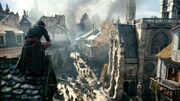 Arno crouching on a rooftop
 -
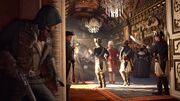 Arno stalking a target
 -
 Arno performing an air assassination
 -
 Arno utilizing the Phantom Blade
 -
 Arno engaging several guards with a lance


References
- ↑ Assassin's Creed on Twitter
- ↑ GameInformer: Ten Things You Need To Know About Assassin's Creed Unity
- ↑ Assassin's Creed: Unity Experience Trailer #1: New Engine, New Gameplay
- ↑ Assassin's Creed: Unity bringing co-op to the series on Oct 28
- ↑ 5.0 5.1 Assassin's Creed: Unity - Introduction to Arno
- ↑ Game Informer: Get to know Arno
- ↑ AC Initiates: The Network Podcast - Episode 5
- ↑ Assassin's Creed: Unity FAQ Answers All Your Questions about Story, Co-op, Next-Gen Graphics and More
- ↑ Assassin's Creed: Unity Devblog – Arno with Travis Stout
- ↑ Gametsu: Assassin’s Creed: Unity Gamescom screenshots
- ↑ Cite error: Invalid
<ref>tag; no text was provided for refs namedE3 Interview
| ||||||||||||||||||||||||||||||||||