

Freerunning: Difference between revisions
imported>Nostalgia AC Revamp |
m Text replacement - " " to " " |
||
| (194 intermediate revisions by 90 users not shown) | |||
| Line 1: | Line 1: | ||
{{ | {{Era|Culture}}{{WP-REAL|Parkour}} | ||
{{Dialogue|Rosa|Climbing a bit of scaffolding is all well and good, but let's see how you do out in the open.|Ezio|Top of that tower, then? Torno fra un attimo. (I'll be right back.)|Rosa challenging Ezio Auditore.|Assassin's Creed II|By Leaps and Bounds}} | |||
[[File: | [[File:Zw-codex-23.png|thumb|250px|The [[Altaïr Ibn-La'Ahad's Codex|Codex]] sketch on freerunning]] | ||
'''Freerunning | '''Freerunning''' is a form of acrobatics in which participants navigate through a landscape by performing fluid movements over and across urban or natural structures. | ||
This particular form of movement was utilized primarily by members of the [[Assassins|Assassin Order]], and was a vital asset both during and after assassinations. Over time, Assassins would also use a series of tools to supplement their climbing and freerunning abilities. Other than the Assassins, several factions were also known to be adept freerunners, including [[Agile guards]], [[Thieves]], [[Borgia messengers]], [[Papal Guard|Papal guards]], [[Followers of Romulus]], and [[Janissaries]]. Additionally, freerunning was integrated into the [[Animi Training Program]], in order for Abstergo recruits to mimic the skills learned predominantly by Assassins in history. | |||
[[ | |||
==Vertical movement== | |||
[[File:Sixth day 4.png|thumb|250px|right|[[Ezio Auditore da Firenze|Ezio Auditore]] climbing up onto a bar]] | |||
*'''Wallpass''' | In general, vertical movements involved climbing or scaling structures that provided adequate handholds, or a texture rough enough to grip. Inversely, they also allowed one to safely drop down from a height. | ||
*'''Climb-up''' | *'''Wallpass''' was the act of climbing a tall wall by kicking its surface once to propel upwards.<ref name="AC">''[[Assassin's Creed]]''</ref> | ||
*''' | *'''Climb-up''' was the movement of pulling oneself up onto an obstacle from a hanging position.<ref name="AC" /> | ||
*''' | *'''Drop''' was the act of jumping downwards, after releasing one's grip from a hanging position or bar.<ref name="AC" /> | ||
*''' | *'''Long jump''' was a leap from a high height, and was usually followed by a break fall.<ref name="AC" /> | ||
*''' | *'''Climb leap''' was a vertical jump while holding onto a vertical surface, which allowed one to grab potentially out-of-reach handholds.<ref name="AC2">''[[Assassin's Creed II]]''</ref> | ||
*''' | *'''Beam jump''' was performed from [[Horses|horseback]], and allowed one to use the horse's momentum to leap from the saddle, grab a beam, and swing around to either land on it, or on an adjacent one.<ref name="ACB">''[[Assassin's Creed: Brotherhood]]''</ref> | ||
*The '''[[Leap of Faith]]''' was performed only by trained Assassins and certain Templars and Abstergo recruits, which involved leaping from a significant height onto a cushioned material.<ref name="AC" /> | |||
*'''Leap to swing''' is a variation of the Leap of Faith which is consisting in diving towards an horizontal rope from a high point and to absorb the fall by grabbing the rope at the last second.<ref>''[[Assassin's Creed Unity]]'' </ref> | |||
== | ==Horizontal movement== | ||
[[File: | [[File:Altair free-run.jpg|thumb|250px|[[Altaïr Ibn-La'Ahad]] performing a gap jump]] | ||
Horizontal movements generally involved moving over large distances such as [[swimming]], sprinting, running or walking, or methods that allowed one to clear obstacles, such as gaps or breaks. | |||
=== | *'''Swing''' was a movement in which one swung onto a bar and let go, enabling one to grab another object or drop to the ground.<ref name="AC" /> | ||
*'''Pass''' involved quickly and smoothly passing over medium sized obstacles.<ref name="AC" /> | |||
== | *'''Break fall''' was a forward roll where the hands, arms, and diagonal of the back made contact with the ground.<ref name="AC" /> | ||
{{ | *'''Arm jump''' was to land on the side of an obstacle in a hanging position, hands gripping the top edge and holding the body in place.<ref name="AC" /> | ||
*'''Back eject''' was to jump backwards from a hanging position onto an opposite structure.<ref name="AC2" /> | |||
== | *'''Gap jump''' was performed similarly to a long jump, except over an open expanse between two relatively level areas.<ref name="AC" /> | ||
The | *'''Precision jump''' was a moving jump from one object to a specific spot on another object, usually with a small surface.<ref name="AC" /> | ||
*'''Dive''' was only used with merchant stalls, where one jumped hands-first through an open stall and used a roll to get back up quickly.<ref name="AC" /> | |||
*'''Spring jump''' could only be done using a springboard, such as those in the [[Oltrarno District]] of [[Florence]]. It allowed one to jump forward twice as far, through the external force of the device.<ref>''[[Assassin's Creed II]]'' - ''[[Bonfire of the Vanities (DLC)|Bonfire of the Vanities]]''</ref> | |||
*'''Corner swing''' was when one would sharply turn a corner, by jumping forward and grabbing onto a lantern (or any other fixture) mounted on a building's corner, then using one's momentum to swing on it.<ref name="ACB" /> | |||
*'''Vault''' was to use one's own momentum to pass over or slide under obstacles.<ref>''[[Assassin's Creed III]]''</ref> | |||
==Tools== | |||
{{Quote|When he tires of running, an Assassin must take to the air.|Yusuf Tazim describing zipline uses to Ezio Auditore, 1511.|Assassin's Creed: Revelations|Advanced Tactics}} | |||
[[File:ACR_Ezio_zipline.png|thumb|250px|right|Ezio using the Hookblade to traverse a zipline]] | |||
As they used freerunning for travel and escape, Assassins (or their allies) developed tools that would improve their abilities. Among these were the [[Metal Cestus#Climb Leap Glove|Climb Leap Glove]] manufactured by [[Leonardo da Vinci]],<ref name="ACB" /> and the [[Hookblade]], which was used by the [[Ottoman Brotherhood of Assassins|Ottoman Assassins]].<ref name="ACR">''[[Assassin's Creed: Revelations]]''</ref> | |||
Though the climb leap technique could also be performed unaided,<ref name="AC2" /> the Climb Leap Glove improved the strength of one's grip, and allowed older or less experienced individuals to perform the technique.<ref name="ACB" /> | |||
The Hookblade aided in both vertical and horizontal movement. When used with [[zipline]]s posted on [[Constantinople]]'s rooftops, the Hookblade allowed one to travel great diagonal distances much quicker than running or climbing normally. The device also extended one's reach upwards during a climb leap, or forwards during an arm jump.<ref name="ACR" /> | |||
During the [[Louisiana Rebellion]], [[Aveline de Grandpré]] exploited the [[whip]] to navigate across different routes and rooftops, using it to swing to out of reach beams.<ref>''[[Assassin's Creed III: Liberation]]''</ref> | |||
In 1868, the [[British Brotherhood of Assassins|British Assassins]] [[Jacob Frye|Jacob]] and [[Evie Frye]] had rope launchers fitted into their [[Assassin Gauntlet|Assassin gauntlets]] by [[Alexander Graham Bell]]. From that point on, they would utilize the rope launcher to swiftly scale tall buildings or form temporary ziplines.<ref name="ACS">''[[Assassin's Creed: Syndicate]]''</ref> | |||
==Trivia== | ==Trivia== | ||
*There | *There was a bug present in most installments of the series, where [[civilians]] in certain areas or circumstances were able to perform freerunning movements. | ||
*Freerunning puzzles have become a mainstay in the series since ''[[Assassin's Creed II]]'', coming in the form of [[Assassin Tombs]], [[Secret location|Templar Lairs]], [[Lair of Romulus|Lairs of Romulus]], [[Memory Seals|Memory Seal]] locations, the locations for pieces of [[William Kidd|Captain Kidd's]] [[Rings of Eden|treasure]] map, and [[Tombs of the Fallen]]. | |||
==Gallery== | |||
<gallery widths="180" position="center" captionalign="center"> | |||
BLB 2.png|Ezio Auditore scaling [[Santa Maria dei Frari]] | |||
ACII-Overbeams 3.png|Ezio moving along a rafter | |||
Il Duomo's Secret 5.png|Ezio catching a ledge | |||
[[ | A Wolf in Sheep's Clothing 8.png|Ezio performing a corner swing | ||
[[ | ACShadows Promotional Screenshot 10.jpg|[[Fujibayashi Naoe]] freerunning on a roof | ||
[[ | The Sage's Buried Secret 1.png|[[Edward Kenway]] freeruning through a [[Maya]] temple | ||
[[ | ACFT - Saito freerunning in Manila.png|[[Shimazu Saito]] freerunning across [[Manila]]'s rooftops | ||
[[ | Journey to the New World 26.png|[[Haytham Kenway]] scaling the mast of the ''[[Providence]]'' | ||
[[ | The Rebel Camp 2.png|[[Aveline de Grandpré]] navigating the outskirts of a [[Forts|fort]] | ||
[[ | ACIII-RuinCerros 3.png|[[Ratonhnhaké:ton|Connor]] running along tree branches | ||
[[Category:Assassin | Oak Island 9.png|Connor swinging from wooden beams | ||
Leap to swing.png|[[Arno Dorian]] performing a leap to swing move | |||
AC2 Desmond Warehouse Freerunning.png|[[Desmond Miles]] freerunning in the [[Rome hideout]] | |||
Apple Retrieval 4.png|Desmond freerunning in the [[Colosseum Vault]] | |||
AC3 Desmond Skyscrapper.png|Desmond freerunning through a skyscraper in [[New York City|New York]] | |||
ACV - Animus Anomaly.jpg|[[Layla Hassan]] freerunning while completing an [[Animus Anomalies|Animus Anomaly]] | |||
ACFT - Noa freerunning.png|[[Noa Kim]] freerunning at [[Yangon]]'s harbor | |||
</gallery> | |||
==References== | |||
{{Reflist}} | |||
[[Category:Assassin skills]] | |||
Latest revision as of 23:41, 9 July 2026

Freerunning is a form of acrobatics in which participants navigate through a landscape by performing fluid movements over and across urban or natural structures.
This particular form of movement was utilized primarily by members of the Assassin Order, and was a vital asset both during and after assassinations. Over time, Assassins would also use a series of tools to supplement their climbing and freerunning abilities. Other than the Assassins, several factions were also known to be adept freerunners, including Agile guards, Thieves, Borgia messengers, Papal guards, Followers of Romulus, and Janissaries. Additionally, freerunning was integrated into the Animi Training Program, in order for Abstergo recruits to mimic the skills learned predominantly by Assassins in history.
Vertical movement[edit | edit source]

In general, vertical movements involved climbing or scaling structures that provided adequate handholds, or a texture rough enough to grip. Inversely, they also allowed one to safely drop down from a height.
- Wallpass was the act of climbing a tall wall by kicking its surface once to propel upwards.[1]
- Climb-up was the movement of pulling oneself up onto an obstacle from a hanging position.[1]
- Drop was the act of jumping downwards, after releasing one's grip from a hanging position or bar.[1]
- Long jump was a leap from a high height, and was usually followed by a break fall.[1]
- Climb leap was a vertical jump while holding onto a vertical surface, which allowed one to grab potentially out-of-reach handholds.[2]
- Beam jump was performed from horseback, and allowed one to use the horse's momentum to leap from the saddle, grab a beam, and swing around to either land on it, or on an adjacent one.[3]
- The Leap of Faith was performed only by trained Assassins and certain Templars and Abstergo recruits, which involved leaping from a significant height onto a cushioned material.[1]
- Leap to swing is a variation of the Leap of Faith which is consisting in diving towards an horizontal rope from a high point and to absorb the fall by grabbing the rope at the last second.[4]
Horizontal movement[edit | edit source]

Horizontal movements generally involved moving over large distances such as swimming, sprinting, running or walking, or methods that allowed one to clear obstacles, such as gaps or breaks.
- Swing was a movement in which one swung onto a bar and let go, enabling one to grab another object or drop to the ground.[1]
- Pass involved quickly and smoothly passing over medium sized obstacles.[1]
- Break fall was a forward roll where the hands, arms, and diagonal of the back made contact with the ground.[1]
- Arm jump was to land on the side of an obstacle in a hanging position, hands gripping the top edge and holding the body in place.[1]
- Back eject was to jump backwards from a hanging position onto an opposite structure.[2]
- Gap jump was performed similarly to a long jump, except over an open expanse between two relatively level areas.[1]
- Precision jump was a moving jump from one object to a specific spot on another object, usually with a small surface.[1]
- Dive was only used with merchant stalls, where one jumped hands-first through an open stall and used a roll to get back up quickly.[1]
- Spring jump could only be done using a springboard, such as those in the Oltrarno District of Florence. It allowed one to jump forward twice as far, through the external force of the device.[5]
- Corner swing was when one would sharply turn a corner, by jumping forward and grabbing onto a lantern (or any other fixture) mounted on a building's corner, then using one's momentum to swing on it.[3]
- Vault was to use one's own momentum to pass over or slide under obstacles.[6]
Tools[edit | edit source]

As they used freerunning for travel and escape, Assassins (or their allies) developed tools that would improve their abilities. Among these were the Climb Leap Glove manufactured by Leonardo da Vinci,[3] and the Hookblade, which was used by the Ottoman Assassins.[7]
Though the climb leap technique could also be performed unaided,[2] the Climb Leap Glove improved the strength of one's grip, and allowed older or less experienced individuals to perform the technique.[3]
The Hookblade aided in both vertical and horizontal movement. When used with ziplines posted on Constantinople's rooftops, the Hookblade allowed one to travel great diagonal distances much quicker than running or climbing normally. The device also extended one's reach upwards during a climb leap, or forwards during an arm jump.[7]
During the Louisiana Rebellion, Aveline de Grandpré exploited the whip to navigate across different routes and rooftops, using it to swing to out of reach beams.[8]
In 1868, the British Assassins Jacob and Evie Frye had rope launchers fitted into their Assassin gauntlets by Alexander Graham Bell. From that point on, they would utilize the rope launcher to swiftly scale tall buildings or form temporary ziplines.[9]
Trivia[edit | edit source]
- There was a bug present in most installments of the series, where civilians in certain areas or circumstances were able to perform freerunning movements.
- Freerunning puzzles have become a mainstay in the series since Assassin's Creed II, coming in the form of Assassin Tombs, Templar Lairs, Lairs of Romulus, Memory Seal locations, the locations for pieces of Captain Kidd's treasure map, and Tombs of the Fallen.
Gallery[edit | edit source]
-
 Ezio Auditore scaling Santa Maria dei Frari
 -
 Ezio moving along a rafter
 -
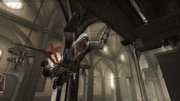 Ezio catching a ledge
 -
 Ezio performing a corner swing
 -
 Fujibayashi Naoe freerunning on a roof
 -
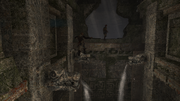 Edward Kenway freeruning through a Maya temple
 -
 Shimazu Saito freerunning across Manila's rooftops
 -
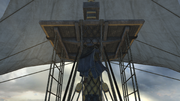 Haytham Kenway scaling the mast of the Providence
 -
 Aveline de Grandpré navigating the outskirts of a fort
 -
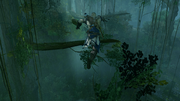 Connor running along tree branches
 -
 Connor swinging from wooden beams
 -
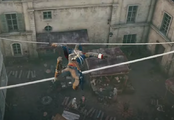 Arno Dorian performing a leap to swing move
 -
 Desmond Miles freerunning in the Rome hideout
 -
 Desmond freerunning in the Colosseum Vault
 -
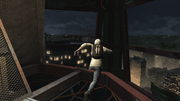 Desmond freerunning through a skyscraper in New York
 -
 Layla Hassan freerunning while completing an Animus Anomaly
 -


References[edit | edit source]
- ↑ 1.00 1.01 1.02 1.03 1.04 1.05 1.06 1.07 1.08 1.09 1.10 1.11 Assassin's Creed
- ↑ 2.0 2.1 2.2 Assassin's Creed II
- ↑ 3.0 3.1 3.2 3.3 Assassin's Creed: Brotherhood
- ↑ Assassin's Creed Unity
- ↑ Assassin's Creed II - Bonfire of the Vanities
- ↑ Assassin's Creed III
- ↑ 7.0 7.1 Assassin's Creed: Revelations
- ↑ Assassin's Creed III: Liberation
- ↑ Assassin's Creed: Syndicate