

Christianity: Difference between revisions
imported>Theassasinmentor2020 Adding categories |
|||
| (73 intermediate revisions by 24 users not shown) | |||
| Line 1: | Line 1: | ||
{{Era|Culture}}{{WP-REAL}} | |||
{{Update|''[[Discovery Tour: Viking Age]]''}} | |||
[[File:ACV Christian Cross.png|thumb|180px|A Christian cross]] | |||
'''Christianity''' is a monotheistic religion based on the life and teachings of [[Jesus of Nazareth]]. It originated as a sect of [[Judaism]] in the [[Levant]], from where it spread to [[Europe]]. Though initially persecuted by the [[Roman Empire]], its adoption as the state religion by [[Constantine I]] set it on the course of becoming Europe's most prominent faith before spreading to much of the [[Earth|world]] with its propagation via European colonialism in the [[Age of Discovery|Age of Exploration]]. Its adherents are commonly known as '''Christians''', and in the 21st century, it remains the world's largest religion with many denominations.<ref>{{WP|Christianity}}</ref> | |||
==Beliefs== | |||
As in other {{Wiki|Abrahamic religions}}, the central belief of Christianity revolves around the existence of only one deity, the {{Wiki|God in Abrahamic religions|Abrahamic God}}, who is believed to be a primordial omnipotent entity.<ref name="In Bocca al Lupo">''[[Assassin's Creed II]]'' – [[In Bocca al Lupo]]</ref> Unlike Judaism, however, it shares the belief with [[Islam]] that Jesus of Nazareth was the messiah which [[human]]ity had awaited for and that following the teachings of Jesus would result in mankind achieving eternal peace in the Kingdom of Heaven. In Christianity, Jesus himself is God, a doctrine encapsulated in the doctrine of {{Wiki|Trinity}} where though there is one God, God is of three distinct persons: the Father, the Son (Jesus), and the Holy Spirit.<ref name="WP">{{WP|Holy Trinity}}</ref> | |||
==Denominations== | |||
===Eastern Orthodoxy=== | |||
Eastern Orthodoxy is one of the main branches of Christianity and the official state religion of the [[Byzantine Empire]]. After the [[Fall of Constantinople|fall of the Byzantine Empire]], the church had as {{Wiki|Patriarch}} [[Pachomius I of Constantinople|Pachomius I]], whom the Templars plotted to [[Assassination|assassinate]].<ref>''[[Assassin's Creed: Revelations]]'' – [[The Deacon, Part 1]]</ref> While on sabbatical<ref>''[[Assassin's Creed: Revelations]]'' – [[The Hangman]]</ref> in [[Constantinople]],<ref>''[[Assassin's Creed: Revelations]]'' – [[A Warm Welcome (Revelations)|A Warm Welcome]]</ref> the [[Italian Brotherhood of Assassins|Italian Assassin]] [[Ezio Auditore da Firenze|Ezio Auditore]] learned the [[Byzantine Rite of the Templar Order|Byzantine Templar]] and rogue deacon [[Cyril of Rhodes]] was assigned this criminal task and killed him, preventing the Patriarch's murder.<ref>''[[Assassin's Creed: Revelations]]'' – [[The Deacon, Part 2]]</ref> | |||
==History== | |||
===Origins and spread=== | |||
Jesus was a preacher and a carpenter from Nazareth, near [[Jerusalem]], who was renowned for his divine wisdom and a number of miracles which are believed to have been the work of a [[Piece of Eden]],<ref>''[[Assassin's Creed]]'' – [[Assassination (Majd Addin)]]</ref> which [[Civilian|everyday people]] know as the [[Shrouds of Eden|Shroud of Turin]]. Deified after his death, his most remarkable feat is said to have been his {{Wiki|Resurrection of Jesus|resurrection}} three days after the [[Roman Empire]], under the influence of the [[Order of the Ancients]], had him [[Crucifixion|crucified]]. His legacy was kept alive by his disciples.<ref>''[[Assassin's Creed II]]'' – [[Glyphs|Glyph]] #7: "Keep On Seeking, And You Will Find"</ref><ref>''[[Assassin's Creed: Initiates]]'' – [[Database: Messiah]]</ref> | |||
''' | [[File:ACV Celtic Cross.png|thumb|left|250px|A Celtic cross in the Early Middle Ages]] | ||
[[ | By the 5th century, Christianity had become central to [[Byzantine Empire|Byzantine]] politics and society;<ref name="ACR">''[[Assassin's Creed: Revelations]]''</ref> by the 11th century, it pervaded every aspect of European life. [[Church]]es, places of worship for this faith, were built in virtually every European city, with the largest cities like Constantinople, [[Paris]], [[London]], and [[Rome]] boasting the architectural marvels that are [[cathedral]]s.<ref name="AC2">''[[Assassin's Creed II]]''</ref><ref name="ACB">''[[Assassin's Creed: Brotherhood]]''</ref><ref name="ACU">''[[Assassin's Creed: Unity]]''</ref><ref name="ACS">''[[Assassin's Creed: Syndicate]]''</ref> Rome became the capital of Christendom when its bishop was established as the [[Papacy|Pope]], the supreme authority on Christen doctrine and the community's link with God.<ref name="AC2" /><ref name="ACB" /> | ||
During the [[Viking expansion]] into [[England]], churches and monastaries became a valuable target for the invading [[Vikings]] due to their treasuries housing valuable religious artifacts.<ref>''[[Discovery Tour: Viking Age]]'' – [[Learnings: Relics and Saints]]</ref> Various Order of the Ancients members active during this period, including [[Ingeborg]],<ref>''[[Assassin's Creed: Valhalla]]'' – [[Burning the Firebrand]]</ref> [[Herefrith]],<ref>''[[Assassin's Creed: Valhalla]]'' – [[A Sword-Shower in Anecastre]]</ref> and [[Blaeswith]],<ref>''[[Assassin's Creed: Valhalla]]'' – [[Breaking the Order]]</ref> became members of the clergy, using religion to try and influence the general populace. However, their actions were seen as heretical by King [[Alfred the Great|Alfred]] of [[Wessex]], the Order's [[Grand Maegester of the Order of the Ancients|Grand Maegester]] and a devout Christian, who engineered the Order's destruction so he could rebuilt it in accordance with his religious beliefs.<ref>''[[Assassin's Creed: Valhalla]]'' – [[The Poor Fellow-Soldier]]</ref> | |||
===Religious persecutions=== | |||
[[File:AC1 Crusader Sergeant.png|thumb|150px|A Crusader sergeant]] | |||
Religious zealotry became a prevailing issue throughout Christianity's history. The 11th to 14th centuries were the high point of the [[Crusades]], a series of religious wars waged by [[Crusaders|European Christian armies]] against [[Saracens|Saracen]] states in the east, principally to conquer the [[Kingdom|Holy Land]]. Among the military orders participating in these Crusades was the [[Levantine Rite of the Templar Order|Knights Templar]], actually a front for the millennia-old, secret organization that thereafter became known as the [[Templars|Templar Order]].<ref name="AC1">''[[Assassin's Creed]]''</ref> | |||
In the 15th century, persecution of non-Christians escalated with the [[Spain|Spanish]] ''[[Reconquista]]'' headed by the [[Spanish Inquisition|Inquisition]], where Jews, Muslims, and atheists alike were purged as heretics and [[Auto-da-fé|burned to death]] in public.<ref name="AC2D">''[[Assassin's Creed II: Discovery]]''</ref><ref name="ACReb">''[[Assassin's Creed: Rebellion]]''</ref> Meanwhile in [[Florence]], the [[Dominican Order|Dominican]] [[monk]] [[Girolamo Savonarola]] used an [[Apple of Eden 6|Apple of Eden]] to seize power and impose his fundamentalist vision by forcing residents to [[Bonfire of the Vanities|destroy works of art and literature]] at pain of death.<ref name="Bonfire of the Vanities">''[[Assassin's Creed II]] – [[Bonfire of the Vanities (DLC)|Bonfire of the Vanities]]''</ref> | |||
===Corruption under the Borgia=== | |||
Simultaneously, the Roman Catholic Church became rife with corruption even while it patronized the [[Renaissance]] through artistic wonders like [[Cattedrale di Santa Maria del Fiore]], the [[Basilica di San Marco]], and the [[Sistine Chapel]].<ref name="AC2" /><ref name="ACB" /> [[Cardinal]]s and monks like Archbishop [[Francesco Salviati]], [[Antonio Maffei]], and [[Stefano da Bagnone]] took part in the [[Pazzi conspiracy]], murdering [[Giuliano de' Medici]] in broad daylight,<ref name="Wolves in Sheep's Clothing">''[[Assassin's Creed II]]'' – [[Wolves in Sheep's Clothing]]</ref> while others like [[Ristoro]] regularly molested [[courtesan]]s at [[brothel]]s and murdered fellow monks who questioned his devotion to his vows.<ref name="Fiora Cavazza">''[[Assassin's Creed: Project Legacy]]'' – [[Rome: Chapter 1 – Fiora Cavazza]]</ref><ref name="Excommunication">''[[Assassin's Creed: Brotherhood]]'' – [[Excommunication]]</ref> Even outside of Spain, it was not unheard of to find Catholic priests who were wiling take bribes to brand random civilians as heretics and have them arrested and executed.<ref name="Francesco Vecellio 1">''[[Assassin's Creed: Project Legacy]]'' – [[Italian Wars: Chapter 2 – Francesco Vecellio]]</ref> | |||
[[File:A-wolf-in-sheeps-clothing-memory.png|thumb|left|250px|Mass being held at Basilica di San Pietro, 1503]] | |||
A great deal of these cases, however, were perpetrated by the Templars, who used religion, including Christianity, to further their own goals. Grand Inquisitor [[Tomás de Torquemada]] led the [[Spanish Rite of the Templar Order|Spanish Rite]] while Rodrigo Borgia was [[Grand Master of the Templar Order|Grand Master]] of the [[Roman Rite of the Templar Order|Roman Rite]] who, prior to his tenure as Pope Alexander VI, had orchestrated the Pazzi conspiracy. As Pope, Rodrigo presided over an unprecedented level of corruption in the Church, using the [[House of Borgia|Borgia family]]'s influence to extort and shutdown businesses for its own benefit and engage in wanton killings of anyone who offended the Borgia or their patrons, among them scientists,<ref name="ACB" /><ref name="Francesco Vecellio 2">''[[Assassin's Creed: Project Legacy]]'' – [[Rome: Chapter 3 – Francesco Vecellio]]</ref><ref name="Conpernicus Conspiracy">''[[Assassin's Creed: Brotherhood]]'' – ''[[Copernicus Conspiracy]]''</ref> Christian reformers,<ref name="Contracts">''[[Assassin's Creed: Project Legacy]]'' – [[Contracts (Project Legacy)|Contracts]]</ref> and women they had violated.<ref name="Well Executed">''[[Assassin's Creed: Brotherhood]]'' – [[Well Executed]]</ref> Notwithstanding this, he had only become Pope for the purpose of overthrowing God and stealing his power, believing that the being lay dormant in the [[Vatican Vault|Vault]] beneath the [[Vaticano District|Vatican]] and could be slain by the Pieces of Eden.<ref name="In Bocca al Lupo" /> | |||
===Protestant Reformation=== | |||
The Borgia reign over the Papacy collapsed in 1503 under an active campaign by the Templars' sworn enemies, the [[Assassins|Assassin Brotherhood]], to [[liberation of Rome|liberate Rome]]. Tensions between the Catholic Church and common Christians did not end there, however. Pope [[Julius II]], earning the epithet "the Warrior Pope", actively engaged the Papal States in [[Italian Wars|wars of domination]] over [[Italy]] that were not unlike the conquests of Rodrigo's son [[Cesare Borgia|Cesare]], who he had a hand in arresting.<ref name="All Road Lead To...">''[[Assassin's Creed: Brotherhood]]'' – [[All Roads Lead To...]]</ref> His successor, [[Leo X]], was an ally of the Assassins but was also notorious for the commercialization of {{Wiki|indulgence}}s, selling absolution from sins.<ref name="Revelations novel">[[Assassin's Creed: Revelations (novel)|''Assassin's Creed: Revelations'' novel]]</ref> | |||
[[File:Martin Luther.jpg|thumb|230px|Martin Luther]] | |||
Church practices such as these alienated Christian scholars who agitated for reforms. Among the most notable were [[Desiderius Erasmus]], a prior target of the Borgia,<ref name="Contracts" /> and [[Martin Luther]], an archenemy of Leo X.<ref>''[[Assassin's Creed DNA]]'' – Timeline: 1517</ref> The two were at odds; Erasmus had become an Assassin of the [[North European Brotherhood of Assassins|North European Brotherhood]] and had written a letter in 1512 warning Ezio of Luther's radicalism.<ref name="Revelations novel" /> In 1517, Luther purportedly nailed his famous ''{{Wiki|Ninety-five Theses}}'' denouncing Catholicism onto the door of a church at the [[University of Wittenberg]], starting the {{Wiki|Protestant Reformation}}.<ref>{{WP|Protestant Reformation}}</ref> | |||
The movement triggered more than a century of religious warfare in Europe as governments and families alike increasingly found themselves divided between Catholicism and Protestantism. The schism played a prominent role in the [[English Civil War]] of the mid-17th century, with Catholics largely siding with the [[monarchy]] and Protestants siding with the [[Roundheads|Parliamentarians]].<ref>{{WP|English Civil War}}</ref> | |||
===Modern legacy=== | |||
By way of the European colonial powers, particularly the [[Spanish Empire|Spanish]] and the [[British Empire]]s, Christianity spread to the [[Americas]] and grew in prominence in [[Africa]]{{Fact|24 April 2020}} and [[Asia]].<ref>''[[Assassin's Creed: Memories]]''</ref><ref>''[[Assassin's Creed: Forgotten Temple]]''</ref><ref>''[[Assassin's Creed: Shadows]]''</ref> The thirteen British American colonies which seceded as the [[United States|United States of America]] in the late 18th century was already heavily Protestant at the time of its [[American Revolution|revolution]] as a result of its cultural and political history.<ref name="AC3">''[[Assassin's Creed III]]''</ref> | |||
At the same time, the faith faced new challenges in Europe owing to the rise of [[Age of Enlightenment|Enlightenment]] ideas; a significant segment of French society professed to atheism during the [[French Revolution]],<ref name="ACU">''[[Assassin's Creed: Unity]]''</ref> with nation-wide {{Wiki|Dechristianization of France during the French Revolution|dechristianization}} being official policy of the new [[First French Republic|French Republic]].<ref>''[[Project Widow]]'' – "Our Lady"</ref> Nonetheless, Christianity remains the largest religion on Earth in the 21st century. | |||
Its troubled history likely weighed on the mind of the Assassin [[Desmond Miles]] when, on 21 December 2012, he was presented with the choice of either sacrificing his life to save humanity from a [[Second Disaster|coronal mass ejection]] or surviving to become a leader to the few populations of survivors. In the [[Calculations|vision]] he was shown by [[Minerva]] and [[Juno]], he witnessed his future in the latter course, where he would become an exalted hero whose teachings of love and peace would inspire the hearts of many and lead to a rebirth of civilization, but in death, that love would become zealotry and dogma. Eventually, he would become deified by later generations, and the very memory of him as a savior would be twisted into an icon to justify persecution, violence, and oppression. The vision echoed Jesus's legacy, and Juno even drove home the point that for Desmond to choose that route would mean renewing the cycle. With his mind set, Desmond touched the [[global aurora borealis device]] that would activate the planetary shield at the cost of his life, thereby saving the world.<ref name="AC3" /> | |||
==Gallery== | |||
<gallery widths="180" position="center" captionalign="center"> | |||
Basilica di San Pietro.png|St. Peter's Basilica, the largest Catholic church in the world | |||
Sistine.jpg|Pope Alexander VI holding Mass inside the Sistine Chapel | |||
SMDFDB.png|[[Cattedrale di Santa Maria del Fiore]], a prominent church in [[Florence]] | |||
Saint marks basilica.png|The [[Basilica di San Marco]], a landmark of [[Venice]] | |||
Hagia Sophia 001.jpg|[[Hagia Sophia]], a former basilica converted into a [[mosque]] | |||
ACU Notre-Dame.png|[[Notre-Dame]], a famous cathedral in Paris | |||
ACS St Paul's Cathedral.jpg|[[St. Paul's Cathedral]] in [[London]] | |||
ACFT - Magellan's cross.png|[[Ferdinand Magellan]]'s expedition planting a Christian cross in [[Cebu]] | |||
</gallery> | |||
==Appearances== | |||
*''[[Assassin's Creed]]'' {{1st}} | |||
*''[[Assassin's Creed: Altaïr's Chronicles]]'' | |||
*''[[Assassin's Creed II]]'' | |||
*''[[Assassin's Creed II: Discovery]]'' {{Imo}} | |||
*''[[Assassin's Creed: Project Legacy]]'' | |||
*''[[Assassin's Creed: Brotherhood]]'' | |||
*''[[Assassin's Creed: Revelations]]'' | |||
*''[[Assassin's Creed III]]'' | |||
**''[[The Tyranny of King Washington]]'' | |||
*''[[Assassin's Creed IV: Black Flag]]'' | |||
**''[[Freedom Cry]]'' | |||
*''[[Assassin's Creed: Pirates]]'' {{Mo}} | |||
*''[[Assassin's Creed: Memories]]'' {{Mo}} | |||
*''[[Assassin's Creed: Rogue]]'' | |||
*''[[Assassin's Creed: Unity]]'' | |||
**''[[Dead Kings]]'' | |||
*''[[Assassin's Creed: Syndicate]]'' | |||
**''[[Jack the Ripper (DLC)|Jack the Ripper]]'' | |||
*''[[Assassin's Creed Chronicles: Russia]]'' | |||
*[[Assassin's Creed (film)|''Assassin's Creed'' film]] | |||
*''[[Assassin's Creed: Rebellion]]'' | |||
*''[[Assassin's Creed: Odyssey]]'' | |||
*''[[Assassin's Creed: Valhalla]]'' | |||
**''[[The Way of the Berserker]]'' {{Mo}} | |||
**''[[Wrath of the Druids]]'' | |||
*''[[Discovery Tour: Viking Age]]'' | |||
*''[[Cike Xintiao: Chang'an Wang]]'' {{C|as ''Jingjiao''}} | |||
*''[[Assassin's Creed: Forgotten Temple]]'' | |||
*''[[Assassin's Creed: Mirage]]'' | |||
*''[[Assassin's Creed: Mirage – A Soar of Eagles]]'' | |||
*''[[Assassin's Creed: Shadows]]'' | |||
*''[[Assassin's Creed: Shadows – Tales of Iga]]'' | |||
*''[[Animus Hub]]'' {{Mdat}} | |||
==References== | |||
{{Scroll box|content={{Reflist|2}}}} | |||
[[Category:Christianity]] | [[Category:Christianity]] | ||
[[Category:Abrahamic religions]] | |||
[[Category:Biblical mythology]] | |||
Latest revision as of 03:32, 19 August 2026

|
Patience, brothers. Soon we will reveal the secrets of Discovery Tour: Viking Age. This article has been identified as being out of date. Please update the article to reflect recent releases and then remove this template once done. |

Christianity is a monotheistic religion based on the life and teachings of Jesus of Nazareth. It originated as a sect of Judaism in the Levant, from where it spread to Europe. Though initially persecuted by the Roman Empire, its adoption as the state religion by Constantine I set it on the course of becoming Europe's most prominent faith before spreading to much of the world with its propagation via European colonialism in the Age of Exploration. Its adherents are commonly known as Christians, and in the 21st century, it remains the world's largest religion with many denominations.[1]
Beliefs[edit | edit source]
As in other Abrahamic religions, the central belief of Christianity revolves around the existence of only one deity, the Abrahamic God, who is believed to be a primordial omnipotent entity.[2] Unlike Judaism, however, it shares the belief with Islam that Jesus of Nazareth was the messiah which humanity had awaited for and that following the teachings of Jesus would result in mankind achieving eternal peace in the Kingdom of Heaven. In Christianity, Jesus himself is God, a doctrine encapsulated in the doctrine of Trinity where though there is one God, God is of three distinct persons: the Father, the Son (Jesus), and the Holy Spirit.[3]
Denominations[edit | edit source]
Eastern Orthodoxy[edit | edit source]
Eastern Orthodoxy is one of the main branches of Christianity and the official state religion of the Byzantine Empire. After the fall of the Byzantine Empire, the church had as Patriarch Pachomius I, whom the Templars plotted to assassinate.[4] While on sabbatical[5] in Constantinople,[6] the Italian Assassin Ezio Auditore learned the Byzantine Templar and rogue deacon Cyril of Rhodes was assigned this criminal task and killed him, preventing the Patriarch's murder.[7]
History[edit | edit source]
Origins and spread[edit | edit source]
Jesus was a preacher and a carpenter from Nazareth, near Jerusalem, who was renowned for his divine wisdom and a number of miracles which are believed to have been the work of a Piece of Eden,[8] which everyday people know as the Shroud of Turin. Deified after his death, his most remarkable feat is said to have been his resurrection three days after the Roman Empire, under the influence of the Order of the Ancients, had him crucified. His legacy was kept alive by his disciples.[9][10]

By the 5th century, Christianity had become central to Byzantine politics and society;[11] by the 11th century, it pervaded every aspect of European life. Churches, places of worship for this faith, were built in virtually every European city, with the largest cities like Constantinople, Paris, London, and Rome boasting the architectural marvels that are cathedrals.[12][13][14][15] Rome became the capital of Christendom when its bishop was established as the Pope, the supreme authority on Christen doctrine and the community's link with God.[12][13]
During the Viking expansion into England, churches and monastaries became a valuable target for the invading Vikings due to their treasuries housing valuable religious artifacts.[16] Various Order of the Ancients members active during this period, including Ingeborg,[17] Herefrith,[18] and Blaeswith,[19] became members of the clergy, using religion to try and influence the general populace. However, their actions were seen as heretical by King Alfred of Wessex, the Order's Grand Maegester and a devout Christian, who engineered the Order's destruction so he could rebuilt it in accordance with his religious beliefs.[20]
Religious persecutions[edit | edit source]

Religious zealotry became a prevailing issue throughout Christianity's history. The 11th to 14th centuries were the high point of the Crusades, a series of religious wars waged by European Christian armies against Saracen states in the east, principally to conquer the Holy Land. Among the military orders participating in these Crusades was the Knights Templar, actually a front for the millennia-old, secret organization that thereafter became known as the Templar Order.[21]
In the 15th century, persecution of non-Christians escalated with the Spanish Reconquista headed by the Inquisition, where Jews, Muslims, and atheists alike were purged as heretics and burned to death in public.[22][23] Meanwhile in Florence, the Dominican monk Girolamo Savonarola used an Apple of Eden to seize power and impose his fundamentalist vision by forcing residents to destroy works of art and literature at pain of death.[24]
Corruption under the Borgia[edit | edit source]
Simultaneously, the Roman Catholic Church became rife with corruption even while it patronized the Renaissance through artistic wonders like Cattedrale di Santa Maria del Fiore, the Basilica di San Marco, and the Sistine Chapel.[12][13] Cardinals and monks like Archbishop Francesco Salviati, Antonio Maffei, and Stefano da Bagnone took part in the Pazzi conspiracy, murdering Giuliano de' Medici in broad daylight,[25] while others like Ristoro regularly molested courtesans at brothels and murdered fellow monks who questioned his devotion to his vows.[26][27] Even outside of Spain, it was not unheard of to find Catholic priests who were wiling take bribes to brand random civilians as heretics and have them arrested and executed.[28]

A great deal of these cases, however, were perpetrated by the Templars, who used religion, including Christianity, to further their own goals. Grand Inquisitor Tomás de Torquemada led the Spanish Rite while Rodrigo Borgia was Grand Master of the Roman Rite who, prior to his tenure as Pope Alexander VI, had orchestrated the Pazzi conspiracy. As Pope, Rodrigo presided over an unprecedented level of corruption in the Church, using the Borgia family's influence to extort and shutdown businesses for its own benefit and engage in wanton killings of anyone who offended the Borgia or their patrons, among them scientists,[13][29][30] Christian reformers,[31] and women they had violated.[32] Notwithstanding this, he had only become Pope for the purpose of overthrowing God and stealing his power, believing that the being lay dormant in the Vault beneath the Vatican and could be slain by the Pieces of Eden.[2]
Protestant Reformation[edit | edit source]
The Borgia reign over the Papacy collapsed in 1503 under an active campaign by the Templars' sworn enemies, the Assassin Brotherhood, to liberate Rome. Tensions between the Catholic Church and common Christians did not end there, however. Pope Julius II, earning the epithet "the Warrior Pope", actively engaged the Papal States in wars of domination over Italy that were not unlike the conquests of Rodrigo's son Cesare, who he had a hand in arresting.[33] His successor, Leo X, was an ally of the Assassins but was also notorious for the commercialization of indulgences, selling absolution from sins.[34]

Church practices such as these alienated Christian scholars who agitated for reforms. Among the most notable were Desiderius Erasmus, a prior target of the Borgia,[31] and Martin Luther, an archenemy of Leo X.[35] The two were at odds; Erasmus had become an Assassin of the North European Brotherhood and had written a letter in 1512 warning Ezio of Luther's radicalism.[34] In 1517, Luther purportedly nailed his famous Ninety-five Theses denouncing Catholicism onto the door of a church at the University of Wittenberg, starting the Protestant Reformation.[36]
The movement triggered more than a century of religious warfare in Europe as governments and families alike increasingly found themselves divided between Catholicism and Protestantism. The schism played a prominent role in the English Civil War of the mid-17th century, with Catholics largely siding with the monarchy and Protestants siding with the Parliamentarians.[37]
Modern legacy[edit | edit source]
By way of the European colonial powers, particularly the Spanish and the British Empires, Christianity spread to the Americas and grew in prominence in Africa [citation needed] and Asia.[38][39][40] The thirteen British American colonies which seceded as the United States of America in the late 18th century was already heavily Protestant at the time of its revolution as a result of its cultural and political history.[41]
At the same time, the faith faced new challenges in Europe owing to the rise of Enlightenment ideas; a significant segment of French society professed to atheism during the French Revolution,[14] with nation-wide dechristianization being official policy of the new French Republic.[42] Nonetheless, Christianity remains the largest religion on Earth in the 21st century.
Its troubled history likely weighed on the mind of the Assassin Desmond Miles when, on 21 December 2012, he was presented with the choice of either sacrificing his life to save humanity from a coronal mass ejection or surviving to become a leader to the few populations of survivors. In the vision he was shown by Minerva and Juno, he witnessed his future in the latter course, where he would become an exalted hero whose teachings of love and peace would inspire the hearts of many and lead to a rebirth of civilization, but in death, that love would become zealotry and dogma. Eventually, he would become deified by later generations, and the very memory of him as a savior would be twisted into an icon to justify persecution, violence, and oppression. The vision echoed Jesus's legacy, and Juno even drove home the point that for Desmond to choose that route would mean renewing the cycle. With his mind set, Desmond touched the global aurora borealis device that would activate the planetary shield at the cost of his life, thereby saving the world.[41]
Gallery[edit | edit source]
-
 St. Peter's Basilica, the largest Catholic church in the world
 -
 Pope Alexander VI holding Mass inside the Sistine Chapel
 -
 Cattedrale di Santa Maria del Fiore, a prominent church in Florence
 -
 The Basilica di San Marco, a landmark of Venice
 -
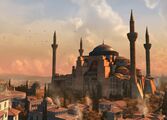 Hagia Sophia, a former basilica converted into a mosque
 -
 Notre-Dame, a famous cathedral in Paris
 -

-
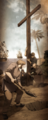 Ferdinand Magellan's expedition planting a Christian cross in Cebu


Appearances[edit | edit source]
- Assassin's Creed (first appearance)
- Assassin's Creed: Altaïr's Chronicles
- Assassin's Creed II
- Assassin's Creed II: Discovery (indirect mention only)
- Assassin's Creed: Project Legacy
- Assassin's Creed: Brotherhood
- Assassin's Creed: Revelations
- Assassin's Creed III
- Assassin's Creed IV: Black Flag
- Assassin's Creed: Pirates (mentioned only)
- Assassin's Creed: Memories (mentioned only)
- Assassin's Creed: Rogue
- Assassin's Creed: Unity
- Assassin's Creed: Syndicate
- Assassin's Creed Chronicles: Russia
- Assassin's Creed film
- Assassin's Creed: Rebellion
- Assassin's Creed: Odyssey
- Assassin's Creed: Valhalla
- The Way of the Berserker (mentioned only)
- Wrath of the Druids
- Discovery Tour: Viking Age
- Cike Xintiao: Chang'an Wang (as Jingjiao)
- Assassin's Creed: Forgotten Temple
- Assassin's Creed: Mirage
- Assassin's Creed: Mirage – A Soar of Eagles
- Assassin's Creed: Shadows
- Assassin's Creed: Shadows – Tales of Iga
- Animus Hub (mentioned in Database entry only)
