

Hagia Sophia: Difference between revisions
imported>The Forgotten Fragment No edit summary |
|||
| (42 intermediate revisions by 27 users not shown) | |||
| Line 1: | Line 1: | ||
{{Era| | {{Era|Landmarks}}{{WP-REAL}} | ||
{{WP-REAL | [[File:Hagia Sophia 001.jpg|thumb|250px|Hagia Sophia]] | ||
The '''Hagia Sophia''', otherwise known as the '''Sancta Sophia''' or the '''Church of Holy Wisdom''', is a former Eastern-Orthodox [[Christianity|Christian]] basilica located in the [[Imperial District]] of [[Constantinople]]. Following the [[Fall of Constantinople|fall]] of the city in 1453 to [[Ottoman Empire|Ottoman]] hands, it was converted into an [[Islam|Islamic]] mosque by [[Mehmet II]], where it was also used as a library. It currently is a museum. | |||
| | |||
| | |||
The '''Hagia Sophia''', otherwise known as the '''Sancta Sophia''' or the '''Church of Holy Wisdom''', | |||
==History== | ==History== | ||
Designed by the Byzantine [[Greece|Greek]] | ===Construction=== | ||
Designed by the [[Byzantine Empire|Byzantine]] [[Greece|Greek]] [[architect]]s {{Wiki|Isidore of Miletus}} and {{Wiki|Anthemius of Tralles}}, Hagia Sophia occupied the spot where two earlier churches were previously located in. It was completed by the order of the [[Roman Empire|Roman Emperor]] [[Justinian I]] in the year 537, when it began to serve as the imperial, patriarchal cathedral.<ref name="Database">''[[Assassin's Creed: Revelations]]'' – [[Database: Hagia Sophia]]</ref> | |||
===Ottoman conquest=== | |||
In 1453, after the fall of Constantinople to the Ottoman forces of Sultan Mehmet II, the Hagia Sophia was converted into an imperial mosque, and renamed "Ayasofya Camii".<ref name="Database" /> | |||
===16th century=== | |||
In the year 1510, the [[Janissary]] [[Murat Bin Husn]] concealed the [[armor of Ishak Pasha]] inside the Hagia Sophia.<ref>''[[Assassin's Creed: Revelations – Discover Your Legacy]]''</ref> The following year, [[Ezio Auditore da Firenze]] recovered [[Ishak Pasha]]'s scattered [[Ishak Pasha's memoir pages|memoirs]] and entered the mosque, where within minutes, he had climbed to the ceiling of the dome and activated an entrance to the armor's storage room, before taking the set back to the [[Galata headquarters]].<ref name="Hagia Sophia's Secret">''Assassin's Creed: Revelations'' – [[Hagia Sophia's Secret]]</ref> | |||
Around the same time, while looking for the second [[Masyaf Key]], Ezio climbed one of the Hagia Sophia's minarets, where he used his [[Eagle Vision#Eagle Sense|Eagle Sense]] to locate a [[Mission to Constantinople|book]] on one of the landmark's rooftops.<ref>''Assassin's Creed: Revelations'' – [[Signs and Symbols, Part I]]</ref> | |||
In 1511, [[Sofia Sartor]] requested some white tulips from Ezio, and after he tracked a florist to the Hagia Sophia, Ezio learned that he could find some of the flowers in the courtyard. Following this, he also discovered that Sofia had prepared a picnic in the shadow of the great mosque, before he handed the bouquet he had picked with his [[Hidden Blade]] over to her.<ref name="A Little Errand">''Assassin's Creed: Revelations'' – [[A Little Errand]]</ref> | |||
===Modern times=== | |||
In [[modern times]], the Hagia Sophia is officially no longer used for worship, but has instead been converted into a museum.<ref name="Database" /> | |||
==Trivia== | ==Trivia== | ||
*The [[ | *The [[assassin's Creed: Revelations achievements|achievement]] "'''Spider Assassin'''" could be earned by climbing the Hagia Sophia from its base to the pinnacle in under 25 seconds. | ||
*One of | *One of Ishak Pasha's memoir pages was located on the pinnacle of the landmark. | ||
*The Hagia Sophia was a purchasable landmark in Constantinople, for the price of 60,400 Akçe. | *The Hagia Sophia was a purchasable landmark in Constantinople, for the price of 60,400 [[Akçe]]. | ||
*In reality, Hagia Sophia only had two minarets in 1511. [[Darby McDevitt]] explained that the landmark's representation having four minarets "was the iconic image of the Hagia Sofia" and had to be in the game.<ref> | *In reality, Hagia Sophia only had two minarets in 1511. [[Darby McDevitt]] explained that the landmark's representation having four minarets "was the iconic image of the Hagia Sofia" and had to be in the game.<ref>{{Cite web|url=https://www.thenationalnews.com/arts-culture/assassin-s-creed-revelations-is-historically-impressive-1.444681|title=Assassin's Creed: Revelations is historically impressive|archiveurl=https://web.archive.org/web/20111117012449/http://www.thenational.ae/arts-culture/assassins-creed-revelations-is-historically-impressive|archivedate=17 November 2011|author=Ritman, Alex|date=13 November 2011|publisher=''{{Wiki|The National (Abu Dhabi)|The National}}''|accessdate=12 December 2011}}</ref> | ||
*The interior of the Hagia Sophia appeared much larger than the entire structure itself when standing outside the building. | *The interior of the Hagia Sophia appeared much larger than the entire structure itself when standing outside the building. | ||
==Gallery== | ==Gallery== | ||
<gallery captionalign="center" position="center | <gallery captionalign="center" position="center" widths="180"> | ||
ACR Hagia Sophia - Concept Art.png|Concept art of the Hagia Sophia | |||
800px- | 800px-Hagia Sophia.png|Comparison of the real landmark and its representation in ''Revelations'' | ||
ACR Hagia Sophia closeup.png|Close up of Hagia Sophia | ACR Hagia Sophia closeup.png|Close up of Hagia Sophia | ||
ACR Hagia Sophia Interior.png|Interior of the Hagia Sophia | |||
AC Atlas Hagia Sophia.jpg|Artwork from ''[[Assassin's Creed: Atlas]]'' | |||
</gallery> | </gallery> | ||
==Appearances== | |||
*''[[Assassin's Creed: Revelations]]'' {{1st}} | |||
*''[[Assassin's Creed: Revelations – Discover Your Legacy]]'' | |||
*''[[Assassin's Creed: Valhalla]]'' {{Mo}} | |||
*''[[Assassin's Creed: The Golden City]]'' {{Mo}} | |||
*''[[Echoes of History]] – Renaissance'' {{Mo}} | |||
*''[[Assassin's Creed: Mirage]] – [[Valley of Memory]]'' {{Mo|"Aya Sofiya"}} | |||
==References== | ==References== | ||
{{Reflist}} | {{Reflist}} | ||
{{ | {{ACDYL}} | ||
[ | <!--[fr:Basilique Sainte-Sophie]--> | ||
[ | <!-- | ||
[zh:圣索菲亚大教堂] | |||
--> | |||
[[Category:Churches]] | [[Category:Churches]] | ||
[[Category:Mosques]] | |||
[[Category:Landmarks in Constantinople]] | |||
[[Category:Assassin Tombs]] | |||
Latest revision as of 03:09, 14 May 2026

The Hagia Sophia, otherwise known as the Sancta Sophia or the Church of Holy Wisdom, is a former Eastern-Orthodox Christian basilica located in the Imperial District of Constantinople. Following the fall of the city in 1453 to Ottoman hands, it was converted into an Islamic mosque by Mehmet II, where it was also used as a library. It currently is a museum.
History[edit | edit source]
Construction[edit | edit source]
Designed by the Byzantine Greek architects Isidore of Miletus and Anthemius of Tralles, Hagia Sophia occupied the spot where two earlier churches were previously located in. It was completed by the order of the Roman Emperor Justinian I in the year 537, when it began to serve as the imperial, patriarchal cathedral.[1]
Ottoman conquest[edit | edit source]
In 1453, after the fall of Constantinople to the Ottoman forces of Sultan Mehmet II, the Hagia Sophia was converted into an imperial mosque, and renamed "Ayasofya Camii".[1]
16th century[edit | edit source]
In the year 1510, the Janissary Murat Bin Husn concealed the armor of Ishak Pasha inside the Hagia Sophia.[2] The following year, Ezio Auditore da Firenze recovered Ishak Pasha's scattered memoirs and entered the mosque, where within minutes, he had climbed to the ceiling of the dome and activated an entrance to the armor's storage room, before taking the set back to the Galata headquarters.[3]
Around the same time, while looking for the second Masyaf Key, Ezio climbed one of the Hagia Sophia's minarets, where he used his Eagle Sense to locate a book on one of the landmark's rooftops.[4]
In 1511, Sofia Sartor requested some white tulips from Ezio, and after he tracked a florist to the Hagia Sophia, Ezio learned that he could find some of the flowers in the courtyard. Following this, he also discovered that Sofia had prepared a picnic in the shadow of the great mosque, before he handed the bouquet he had picked with his Hidden Blade over to her.[5]
Modern times[edit | edit source]
In modern times, the Hagia Sophia is officially no longer used for worship, but has instead been converted into a museum.[1]
Trivia[edit | edit source]
- The achievement "Spider Assassin" could be earned by climbing the Hagia Sophia from its base to the pinnacle in under 25 seconds.
- One of Ishak Pasha's memoir pages was located on the pinnacle of the landmark.
- The Hagia Sophia was a purchasable landmark in Constantinople, for the price of 60,400 Akçe.
- In reality, Hagia Sophia only had two minarets in 1511. Darby McDevitt explained that the landmark's representation having four minarets "was the iconic image of the Hagia Sofia" and had to be in the game.[6]
- The interior of the Hagia Sophia appeared much larger than the entire structure itself when standing outside the building.
Gallery[edit | edit source]
-
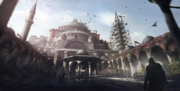 Concept art of the Hagia Sophia
 -
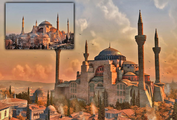 Comparison of the real landmark and its representation in Revelations
 -
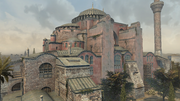 Close up of Hagia Sophia
 -
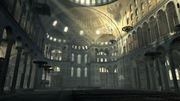 Interior of the Hagia Sophia
 -
 Artwork from Assassin's Creed: Atlas


Appearances[edit | edit source]
- Assassin's Creed: Revelations (first appearance)
- Assassin's Creed: Revelations – Discover Your Legacy
- Assassin's Creed: Valhalla (mentioned only)
- Assassin's Creed: The Golden City (mentioned only)
- Echoes of History – Renaissance (mentioned only)
- Assassin's Creed: Mirage – Valley of Memory (mentioned only, as "Aya Sofiya")
References[edit | edit source]
- ↑ 1.0 1.1 1.2 Assassin's Creed: Revelations – Database: Hagia Sophia
- ↑ Assassin's Creed: Revelations – Discover Your Legacy
- ↑ Assassin's Creed: Revelations – Hagia Sophia's Secret
- ↑ Assassin's Creed: Revelations – Signs and Symbols, Part I
- ↑ Assassin's Creed: Revelations – A Little Errand
- ↑ Ritman, Alex (13 November 2011). Assassin's Creed: Revelations is historically impressive. The National. Archived from the original on 17 November 2011. Retrieved on 12 December 2011.
| ||||||||||||||||||||||||||||