
Egyptian rebels

|
I wanted to ask you something. Which is... what's your name? This article title is conjecture. Although the article subject is canon, no official name for it has been given. |
Egyptian rebels opposed Pharaoh Ptolemy XIII's rule of Egypt during the Alexandrine war and the Roman Empire's subsequent conquest.
History[edit | edit source]
From 51 BCE, Ptolemy XIII and his older sister Cleopatra VII were co-rulers of the Ptolemaic Kingdom until Ptolemy expelled Cleopatra with the support of Order of the Ancients, becoming the Order's puppet in the process. With the pharaoh in their pockets, the Order gained vast control of Egypt. Meanwhile, Cleopatra roamed at large, contriving every means to oust her brother and be reinstated on the throne with the help of her supporters. [citation needed]
Egypt under the Order of the Ancients was characterized by widespread corruption, state terror, social inequalities, and extortion across the nomes. Discriminatory policies against native Egyptians by the ethnic Greek elite was also especially pronounced in Greek centres like Alexandria and Krokodilopolis.The nation was decaying into a failed state, and banditry was rife. Many everyday Egyptian peasants lived in fear of both the state police, in particular the Phylakitai, and the bandits in the countryside and were forced to band together for common protection. [citation needed] By 48 BCE, Egyptians across the country had risen in revolt against Ptolemy's rule, creating hidden bases such as Remetch Ra, a community nestled within a vast cave network in the Isolated Desert.[1] Covert resistance was also found among wealthy, urban Egyptian families like that of Khenut and Hotephres in Krokodilopolis. The latter was one of many informants who reported to Cleopatra's spy master Apollodorus. [citation needed]
Bayek's assistance[edit | edit source]
The last Medjay, Bayek of Siwa and his wife Aya were pivotal in turning the tide against Ptolemy. Both were pursuing vengeance against the Order of the Ancients for murdering their son Khemu in 49 BCE, but Aya readily lent her service to Cleopatra's cause, much to the apprehension of Bayek. After the two assassinated six members of the Order, Bayek met Cleopatra and agreed to officially become her Medjay since their interests seemed to align. Apollodorus had intel on other members of the Order across Egypt through his informants, and Cleopatra also wished to have them hunted down.[2]
Throughout his operation, Bayek met many common Egyptian people and assisted them with their crises to the best of his ability. This included directly involving himself with rebel guerilla fighters in the mountains. In Saqqara Nome, he rescued the rebel leader Theodoros from Ptolemy's soldiers and escorted him back to his comrades. Theodoros explained to Bayek that his goal was to avenge his father, who had been murdered by the Ptolemaic general Derratos. To help him, Bayek captured Darratos' scribe in Karanis for the rebels.[3] By interrogating him, the rebels learned that Derratos had made camp next to a beached trireme. Bayek and Theodoros then led a surprise attack on the camp and successfully slew the general.[4]
In Remetch Ra, two children of the rebel community, Istellah and Hetanu, went missing after going treasure hunting in the ruins of a temple dedicated to Alexander the Great. Two warriors, Sebni and Khamet, were dispatched to find them, but they were captured by Ptolemy's soldiers and imprisoned at Camp Hetoimazo. Bayek learned of the incident from Nawa, a teacher of the two children, and lent his support. After rescuing Sebni and Khamet at the Ptolemaic camp, he found Hetanu trapped in the temple and saved him, but Istellah had left to find help at the rebel camp in Theos Elpis Rift. There, she had been kidnapped during a raid by the Ptolemies because their commander, Medon, desired the shield of Alexander she had found. Bayek killed Medon in an ambush to seize back the shield, then rescued Istellah from the Ptolemaic base at Pissa Oros Citadel, delivering her safely at last to the rebel camp at Akros Peak.[1]
After the Roman occupation of Cyrenaica. a Roman soldier Titus, having grown tired of the oppression of the common people by his comrades, decided to deserted the Roman army and joined the rebels, His attempts was a failure however, Resulting in his imprisonment in the Apollonia barracks, Bayek later arrived at Apollonia and met Titus's mother Agatha, whom begged the Medjay to rescue her son. After Titus has been rescued, The boy revealed to Bayek that his former superior Marcellus Asina was planning an invasion of Egypt with a fleet of Roman ships, Bayek located the general and assassinated him, thus preventing the imminent invasion.[5]
Roman intervention[edit | edit source]
In 47 BCE, the Roman general Julius Caesar arrived in Alexandria in pursuit of his rival Pompey, who he had just decisively defeated at the Battle of Pharsalus. Ptolemy had had Pompey killed while the Roman general was seeking refuge in an ill-judged gesture to win Caesar's support. Instead, Caesar was appalled, and then their meeting was interrupted by Cleopatra, who had opportunistically snuck into Ptolemy's palace with the help of Aya, Bayek, and Apollodorus. With her charms, Cleopatra was able to elicit Caesar's support by offering him her marriage and co-rulership of Egypt. The alliance with Caesar granted Cleopatra external recognition as the rightful pharaoh over Ptolemy.[6] Defiant, Ptolemy besieged the palace and harbour with his troops,[6] but Caesar and Cleopatra's forces prevailed to defeat Ptolemy in the subsequent Battle of the Nile, where the boy pharaoh perished.[7]
The Alexandrine Civil War ended with Cleopatra's victory, but Egypt's status as a Roman puppet state was cemented. Roman rule only added an additional layer of ethnic oppression on top of the Greeks and Egyptians.[8][9] In Cyrenaica, Bayek observed how Greek customs were now being denigrated the same way the Greeks had frequently defiled sacred Egyptian religious traditions.[8][10] The rebellion against the Ptolemaic dynasty thus did not end with Ptolemy's death but spread to encompass Greeks defending their communities from abuses of power as well. [citation needed]
Equipment[edit | edit source]
Because many of the rebel fighters hailed from humble origins, most lacked even the most rudimentary of armour, wearing little more than leather waistbands and simple cloth garments. They armed themselves with swords, spears, and bows.
Gallery[edit | edit source]
-
 Rebels training outside Rematch Ra
 -
 A pair of rebels
 -
 A pair of rebels guarding an entrance
 -
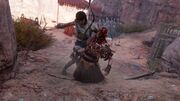 A rebel killing a Roman soldier


Behind the scenes[edit | edit source]
The Egyptian rebels feature in Assassin's Creed: Origins (2017) as an ally faction. They roam the rural areas of Egypt and skirmish with Ptolemaic soldiers and bandits, with or without the player's provocation. They may also be found as prisoners in enemy camps and forts. A portion of side-quests in the game revolve around assisting the rebels.
The rebels are never identified in either gameplay or story dialogue by any name other than "rebels". Although their insurgency is expressly aimed at Pharaoh Ptolemy XIII, neither their support for Cleopatra VII's bid for the throne nor their cohesion as a unified group is ever made clear. Grievances expressed by characters partaking in the rebellion are always aimed at social injustices and violence wrought against their local communities by the regime.
Appearances[edit | edit source]
References[edit | edit source]
- ↑ 1.0 1.1 Assassin's Creed: Origins – Plight of the Rebels
- ↑ Assassin's Creed: Origins – Egypt's Medjay
- ↑ Assassin's Creed: Origins – A Rebel Alliance
- ↑ Assassin's Creed: Origins – Rebel Strike
- ↑ Assassin's Creed: Origins - Dead in the Water
- ↑ 6.0 6.1 Assassin's Creed: Origins – Aya: Blade of the Goddess
- ↑ Assassin's Creed: Origins – The Battle of the Nile
- ↑ 8.0 8.1 Assassin's Creed: Origins – The Final Weighing
- ↑ Assassin's Creed: Origins – Absolute Power
- ↑ Assassin's Creed: Origins – Founding Father