


User:Alientraveller/Sandbox
- "We must indeed all hang together, or most assuredly we shall all hang separately."
- ―Benjamin Franklin at the signing of the Declaration of Independence.[src]
Benjamin Franklin (17 January 1706 – 17 April 1790) was one of the Founding Fathers of the United States, and a noted polymath; Franklin was a leading author, printer, political theorist, politician, postmaster, scientist, musician, inventor, satirist, civic activist, statesman, and diplomat.
Franklin became acquainted with Haytham Kenway when he arrived in North America. He only met Haytham's son Ratonhnhaké:ton once in the real world, but in an alternate reality created by an Apple of Eden, he was an essential ally in overthrowing King Washington.
Biography
Early life
Benjamin Franklin was born in Boston in 1706, the tenth son of a soap-maker. He began working as an apprentice printer for his brother in 1718, as an apprentice printer. However, their relationship was rocky, particularly after the elder Franklin found out that young Benjamin had been writing for the paper under a pseudonym - Silence Dogood - and writing an extremely popular column at that.
Benjamin ran away in 1723, and headed for Philadelphia, which became his primary residence for the rest of his life. He continued his career in printing and writing, eventually becoming the publisher of the Pennsylvania Gazette.
Franklin had a talent for persuasion, and that made him an ideal diplomat. In 1757 he went to London to represent Pennsylvania in an ongoing legal battle with the Penn family. It was the first of several extended political trips to Britain, and he would act as the state representative for Massachusetts, Georgia and New Jersey as well. In fact, Franklin was in Europe for most of the Revolution, though he was in the colonies to help with the writing of the Declaration of Independence.
Franklin was a vocal opponent of British impositions on the colonies (like the Stamp Act), and although he first fought for the rights of Colonists as British citizens he eventually became convinced (like many of the Founding Fathers) that independence was the only real solution. Unfortunately, Franklin's change of heart made him clash with his son, William - who served as the Royal Governor of New Jersey. William remained an active Loyalist - the father and son never spoke again.
Benjamin wandered around Boston near his store, and was surprised to find Haytham Kenway offer a lending hand, as those living in Boston usually refused to be of any help, and correctly assumed that Kenway was new to Boston. Franklin then requested that Haytham assist him with the task of finding stolen pages of his Almanac, as they had been scattered throughout Boston due to a robbery.
Later on, Haytham met Franklin at the local general store, where he proposed his idea that having an older woman as a lover would benefit lives, much to Haytham's amusement. They met again another time, where Franklin explained the isolation he felt after the Albany Conference and thanked for Haytham for speaking with him. His notion that the Colonies should be independent from the British Crown greatly intrigued Haytham.
American Revolution

On 4 July 1776, Franklin was present alongside Samuel Adams, John Hancock, and Adams' ally Ratonhnhaké:ton, where he signed the Declaration of Independence right after Hancock.
Inventions
Ratonhnhaké:ton had some of Franklin's inventions stored in a room at the Davenport Homestead.
Alternate timeline
After King Washington gained control over the area, he put Franklin in charge of running Boston. While under Washington's control, Franklin was still hesitant of the King's decisions, claiming one such order to behead random civilians to be "rather harsh." After being freed from Washington's control by Ratonhnhaké:ton, Franklin sought to help the rebellion take down King Washington.
Gallery
-
Concept art of Benjamin Franklin
-
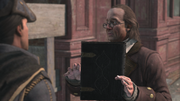 Benjamin meeting Haytham
 -
 Franklin speaking to Haytham Kenway and Charles Lee


Reference

Slavery is the subjugation of another person, to be bought and sold for forced labor. The First Civilization created humans to be their slaves, and the Assassins believe the Templars intend to return humanity to that state.
History

The First Civilization controlled humanity with the Pieces of Eden. However, interbreeding led to the birth of hybrids like Adam and Eve, who were immune to the power of these devices, causing the Human-First Civilization War.[1]
The ancient Egyptians enslaved the Israelites, but were liberated by the prophet Moses, who was armed with the Staff of Eden.[2]
Gladiators in the Roman Empire, like Anacletos, were typically slaves.[3]
The Templar Talal ran a slave ring in Jerusalem during the Third Crusade.[4]
Jenny Kenway, half-sister of the Templar Haytham Kenway, was kidnapped in 1735 and sold into sexual slavery in Topkapı Palace.
Eunuchs[7]

Europeans enslaved many Africans to work in their colonies in North America. In 1754, Silas Thatcher, an officer in the British Army, began enslaving members of the Kanien'kehá:ka Nation. Haytham and his band of Templar brothers freed the slaves and killed Silas.[8]
At the start of the American Revolutionary War, Lord Dunmore offered freedom to any slave who would join the British Army.[9]
Gallery
-
 One of Talal's slaves


References
| ||||||||||||||||||||||||||||||||||||||||
| ||||||||||||||||||||||||||||||||||
Moral ambiguity
- "What follows are the three great ironies of the Assassin Order: (1) Here we seek to promote peace, but murder is our means. (2) Here we seek to open the minds of men, but require obedience to a master and set of rules. (3) Here we seek to reveal the danger of blind faith, yet we are practitioners ourselves."
- ―Altaïr Ibn-La'Ahad's Codex[src]
Despite their relative benevolence to the majority of Templar activities, many Assassins expressed discomfort with their Order. When Desmond Miles was rescued by the Assassins, he assumed they were the "good guys", but Shaun Hastings advised him to "not get carried away", reminding him their function was to kill people. Rebecca Crane acknowledged "it's not ideal. And taking a life is never easy. But sometimes there's no other way. Sometimes, Desmond, people have to die for things to change."[1] Desmond's ancestor Connor tried to avoid killing William Johnson, and when he had to, he told his Mentor Achilles that "I thought it might bring clarity. Or instill a sense of accomplishment. But all I feel is regret." Achilles comforted him, explaining to "hold fast to that. Such sacrifices must never come lightly."[2]
Both Desmond and Lucy Stillman fell out with their leader William Miles: his cold demeanour and the harsh training he put them through since childhood led Desmond to regard his father as a "[prison] warden" rather than a father.[3] Lucy defected to the Templars after being sent to infiltrate them, telling Clay Kaczmarek that William was "using" them and claimed "he doesn't think about the lives he's hurting. We aren't people to him."[4]
Nikolai Orelov served the Order to please his father, with whom he had a negative relationship. When he left, he felt "I began as a crusader for change and now I am no better than a common grave-robber."[5] When the Assassins in the FBI began holding his family hostage to make him give up his secrets, he opined to his son Innokenti "These are not honourable men, Kenya. They are killers. They live by old laws which apply only to them and then call themselves heroes." However, Orelov was also brutal towards his son when training him to fight the Assassins. Viewing these events via his genetic memory, Orelov's great-grandson Daniel Cross deemed the Assassins "a family of wolves, opportunistic, savage. They'll turn on each other at a moment's notice: they're anarchists. And anarchy can never lead to a unified world."[6]
Connor expressed disdain for the Assassins' secrecy, an opinion shared centuries earlier by some Assassins under Altaïr's leadership, who disagreed with him taking the Order back underground. Altaïr wrote "They grow angry, insisting it is a mistake to shroud ourselves. They say it slows our work. But they do not understand the risks. To expose ourselves now would be too dangerous. I fear we would be branded madmen and attacked."[1]
The Assassins also allied with dubious figures such as members of the House of Medici or Vladimir Lenin, or would spare the likes of Tomas de Torquemada, simply because they were not Templars. Vali cel Tradat left the Assassins before the Templars because they did not try to stop the Ottoman Empire's conquest of his native Wallachia.[7]