-
 Havana skyline
 -
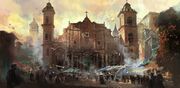
 A plaza in Havana
 -
-
 View of the Havana bay
 -
 An alleyway in Havana
 -
 An alcove in Havana
 -
 Various types of buildings
 -
 Various landmarks
Welcome to Assassin's Creed Wiki! Log in and join the community.


Havana
- "Havana was a low port surrounded by green forest and tall palm trees, their fronds a lush green that wafted gently in the breeze, waving us in as our schooner sailed into port. In the busy town, white-stone buildings with red-slate roofs looked dilapidated and weather-beaten, bleached by the sun and blasted by the wind."
- ―Edward Kenway describing Havana, 1715.[src]
Havana is the capital and commercial center of the island country of Cuba in the Caribbean.
History
Humble beginnings
After the island of Cuba was claimed by Christopher Columbus in the name of the King of Spain, Ferdinand II, colonists quickly flocked to the territory, attracted by its ideal location in the center of the West Indies. However, they were disappointed by the lack of gold, leading them to convert the island into a hub used for conquest and exploiting the wealth of the New World. Notably, Cuba served as Hernán Cortés' stronghold during the invasion of Mexico.[1]
In the early 1500s, several attempts were made to found a town near the Havana Bay, with a settlement eventually being established on the southern coast by the Spanish conquistador Diego Velázquez de Cuéllar.[2] However, the city was moved north in 1519 for strategic reasons, namely the narrow passageway of the bay which provided easy shelter for ships, with three different harbors constructed due to the island's large size.[1]
Sitting on a bay that opened to the Gulf Stream, Havana became a natural stopping point between Europe and the Americas. As the city grew around its trade port, Havana became a target for buccaneer and privateer attacks. In 1555, Havana was partially burnt to the ground by the French corsair Jacques de Sores, forcing the Spanish Crown to build fortifications.[1][2]
Key to the New World
Following a royal decree in 1561, all ships of the annual treasure fleet were required to meet up in Havana before they crossed the Atlantic Ocean. This boosted commerce and development of the city, with Havana supplying food and equipment for most of the Spanish fleet. It eventually became the richest and largest port in the West Indies,[1] making it a prime target for pirates, who hoped to rob the treasure fleet's ships of their riches.[2]
To ward off potential attackers, military forts such as the Castillo de San Salvador de la Punta and the Castillo Morro were constructed.[2] In 1634, Havana was officially designated the "Key to the New World and Rampart of the West Indies" by the Spanish Crown.[1]
During the early 1700s, the Templar Grand Master Laureano de Torres y Ayala served as governor, and orchestrated Templar involvement in the Caribbean from his mansion within the city. At the same time, the Assassin Order maintained a presence in Havana, running an Assassin bureau headed by Rhona Dinsmore.[2]
During the 18th century, the de Grandpré business sent ships to Havana to import and export goods.[3]
Later developments
Modern times
In 2013, it was used as a simulated location created by Abstergo Industries' entertainment branch, for the console stage of their Animus technology.[2]
Trivia
- Havana is the only city in Assassin's Creed IV: Black Flag in which no animals can be hunted.
- Several in-game sources refer to Havana's "Poor District", despite cities in Black Flag not being divided into districts.
- Furthermore, district specification of "Poor", "Middle", and "Rich" is identical to the one seen in Assassin's Creed.
Gallery


-
 In-game map of Havana
 -
 Edward Kenway on a viewpoint in Havana
 -
 The Cathedral of Havana
 -
 Stede Bonnet and Edward at the port of Havana


References