


Masyaf

|
"Information learned is more valuable than information given" This article is currently being reworked by Nostalgia AC as part of their apprenticeship. We ask that edits to this article are only minor or grammatical in nature until this warning is removed in order to not disrupt the major revamp. Should you have any questions regarding the revamp, please contact the apprentice at work's Mentor. |

|
He who increaseth knowledge, increaseth sorrow. This article contains spoilers, meaning it has information and facts concerning recent or upcoming releases from the Assassin's Creed series. If you do not want to know about these events, it is recommended to read on with caution, or not at all. |

|
Ezio, my friend! How may I be of service? This article is in desperate need of a revamp. Please improve it in any way necessary in order for it to achieve a higher standard of quality in accordance with our Manual of Style. |
- "An imposing castle of many turrets, surrounded by shimmering rivers, it presided over the bustling village below, the settlement a high point within the Orontes Valley. An oasis of peace. A paradise."
- ―Niccolò Polo describes Masyaf.[src]
Masyaf is an isolated mountain municipality located in Syria, which once served as a base of operations for the Assassin Order during the era of the Third Crusade. During the early 16th century, however, it was captured by Byzantine Templars.
Within the fortress walls, the Assassin apprentices underwent mental and physical training in preparation for the trials they were to endure in the name of their Brotherhood.
History
Third Crusade
Masyaf acted as the headquarters for the Syrian sect of the Assassin Order after the destruction of their original base at Alamut. In 1176, the fortress came under siege from Saladin, who hoped to prevent the Assassins from making a third, more successful attempt on his life. On the second night of the siege, Umar Ibn-La'Ahad infiltrated the Sultan's tent, leaving a knife in Saladin's sleeping pallet; however, he was forced to kill a Saracen nobleman during his escape once Saladin awoke and raised the alarm.[1]
Heeding the warning, Saladin left Masyaf, his only condition being that he was brought the head of the one who had killed the nobleman. At first the Assassins refused, however, Saladin's advisor threatened the life of the Assassin's spy they had captured, Ahmad Sofian. Umar then volunteered to forfeit his life in exchange for Ahmad's. Afterwards, the siege concluded and the Saracens left.[1]
In 1189, Masyaf was attacked by Templar Crusaders after a Templar agent infiltrated the ranks of the Brotherhood. The fortress was captured by the Templar Crusaders while the Mentor of the Syrian Assassins, Al Mualim, was held hostage, and a battle between the two forces raged on in the village. However, through the efforts of the young Assassin, Altaïr Ibn-La'Ahad, the fortress was retaken, and Al Mualim was saved. With the fortress now recaptured, the Assassins were able to drive the Templars from Masyaf.[2]

By 1191, during the height of the Third Crusade, Masyaf remained unscathed by the war ravaging the Holy Land. Neither the Crusaders nor the Saracens were directly associated with the Order, although each force was aware of their existence. In 1191, after Al Mualim came into possession of an Apple of Eden, and the Templars, then led by Robert de Sable, attacked Masyaf in an attempt to regain the Apple. However, the Assassins sprang a trap, utilizing stored timber to eradicate the Templar forces. With much of his force killed in the trap, Robert retreated from the town.[3]
Later that same year, in September of 1191, Al Mualim used the Apple to enslave the population of Masyaf. He was able to entrance the citizens so that they were under his command. However, Altaïr Ibn-La'Ahad was able to thwart his former Mentor's plan, assassinating Al Mualim. With the death of the corrupted Mentor, the Assassins and their people back to their original state of mind.[3]
Shortly following this however, many Assassins refused to accept Al Mualim's betray and rebelled again Altaïr. His fellow Assassin and longtime rival, Abbas Sofian, threw Altaïr from a cliff, and recovered the Apple in one of the fortress' towers. However, Abbas became overwhelmed with the power of the Apple, and surrendered to Altaïr.[1][3]
Sometime before 1227, Abbas staged a coup d'état and was able to gain control of the Order. Losing control of the Assassins in Syria, Altaïr fled the city, and entered a self-imposed exile. During Abbas' twenty year reign, Masyaf went through large amounts of change; the members of the Order no longer trained daily and the overall discipline was lost within the Order. Taxes were collected from the people, but nothing was provided in return.[1]
However, two decades later in 1247, Altaïr returned to Masyaf, with the intention of gathering allies and eliminating Abbas. He was able to recruit four Assassins whom also disliked Abbas, and had been standing guard at the city gate. Armed with his new allies, Altaïr moved through the city, eliminating the Assassin Captains and eventually reaching the fortress. There, Altaïr had a brief argument with Abbas over the Apple Altaïr had maintained, which resulted in Altaïr shooting and killing Abbas with his hidden gun.[2]
Ten years later, in 1257, the fortress was visited by Niccolò and Maffeo Polo, who were guests of the Order, invited by Altaïr's eldest son, Darim Ibn-La'Ahad. The two men had been chosen to spread the Creed of the Assassins in their homeland, where Altaïr had failed to do so. However, during the six month stay of the Polos', Masyaf was besieged by Mongolians seeking revenge for the Assassins' role in Genghis Khan's death.[1]
Though limited in number after the disbandment of the Order, the remaining Assassins kept the Mongols at bay long enough for the Polo brothers to escape through an escort from Altaïr and Darim. Before the Polo brothers left, however, Altaïr gave Niccolò his personal journel, five keys imbued with a message, and many of his library books.[2]
Immediately following the siege, Altaïr ordered that the remainder of the Order should be spread throughout the world, effectively ending the reign of the Assassins in Masyaf. He bid farewell to his son Darim, and locked himself inside his library with the Apple, leaving the artifact for posterity and perishing peacefully on his throne.[2]
Renaissance

More than two and a half centuries after the fortress was abandoned, a battalion of Byzantine Templars had taken control of Masyaf. The Byzantines patrolled throughout the city and fortress, while a worker attempted to break open the door to Altaïr's library. A Templar captain named Leandros oversaw the Byzantine forces, and ensured that the city remained in their control.[2]
In March of 1511, the Mentor of the Italian Assassins, Ezio Auditore, traveled to the mountain castle in order to learn more about his Order's history, and to discover the contents of Altaïr's library. This quest came about after Ezio discovered a letter from his father concerning a library hidden beneath the Masyaf fortress containing invaluable wisdom.[2]
Upon arrival, however, Ezio was attacked by a large group of Byzantine forces, and was eventually captured after becoming distracted by a vision of Altaïr. Ezio was dragged to a beam on one of the fortress' towers, and Leandros placed and tightened a noose around the Assassin's neck. However, Ezio was able to overpower Leandros, and threw the noose over his neck, before jumping down from the beam, successfully escaping.[2]
Ezio then made his way around Masyaf, eventually learning of Niccolò Polo's journal, an object the Templars possessed. After leaving the fortress, Ezio tailed a Templar Captain through the village, eventually arriving at the city gates. Ezio spotted Leandros in his carriage, and began to pursue to Templar, eventually being forced to cling to a rope hanging from Leandros' carriage.[2]
Ezio managed to cling to the rope for a while, before killing a Byzantine and taking a carriage of his own. Ezio tailed Leandros, eventually arriving at ato a nearby village. However, one of Leandros' men threw a bomb at Ezio, sending him into the canyon below.[2]
The Assassin recovered from his wounds, however, and stealthily assassinated Byzantine arquebusiers, and made his way into the village. There, Leandros taunted Ezio, before retreating farther into the village, ordering his men to kill the Assassin. Ezio overpowered the Byzantines, eventually cornering Leandros in a small section of the village, closing the gate behind him.[2]
The Byzantines attacked Ezio, but were overpowered by the Assassin. After slaying them, Ezio obtained some medicine, and used it to heal his severe wounds. He then made his way up the tall structure Leandros was on top of. Eventually reaching the base, Ezio cornered Leandros, and stabbed the Templar with his hidden blade.[2]
In his final words, Leandros gave Ezio the journal of Niccolò Polo, but informed him that the Templars had already located one of the keys to Altaïr's library, and were closing in on the rest. Before perishing, Leandros also spoke cryptically of a Grand Temple, passing away before he was able to tell Ezio more about the subject. Armed with Niccolò Polo's journal, and knowledge of the Masyaf Keys, Ezio departed from Masyaf.[2]
Layout
Masyaf was built into a mountaintop nestled over the Orontes Valley, with a village at its base and the walled fortress at the peak. The base was protected by a palisade wall and several Assassin guards that patrolled both inside and outside of Masyaf. The sides of the site were protected by immensely high and sheer mountain walls, with a low lake below that may be seen from the entire left-hand side of the fortress and village. A second mountaineous valley and river may be seen on the opposite side of the fortress, but not from the village. Over the second valley on the right-hand side of Masyaf lies a series of wooden beams with ropes overhanging them, criss-crossing until they reach the back of a high tower that appears impossible to scale from the front.[3]
The village
The village was composed of several dozen small mudbrick cottages at the far end of the small Masyaf valley and several were built into the very edge of the left-hand side canyon. The village market was designated at the lowest end of the valley, a location in which the local people could barter for belongings and food or simply converse each day. Masyaf appeared to offer sanctuary to citizens loyal to the Assassins' cause. A second, smaller marketplace was located just below the fortress' long, winding entrance.[3]
The Fortress
{C
At the peak of the mountain lay the Assassin fortress. Within the high stone walls, Assassins practiced combat in the training ring, patrolled the walls and grounds or educated themselves amongst the libraries of the Master. A beautiful garden was situated behind the intimidatingly tough face of the central stone rooms in which women happily lay about in leisure, grass and thriving plants all about the four-levelled space.[3]
Inside the fortress library, one may witness the scholarly habits of Assassin acolytes, wherein several individuals constantly maneuvered the shelves. These people were seeking books to further their education on worldly politics, including the Assassin's creed. Al Mualim himself delved into these books on a daily basis, constantly seeking knowledge to properly guide and educate the fearsome political warriors that faithfully served under him.[3]
The fortress housed all Assassins that resided within Masyaf, as well as the Master's private chamber on the very top of the fortress's highest tower. Watchtowers surrounded the walls, each with expert archers that watched the nearby valleys and central village for approaching danger.[3]
Canyon Walkway and Trap Tower
On the southern side of Masyaf, an Assassin may take a Leap of Faith into haystacks arranged along a wide stone platform that juts out from the mountain wall. From these haystacks, several wooden beams criss-cross the void over the river far below. Ropes were also strung over the wooden beams to aid with crossing the dangerous pathways. At the end of the twisting path over the valley floor, a very high tower reaches into the sky, perfectly blended with the stone mountain wall. An Assassin could have climbed this tower, eventually finding themselves in a room with a grated floor. Piles of logs were kept in here in case of invasion, upon which an Assassin would activate the trap by slashing a latch with their sword and sending the logs into the main force of the enemy's army.
Trivia
- The Assassin's Fortress in Masyaf is very similar to Alamut Castle in Iran.
- Masyaf is the first location that is encountered during the game after Solomon's Temple, and is also the smallest location outside the Kingdom.
- There are no harassers of any sort in Masyaf (i.e. beggars, jar carriers, and guards blocking access).
- Outside of Masyaf, there is a small part of the Kingdom controlled by the Assassins, where one can use Eagle Vision to locate an Assassin guard marked as an enemy.
- During the siege of Masyaf, and during the small cut-scene before the first Leap of Faith, you can see Assassins keeping watch over the lake below.
- Although considered your allies (and indicated to be as such by eagle vision), guards in the city will fight you if provoked.
- Despite the Third Tenet stating that you must not, indirectly or otherwise, harm your fellow Assassins, you can kill Masyaf guards with no synchronization penalty, and no mention is made by anyone.
- The gardens behind the fortress (accessible after Tamir's assassination) are a reference to the legend of the secret Paradise behind the real Assassins' headquarters. The garden Paradise was supposedly an illusion created by Hassan-i Sabbah - the real Assassins' founder - in order to make his followers believe in his divine mission, and execute any order given (usually assassination attempts) without fear of death.
- Masyaf guards sound exactly like the Saracen guards of Jerusalem or Damascus, even going so far as to use the same lines in combat such as "Infidel, die!" or "I'll have your head!". The same goes for the two novices fighting in the training arena.
- Even though you are not supposed to use weapons inside the fortress (except the training area), you may push guards off of the tower and watch them die from the fall, without suffering a loss of synchronization.
- Masyaf is the only Assassin headquarters in the Assassin's Creed series so far to have guards.
- The Assassins' main headquarters during the Crusades and until the strike of the Mongol Empire was the Alamut fortress in Iran, but there are references to another headquarter in Syria.
- Masyaf in Arabic (مصيف) translates to "summer resort" or "summer residence."
- If you enter Masyaf's castle during the first sequence in Revelations, you are able to interact with several objects inside, which will then show some of the things Altaïr did which are later seen in his memories stored on the Masyaf keys.
Gallery
-
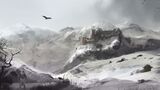 Concept art of Masyaf.
 -
Concept art of the city walls.
-
 Concept art of Assassins in Masyaf.
 -
Concept art of the city walls.
-
 Map of Masyaf.
 -
 Masyaf, Panoramic.
 -
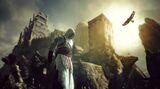 Altaïr at Masyaf.
 -
 Panoramic view of Masyaf's interior.
 -
 Panoramic view of lands around Masyaf.
 -
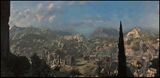 Masyaf village.
 -
 Masyaf during the attack in 1191.
 -
 Altair returning to Masyaf Fortress, after failing his mission.
 -
Masyaf Fortress.
-
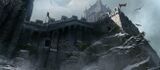 Another concept for the fortress.
 -
 Ezio leaving Masyaf.


See also
Appearances
- Assassin's Creed
- Assassin's Creed II (mentioned only)
- Assassin's Creed: Revelations
References
| ||||||||||||||||||||||||||||
| ||||||||||||||||||||||||||||
| |||||||||||||||||||||||||||||||||||||