

Standing stone: Difference between revisions
imported>Darman36 Not a stub, but could use more info |
imported>Darman36 No edit summary |
||
| Line 4: | Line 4: | ||
{{Expand}} | {{Expand}} | ||
[[File:ACV Stonehenge.png|thumb|250px|Stonehenge, one of the most famous standing stones in the world]] | [[File:ACV Stonehenge.png|thumb|250px|Stonehenge, one of the most famous standing stones in the world]] | ||
A '''standing stone''' is a large man-made upright stone dating from the {{Wiki|Bronze Age}}, which typically can be found solely as {{Wiki| | A '''standing stone''' is a large man-made upright stone dating from the {{Wiki|Bronze Age}}, which typically can be found solely as {{Wiki|monolith}}s, or as part of a group of similar stones. | ||
==History== | ==History== | ||
| Line 37: | Line 37: | ||
*''[[Assassin's Creed: Origins]]'' {{1st}} | *''[[Assassin's Creed: Origins]]'' {{1st}} | ||
*''[[Assassin's Creed: Valhalla]]'' | *''[[Assassin's Creed: Valhalla]]'' | ||
**''[[The Siege of Paris]]'' | |||
==References== | ==References== | ||
Revision as of 01:27, 12 August 2021

|
Where are the paintings? This article is in need of more images and/or better quality pictures from official media in order to achieve a higher status. You can help the Assassin's Creed Wiki by uploading better images on this page. |

|
Ezio, my friend! How may I be of service? This article has a lot of room for expansion. Please improve it with additional information in accordance with the Manual of Style |

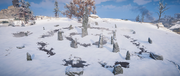
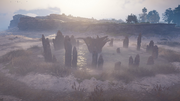
A standing stone is a large man-made upright stone dating from the Bronze Age, which typically can be found solely as monoliths, or as part of a group of similar stones.
History
In the 1st century BCE, the Medjay Bayek of Siwa would often visit various stone circles throughout Egypt with his son Khemu.[1]
During the 6th century, the Irish Celtic monk Brendan of Clonfert encountered numerous standing stones in England and later Vinland, which had been engraved with mysterious symbols inscribed with an ancient script. He would make writings documenting findings, leaving them behind in each location. Three centuries later, the Viking Eivor Varinsdottir visited these locations, finding the monk's documentations.[2]
Known standing stones
- Aescforda Stones in Nottinghamshire
- Aveberie Megaliths in Hampshire
- Cosintun in Leicestershire
- Devil's Quoits in Gloucestershire
- Lord and Lady in Cambridgeshire
- Eorthburg Hlaw in Nottinghamshire
- Medeuuage Megaliths in Kent
- Mycel Fold in Shropshire
- Rodestan Monolith in Yorkshire
- Rollendritch in Gloucestershire
- Seahenge in East Anglia
- Stonehenge in Hampshire
- Tionontaté:ken in Vinland
Gallery
-
 Concept art
 -
 Concept art
 -
-


Appearances
- Assassin's Creed: Origins (first appearance)
- Assassin's Creed: Valhalla
References