


Freerunning: Difference between revisions
imported>GuardDog |
imported>GuardDog m correcting |
||
| Line 7: | Line 7: | ||
This particular form of movement was utilized primarily by members of the [[Assassins|Assassin Order]], and was a vital asset both during and after assassinations. Over time, Assassins would also use a series of tools to supplement their climbing and freerunning abilities. | This particular form of movement was utilized primarily by members of the [[Assassins|Assassin Order]], and was a vital asset both during and after assassinations. Over time, Assassins would also use a series of tools to supplement their climbing and freerunning abilities. | ||
Additionally, freerunning was integrated into the [[Animi Training Program]], in order for [[Abstergo recruits]] to mimic the skills learned predominantly by Assassins in history. | |||
==Vertical movement== | ==Vertical movement== | ||
| Line 19: | Line 19: | ||
*'''Climb leap''' was a vertical jump while holding onto a vertical surface, which allowed one to grab potentially out-of-reach handholds.<ref name="AC2">''[[Assassin's Creed II]]''</ref> | *'''Climb leap''' was a vertical jump while holding onto a vertical surface, which allowed one to grab potentially out-of-reach handholds.<ref name="AC2">''[[Assassin's Creed II]]''</ref> | ||
*'''Beam jump''' was performed from [[Horses|horseback]], and allowed one to use the horse's momentum to leap from the saddle, grab a beam, and swing around to land onto it.<ref name="Brotherhood">''[[Assassin's Creed: Brotherhood]]''</ref> | *'''Beam jump''' was performed from [[Horses|horseback]], and allowed one to use the horse's momentum to leap from the saddle, grab a beam, and swing around to land onto it.<ref name="Brotherhood">''[[Assassin's Creed: Brotherhood]]''</ref> | ||
*'''[[Leap of Faith]]''' was performed only by trained Assassins and Abstergo recruits, which involved leaping from a significant height, onto a cushioned material.<ref name="AC"/> | *'''[[Leap of Faith]]''' was performed only by trained Assassins and Abstergo recruits, which involved leaping from a significant height, onto a cushioned material.<ref name="AC"/> | ||
| Line 29: | Line 28: | ||
[[File:Altair free-run.jpg|thumb|250px|[[Altaïr Ibn-La'Ahad]] performing a gap jump.]] | [[File:Altair free-run.jpg|thumb|250px|[[Altaïr Ibn-La'Ahad]] performing a gap jump.]] | ||
*'''Break fall''' was a forward roll where the hands, arms, and diagonal of the back made contact with the ground.<ref name="AC"/> | *'''Break fall''' was a forward roll where the hands, arms, and diagonal of the back made contact with the ground.<ref name="AC"/> | ||
*'''Arm jump''' was to land on the side of an obstacle in a hanging position, hands gripping the top edge | *'''Arm jump''' was to land on the side of an obstacle in a hanging position, hands gripping the top edge and holding the body in place.<ref name="AC"/> | ||
*'''Back eject''' was to jump backwards from a hanging position onto an opposite structure.<ref name="AC2"/> | *'''Back eject''' was to jump backwards from a hanging position onto an opposite structure.<ref name="AC2"/> | ||
*'''Gap jump''' was performed similarly to a long jump, except over an open expanse between two relatively level areas.<ref name="AC"/> | *'''Gap jump''' was performed similarly to a long jump, except over an open expanse between two relatively level areas.<ref name="AC"/> | ||
*'''Precision jump''' was a moving jump from one object to a | *'''Precision jump''' was a moving jump from one object to a specific spot on another object, usually with a small surface.<ref name="AC"/> | ||
*'''Dive''' was only used with merchant stalls, where one dove hands-first through an open stall and used a roll to get back up quickly.<ref name="AC"/> | |||
*'''Spring jump''' could only be done using a springboard, such as those in the [[Oltrarno District]] of [[Florence]]. It allowed one to jump forward twice as far, through the external force of the device.<ref name="AC2 - Bonfire">''Assassin's Creed II'' - ''[[Bonfire of the Vanities (DLC)]]''</ref> | *'''Spring jump''' could only be done using a springboard, such as those in the [[Oltrarno District]] of [[Florence]]. It allowed one to jump forward twice as far, through the external force of the device.<ref name="AC2 - Bonfire">''Assassin's Creed II'' - ''[[Bonfire of the Vanities (DLC)]]''</ref> | ||
*'''Corner swing''' was when one would sharply turn a corner, by jumping forward and grabbing onto a lantern or pot mounted on a building's corner, before using one's momentum to swing on it.<ref name="Brotherhood"/> | |||
*'''Vault''' was to use one's own momentum to slide over or under obstacles.<ref name="AC3">''[[Assassin's Creed III]]''</ref> | *'''Vault''' was to use one's own momentum to slide over or under obstacles.<ref name="AC3">''[[Assassin's Creed III]]''</ref> | ||
==Tools== | ==Tools== | ||
| Line 50: | Line 50: | ||
*Though referred to as "freerunning" throughout the [[Assassin's Creed (series)|''Assassin's Creed'' series]], the Assassins' focus on speed and efficiency, rather than creativity, more closely resembled standard {{Wiki|Parkour}}. | *Though referred to as "freerunning" throughout the [[Assassin's Creed (series)|''Assassin's Creed'' series]], the Assassins' focus on speed and efficiency, rather than creativity, more closely resembled standard {{Wiki|Parkour}}. | ||
*There was a [[Bugs|bug]] present in most installments of the series, where [[civilians]] in certain areas or circumstances were able to perform freerunning movements. | *There was a [[Bugs|bug]] present in most installments of the series, where [[civilians]] in certain areas or circumstances were able to perform freerunning movements. | ||
*Other than the Assassins, several factions were also known to be adept freerunners | *Other than the Assassins, several factions were also known to be adept freerunners; including [[Agile guards]], [[Thieves]], [[Borgia Messengers]], [[Papal Guard]]s, [[Followers of Romulus]], and [[Janissaries]]. | ||
*Freerunning puzzles have become a mainstay in the series since ''[[Assassin's Creed II]]'', coming in the form of [[Assassin Tombs]], [[Secret Locations|Templar Lairs]], [[Lairs of Romulus]], and [[Memory Seals|Memory Seal locations]]. | *Freerunning puzzles have become a mainstay in the series since ''[[Assassin's Creed II]]'', coming in the form of [[Assassin Tombs]], [[Secret Locations|Templar Lairs]], [[Lairs of Romulus]], and [[Memory Seals|Memory Seal locations]]. | ||
Revision as of 07:24, 25 August 2012

Freerunning is a form of acrobatics, in which participants navigate through a landscape by performing fluid movements over and across urban or natural structures.
This particular form of movement was utilized primarily by members of the Assassin Order, and was a vital asset both during and after assassinations. Over time, Assassins would also use a series of tools to supplement their climbing and freerunning abilities.
Additionally, freerunning was integrated into the Animi Training Program, in order for Abstergo recruits to mimic the skills learned predominantly by Assassins in history.
Vertical movement
In general, vertical movements involved climbing or scaling structures that provided adequate handholds, or a texture rough enough to grip. Inversely, they also allowed one to safely drop down from a height.
- Wallpass was the act of climbing a tall wall by kicking its surface once to propel upwards.[1]
- Climb-up was the movement of climbing up onto an obstacle from a hanging position.[1]

- Drop was the act of dropping from a hanging position or bar.[1]
- Long jump was a jump from a high height, and was usually followed by a break fall.[1]
- Climb leap was a vertical jump while holding onto a vertical surface, which allowed one to grab potentially out-of-reach handholds.[2]
- Beam jump was performed from horseback, and allowed one to use the horse's momentum to leap from the saddle, grab a beam, and swing around to land onto it.[3]
- Leap of Faith was performed only by trained Assassins and Abstergo recruits, which involved leaping from a significant height, onto a cushioned material.[1]
Horizontal movement
Horizontal movements generally involved moving over large distances, or methods that allowed one to clear obstacles, such as gaps or breaks.
- Swing was a movement in which one swung onto a bar and let go, enabling one to grab another object or drop to the ground.[1]
- Pass involved quickly and smoothly passing over medium sized obstacles.[1]

- Break fall was a forward roll where the hands, arms, and diagonal of the back made contact with the ground.[1]
- Arm jump was to land on the side of an obstacle in a hanging position, hands gripping the top edge and holding the body in place.[1]
- Back eject was to jump backwards from a hanging position onto an opposite structure.[2]
- Gap jump was performed similarly to a long jump, except over an open expanse between two relatively level areas.[1]
- Precision jump was a moving jump from one object to a specific spot on another object, usually with a small surface.[1]
- Dive was only used with merchant stalls, where one dove hands-first through an open stall and used a roll to get back up quickly.[1]
- Spring jump could only be done using a springboard, such as those in the Oltrarno District of Florence. It allowed one to jump forward twice as far, through the external force of the device.[4]
- Corner swing was when one would sharply turn a corner, by jumping forward and grabbing onto a lantern or pot mounted on a building's corner, before using one's momentum to swing on it.[3]
- Vault was to use one's own momentum to slide over or under obstacles.[5]
Tools
- "When he tires of running, an Assassin must take to the air."
- ―Yusuf Tazim commenting on the zipline.[src]
As they used freerunning for travel and escape, Assassins (or their allies) developed tools that would improve their abilities. Among these were the Climb Leap Glove manufactured by Leonardo da Vinci,[3] and the Hookblade, which was used by the Assassins of the Turkish branch.[6]
Though the climb leap technique could also be performed unaided,[2] the Climb Leap Glove improved the strength of one's grip and allowed older or less experienced individuals to perform the technique.[3]
The Hookblade aided in both vertical and horizontal movement. When used with ziplines posted on Constantinople's rooftops, the Hookblade allowed one to travel great diagonal distances much quicker than running or climbing normally. The device also extended one's reach upwards during a climb leap, or forwards during an arm jump.[6]
Trivia
- Though referred to as "freerunning" throughout the Assassin's Creed series, the Assassins' focus on speed and efficiency, rather than creativity, more closely resembled standard Parkour.
- There was a bug present in most installments of the series, where civilians in certain areas or circumstances were able to perform freerunning movements.
- Other than the Assassins, several factions were also known to be adept freerunners; including Agile guards, Thieves, Borgia Messengers, Papal Guards, Followers of Romulus, and Janissaries.
- Freerunning puzzles have become a mainstay in the series since Assassin's Creed II, coming in the form of Assassin Tombs, Templar Lairs, Lairs of Romulus, and Memory Seal locations.
Gallery
-
Ezio climbing up a church.
-
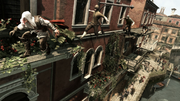 Ezio and several thieves swinging from a bar.
 -
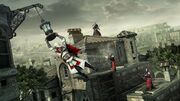 Ezio performing a corner swing.
 -
 Connor Kenway swinging on a tree branch.
 -
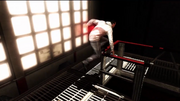 Desmond Miles performing a precision jump.

.jpg)


References
- ↑ 1.00 1.01 1.02 1.03 1.04 1.05 1.06 1.07 1.08 1.09 1.10 1.11 Assassin's Creed
- ↑ 2.0 2.1 2.2 Assassin's Creed II
- ↑ 3.0 3.1 3.2 3.3 Assassin's Creed: Brotherhood
- ↑ Assassin's Creed II - Bonfire of the Vanities (DLC)
- ↑ Assassin's Creed III
- ↑ 6.0 6.1 Assassin's Creed: Revelations
- Gameplay
- Assassin's Creed Gameplay
- Assassin's Creed II Gameplay
- Assassin's Creed: Brotherhood Gameplay
- Assassin's Creed: Altaïr's Chronicles Gameplay
- Assassin's Creed II: Discovery Gameplay
- Assassin's Creed: Revelations Gameplay
- Assassin's Creed: Bloodlines Gameplay
- Assassin's Creed III Gameplay
- Assassin's Creed III: Liberation Gameplay