

Charles the Fat: Difference between revisions
imported>Lacrossedeamon Alright this shit needs to stop, so here's a new start. I'd like nstav to take a look at this as he has more familiarity with non neurotypicals. |
imported>Darman36 Some more sources |
||
| Line 2: | Line 2: | ||
{{Spoilerhd|10 November 2021}} | {{Spoilerhd|10 November 2021}} | ||
{{Update|''[[The Siege of Paris]]''}} | {{Update|''[[The Siege of Paris]]''}} | ||
{{Quote|I am a king. You are a godless invader. Who are you to parley with me?|Charles the Fat to Eivor Varinsdottir.|Assassin's Creed: Valhalla|Majesty in the Dark}} | {{Quote|I am a king. You are a godless invader. Who are you to parley with me?|Charles the Fat to Eivor Varinsdottir, 866.|Assassin's Creed: Valhalla|Majesty in the Dark}} | ||
{{Character Infobox | {{Character Infobox | ||
|name = Charles the Fat | |name = Charles the Fat | ||
| Line 14: | Line 14: | ||
|affiliates = {{Wiki|Carolingian dynasty}} | |affiliates = {{Wiki|Carolingian dynasty}} | ||
}} | }} | ||
'''Charles III''' (839 – 888), also known as '''Charles the Fat''' or the '''Mad King''', was the great-grandson of [[Charlemagne]]<ref name="Database">''[[Assassin's Creed: Valhalla]]'' – [[Database: Charles the Fat]]</ref> and the last emperor of the {{Wiki|Carolingian Empire}} to rule over the Kingdom of [[Francia|West Francia]]. | '''Charles III''' (839 – 888), also known as '''Charles the Fat''' or the '''Mad King''', was the great-grandson of [[Charlemagne]]<ref name="Database">''[[Assassin's Creed: Valhalla]]'' – [[Database: Charles the Fat]]</ref> and the last emperor of the {{Wiki|Carolingian Empire}} to rule over the Kingdom of [[Francia|West Francia]]. In the last few years of his reign alongside his wife [[Richardis]], [[Paris]] was subjected to a [[Vikings|Viking]] [[Siege of Paris (885–886)|siege]] that led to his downfall<ref>''[[Assassin's Creed: Valhalla]] – [[The Siege of Paris]]''</ref> and eventual deposition.<ref name="Wiki">{{WP|Charles the Fat}}</ref> | ||
In the last few years of his reign alongside his wife [[Richardis]], [[Paris]] was subjected to a [[Vikings|Viking]] [[Siege of Paris (885–886)|siege]] that led to his downfall<ref>''[[Assassin's Creed: Valhalla]] – [[The Siege of Paris]]''</ref> and eventual deposition.<ref name="Wiki">{{WP|Charles the Fat}}</ref> | |||
==Biography== | ==Biography== | ||
During his youth, Charles was haunted by "demons" and as a result was subjected to a purification ritual involving fire. While Charles feigned to be cleansed of all demons and became a pious man, he developed a crippling fear of fire due to the experience. Charles remained a kind and pious man well into adulthood, even through he was subjected to random manic episodes in his alone time, where he talked to himself and his "demon" within him. It was noted by Richardis that during his time hearing her prayers, his demons receded and he became a gentle and kind man.<ref>''[[Assassin's Creed: Valhalla]] | During his youth, Charles was haunted by "demons" and as a result was subjected to a purification ritual involving fire. While Charles feigned to be cleansed of all demons and became a pious man, he developed a crippling fear of fire due to the experience. Charles remained a kind and pious man well into adulthood, even through he was subjected to random manic episodes in his alone time, where he talked to himself and his "demon" within him. It was noted by Richardis that during his time hearing her prayers, his demons receded and he became a gentle and kind man.<ref>''[[Assassin's Creed: Valhalla]] – [[The Siege of Paris]]'' – [[The Madness of King Charles]]</ref> | ||
==Personality== | ==Personality== | ||
Due to his traumatic childhood illness, seemingly a form of {{wiki|dissociative identity order}}, and the measures taken to cure it, Charles was a deeply conflicted and erratic man. His relationship with Richardis swung wildly between complete devotion to | Due to his traumatic childhood illness, seemingly a form of {{wiki|dissociative identity order}}, and the ill-informed measures taken to "cure" it, Charles was a deeply conflicted and erratic man.<ref name="TheQueensGambit">''Assassin's Creed: Valhalla – The Siege of Paris'' – [[The Queen's Gambit]]</ref> His relationship with Richardis swung wildly between complete devotion to duplicity,<ref name="MajestyInTheDark">''[[Assassin's Creed: Valhalla]] – [[The Siege of Paris]]'' – [[Majesty in the Dark]]</ref> as he framed and later put Richardis through a literal {{Wikitrial by odeal|trial by fire}}<ref>''Assassin's Creed: Valhalla – The Siege of Paris'' – [[Fire And Faith]]</ref> on false charges of adultery with his archchancellor, [[Liutward]]. Further complicating their relationship was the fact that while he loved Richardis as a wife, they had not produced a son, as he instead preferred to spend time with [[courtesan]]s.<ref name="MajestyInTheDark"/><ref name="TheQueensGambit"/> This caused Charles to become obsessed with his illegitimate son, [[Bernard]], hoping to make him his heir. However, Richardis believed Charles to be a bad influence on the boy and took Bernard into her custody.<ref name="TheQueensGambit"/> | ||
While Charles's | While Charles's "{{Wiki|Id, ego and super-ego|ego}} state" was generally pious, it showed subservience to his heretical "{{Wiki|Alter ego|alter}}". The alter had a habit of quoting scripture, particularly making reference to the ''{{wiki|Book of Revelation}}''. He also used pentagrams, the [[Cult of Baphomet|Sabbatic Goat]], and other heretical iconography.<ref>''[[Assassin's Creed: Valhalla]] – [[The Siege of Paris]]'' – [[Royal Fox Hunt]]</ref> | ||
==Gallery== | ==Gallery== | ||
Revision as of 04:30, 13 September 2021

|
He who increaseth knowledge, increaseth sorrow. This article contains spoilers, meaning it has information and facts concerning recent or upcoming releases from the Assassin's Creed series. If you do not want to know about these events, it is recommended to read on with caution, or not at all. |

|
Patience, brothers. Soon we will reveal the secrets of The Siege of Paris. This article has been identified as being out of date. Please update the article to reflect recent releases and then remove this template once done. |
Charles III (839 – 888), also known as Charles the Fat or the Mad King, was the great-grandson of Charlemagne[1] and the last emperor of the Carolingian Empire to rule over the Kingdom of West Francia. In the last few years of his reign alongside his wife Richardis, Paris was subjected to a Viking siege that led to his downfall[2] and eventual deposition.[3]
Biography
During his youth, Charles was haunted by "demons" and as a result was subjected to a purification ritual involving fire. While Charles feigned to be cleansed of all demons and became a pious man, he developed a crippling fear of fire due to the experience. Charles remained a kind and pious man well into adulthood, even through he was subjected to random manic episodes in his alone time, where he talked to himself and his "demon" within him. It was noted by Richardis that during his time hearing her prayers, his demons receded and he became a gentle and kind man.[4]
Personality
Due to his traumatic childhood illness, seemingly a form of dissociative identity order, and the ill-informed measures taken to "cure" it, Charles was a deeply conflicted and erratic man.[5] His relationship with Richardis swung wildly between complete devotion to duplicity,[6] as he framed and later put Richardis through a literal Template:Wikitrial by odeal[7] on false charges of adultery with his archchancellor, Liutward. Further complicating their relationship was the fact that while he loved Richardis as a wife, they had not produced a son, as he instead preferred to spend time with courtesans.[6][5] This caused Charles to become obsessed with his illegitimate son, Bernard, hoping to make him his heir. However, Richardis believed Charles to be a bad influence on the boy and took Bernard into her custody.[5]
While Charles's "ego state" was generally pious, it showed subservience to his heretical "alter". The alter had a habit of quoting scripture, particularly making reference to the Book of Revelation. He also used pentagrams, the Sabbatic Goat, and other heretical iconography.[8]
Gallery
-
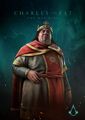 Promotional Art
 -
 Promotional Art
 -
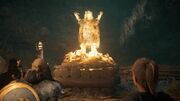 An effigy of Charles burning in Ravensthorpe
 -
 A painting of King Charles in the Villa of Amiens


Appearances
- Assassin's Creed: Valhalla (mentioned only)
- The Siege of Paris (first appearance)
References
- ↑ Assassin's Creed: Valhalla – Database: Charles the Fat
- ↑ Assassin's Creed: Valhalla – The Siege of Paris
- ↑
 Charles the Fat on Wikipedia
- ↑ Assassin's Creed: Valhalla – The Siege of Paris – The Madness of King Charles
- ↑ 5.0 5.1 5.2 Assassin's Creed: Valhalla – The Siege of Paris – The Queen's Gambit
- ↑ 6.0 6.1 Assassin's Creed: Valhalla – The Siege of Paris – Majesty in the Dark
- ↑ Assassin's Creed: Valhalla – The Siege of Paris – Fire And Faith
- ↑ Assassin's Creed: Valhalla – The Siege of Paris – Royal Fox Hunt