

Basilica del Santo Niño: Difference between revisions
imported>Gener4l Cl4ank4 No edit summary |
imported>Gener4l Cl4ank4 mNo edit summary |
||
| Line 14: | Line 14: | ||
<gallery widths="180" position="center" captionalign="center"> | <gallery widths="180" position="center" captionalign="center"> | ||
ACFT - Basilica del Santo Niño tower.png|The basilica's tower | ACFT - Basilica del Santo Niño tower.png|The basilica's tower | ||
ACFT - Magellan's Cross Pavilion.png|The painted ceiling of | ACFT - Magellan's Cross Pavilion.png|The painted ceiling of the Magellan's Cross Pavilion | ||
</gallery> | </gallery> | ||
Revision as of 12:08, 13 February 2024

|
He who increaseth knowledge, increaseth sorrow. This article contains spoilers, meaning it has information and facts concerning Assassin's Creed: Forgotten Temple. If you do not want to know about these events, it is recommended to read on with caution, or not at all. |

The Basilica del Santo Niño, officially the Minor Basilica of the Holy Child and locally known as the Basílica Minore del Santo Niño de Cebú, is a basilica located in Cebu City in the Cebu province of the Philippines. Built in 1565, allegedly on the spot where an image of the Santo Niño de Cebú was found during the Spanish conquistador Miguel López de Legazpi's expedition to the archipelago, it is the oldest Roman Catholic church in the Philippines.[1]
Situated near the basilica is the Magellan's Cross Pavilion, a stone kiosk which allegedly houses the Christian cross planted by the Portuguese explorer Ferdinand Magellan when he arrived on Cebu in 1521.[2]
History
At some point in the early 18th century, the Dutch East India Company navigator Hendrik visited the basilica and met a monk who told him of Ferdinand Magellan's search for an Isu artifact on Cebu two centuries prior. This inspired Hendrik to investigate the legend further and eventually led him to discover the location of the lost Khmer city of Angkor, which was rumored to house Isu relics.[3]
In 2023, the Korean-American Noa Kim and the Japanese Templar Shimazu Sei visited the basilica and the Magellan's Cross Pavilion as part of their efforts to trace Edward Kenway's footsteps in Cebu. Noa used his Eagle Vision inside the pavilion but was unable to find anything useful, which Sei deduced was because the cross was a replica and not the original one planted by Magellan.[4]
Gallery
-
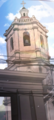 The basilica's tower
 -
 The painted ceiling of the Magellan's Cross Pavilion


Appearances
References
- ↑
 Basilica del Santo Niño on Wikipedia
- ↑ Magellan's Cross Pavilion on Wikipedia
- ↑ Assassin's Creed: Forgotten Temple – Episode 41
- ↑ Assassin's Creed: Forgotten Temple – Episode 43