
Wulfhilda: Difference between revisions
imported>Darman36 No edit summary |
imported>Lady Kyashira mNo edit summary |
||
| Line 1: | Line 1: | ||
{{Era|Individuals}} | {{Era|Individuals}} | ||
{{Character_Infobox | {{Character_Infobox | ||
|name = Wulfhilda | |name = Wulfhilda | ||
| Line 20: | Line 19: | ||
===Tracking down the beast=== | ===Tracking down the beast=== | ||
Eivor returned to Wulfhilda shortly thereafter, reporting that the children [[Ashildr]] and [[Cedl]] saw a "[[Jötnar|Jotun]]" responsible for these attacks and thus not the work of the Viking raiders. The abbess and Eivor then headed further north to investigate more reports of such attacks.<ref name="A Fiend out of Hell" /> After saving an elderly woman from a pack of [[wolves]], Wulfhilda and Eivor travelled to the [[Brisleah Farm]] up north after the woman found an axe belonging to the warband chief [[Hrothgar (Viking)|Hrothgar]] on the animal carcass, placing suspicions on him. However, Wulfhilda was adamant in believing her statement as she had known Hrothgar herself and called him a great man who would never do such a thing.<ref name="Prey in the High Hall">''Assassin's Creed: Valhalla'' – ''[[Prey in the High Hall]]</ref> | Eivor returned to Wulfhilda shortly thereafter, reporting that the children [[Ashildr]] and [[Cedl]] saw a "[[Jötnar|Jotun]]" responsible for these attacks and thus not the work of the Viking raiders. The abbess and Eivor then headed further north to investigate more reports of such attacks.<ref name="A Fiend out of Hell" /> After saving an elderly woman from a pack of [[wolves]], Wulfhilda and Eivor travelled to the [[Brisleah Farm]] up north after the woman found an axe belonging to the warband chief [[Hrothgar (Viking)|Hrothgar]] on the animal carcass, placing suspicions on him. However, Wulfhilda was adamant in believing her statement as she had known Hrothgar herself and called him a great man who would never do such a thing.<ref name="Prey in the High Hall">''Assassin's Creed: Valhalla'' – ''[[The Legend of Beowulf]]'' – ''[[Prey in the High Hall]]</ref> | ||
Arriving at the farm, Wulfhilda and Eivor witnessed the trail of bodies of animals and residents alike who all suffered from the same covered mold and marks from the attacks in the farm. They investigated the top of the monastery in the farm, finding a mortally wounded Hrothgar who, like the children, also reported a "Jotun" responsible for these attacks. After Hrothgar died from his wounds, Wulfhilda and Eivor made the decision to remain behind, believing that the "Jotun" will return. Sure enough, the "Jotun" returned and "attacked" both Eivor and the abbess, causing the former to kill him in self defence. It became apparent that the "Jotun" responsible for the attacks was in fact a [[human]] named [[Grendel]] who suffered a form of deformity that made him different from the rest of the population. As Grendel died calling out for his mother, Wulfhilda gave him his last rites while Eivor went on to track down the trail of mold left by Grendel.<ref name="Prey in the High Hall" /> | Arriving at the farm, Wulfhilda and Eivor witnessed the trail of bodies of animals and residents alike who all suffered from the same covered mold and marks from the attacks in the farm. They investigated the top of the monastery in the farm, finding a mortally wounded Hrothgar who, like the children, also reported a "Jotun" responsible for these attacks. After Hrothgar died from his wounds, Wulfhilda and Eivor made the decision to remain behind, believing that the "Jotun" will return. Sure enough, the "Jotun" returned and "attacked" both Eivor and the abbess, causing the former to kill him in self defence. It became apparent that the "Jotun" responsible for the attacks was in fact a [[human]] named [[Grendel]] who suffered a form of deformity that made him different from the rest of the population. As Grendel died calling out for his mother, Wulfhilda gave him his last rites while Eivor went on to track down the trail of mold left by Grendel.<ref name="Prey in the High Hall" /> | ||
| Line 27: | Line 26: | ||
Eventually, rather than a story, Wulfhilda composed a poem which would later came to be the inspiration for ''[[Beowulf]]'', and sent a copy of the poem to Eivor in Ravensthorpe.<ref name="Prey in the High Hall" /> | Eventually, rather than a story, Wulfhilda composed a poem which would later came to be the inspiration for ''[[Beowulf]]'', and sent a copy of the poem to Eivor in Ravensthorpe.<ref name="Prey in the High Hall" /> | ||
==Gallery== | |||
<gallery widths="180" position="center" captionalign="center"> | |||
ACV A Fiend out of Hell 4.png|Wulfhilda requesting Eivor's aid to investigate the attack | |||
ACV Prey in the High Hall 4.png|Wulfhilda and Eivor following the trail of bodies | |||
ACV Prey in the High Hall 10.png|Wulfhilda giving Grendel his last rites | |||
ACV Ever As Fate Must 7.png|Wulfhilda learning the the truth behind Grendel and the attacks | |||
</gallery> | |||
==Appearances== | ==Appearances== | ||
Revision as of 15:44, 4 December 2022
Wulfhilda was an Anglo-Saxon nun from East Anglia who lived during the 9th century.
Biography
Investigating the attack
An abbess from the Barking Abbey, Wulfhilda was unlike her colleagues who tolerated the presence of the Norse in the region, who had been dubbed as "heathens" by the local population for being pagans and Christians. Despite this, her colleagues tolerate her beliefs, and it was for this reason that the bishop sent her to the southwestern part of East Anglia investigate rumours of a monster mutilating the livestock of the villagers in the region.[1]
Upon her arrival, Wulfhilda looked into the attacks which were not typical from the regular animal attacks. She tried to calm down the local farmers who blamed the attacks on the local Vikings, insisting that it was not their doing but rather the work of the Devil. Shortly after, Wulfhilda was met by Eivor Varinsdottir of the Raven Clan who had also heard of the attacks by her settlement scout Sunniva. After Eivor fend off several of the incensed farmers, Wulfhilda spoke to her and requested her aid into looking into the attacks herself.[1]
Tracking down the beast
Eivor returned to Wulfhilda shortly thereafter, reporting that the children Ashildr and Cedl saw a "Jotun" responsible for these attacks and thus not the work of the Viking raiders. The abbess and Eivor then headed further north to investigate more reports of such attacks.[1] After saving an elderly woman from a pack of wolves, Wulfhilda and Eivor travelled to the Brisleah Farm up north after the woman found an axe belonging to the warband chief Hrothgar on the animal carcass, placing suspicions on him. However, Wulfhilda was adamant in believing her statement as she had known Hrothgar herself and called him a great man who would never do such a thing.[2]
Arriving at the farm, Wulfhilda and Eivor witnessed the trail of bodies of animals and residents alike who all suffered from the same covered mold and marks from the attacks in the farm. They investigated the top of the monastery in the farm, finding a mortally wounded Hrothgar who, like the children, also reported a "Jotun" responsible for these attacks. After Hrothgar died from his wounds, Wulfhilda and Eivor made the decision to remain behind, believing that the "Jotun" will return. Sure enough, the "Jotun" returned and "attacked" both Eivor and the abbess, causing the former to kill him in self defence. It became apparent that the "Jotun" responsible for the attacks was in fact a human named Grendel who suffered a form of deformity that made him different from the rest of the population. As Grendel died calling out for his mother, Wulfhilda gave him his last rites while Eivor went on to track down the trail of mold left by Grendel.[2]
Eivor returned to Wulfhilda sometime thereafter, having tracked down the mold to a massive cavern of caves called Grime's Graves. She reported that the elderly lady they encountered earlier was the mother of Grendel, and she tried to protect her child from the villagers in whatever methods possible. With the mystery of the animal attacks solved, Wulfhilda made her return to the abbey to report her findings, promising Eivor that she would change the contents and omit Eivor out of the story.[2]
Eventually, rather than a story, Wulfhilda composed a poem which would later came to be the inspiration for Beowulf, and sent a copy of the poem to Eivor in Ravensthorpe.[2]
Gallery
-
 Wulfhilda requesting Eivor's aid to investigate the attack
 -
 Wulfhilda and Eivor following the trail of bodies
 -
 Wulfhilda giving Grendel his last rites
 -
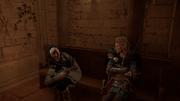 Wulfhilda learning the the truth behind Grendel and the attacks


Appearances
References
- ↑ 1.0 1.1 1.2 Assassin's Creed: Valhalla – The Legend of Beowulf – A Fiend out of Hell
- ↑ 2.0 2.1 2.2 2.3 Assassin's Creed: Valhalla – The Legend of Beowulf – Prey in the High Hall