

Jacques-Louis David: Difference between revisions
imported>Darman36 No edit summary |
imported>Soranin No edit summary |
||
| Line 16: | Line 16: | ||
David actively supported the [[French Revolution]], joining the [[Jacobins|Jacobin Club]], producing a {{wiki|commons:File:Serment du Jeu de Paume - Jacques-Louis David.jpg|drawing}} of the {{wiki|Tennis Court Oath}} and befriending the noted Jacobin [[Maximilien de Robespierre]].<ref name="Database">''[[Assassin's Creed: Unity]]'' – [[Database: Jacques-Louis David]]</ref> He also drew meetings of the club, being probably the first "photo" reporter in history.<ref>''Assassin's Creed: Unity'' – [[Database: Club des Jacobins]]</ref> As Robespierre and the Jacobins came to power in 1793, the former collaborated with David to use art and culture as a political tool.<ref name="PW">''[[Project Widow]]'' – "Woe is Robespierre"</ref> | David actively supported the [[French Revolution]], joining the [[Jacobins|Jacobin Club]], producing a {{wiki|commons:File:Serment du Jeu de Paume - Jacques-Louis David.jpg|drawing}} of the {{wiki|Tennis Court Oath}} and befriending the noted Jacobin [[Maximilien de Robespierre]].<ref name="Database">''[[Assassin's Creed: Unity]]'' – [[Database: Jacques-Louis David]]</ref> He also drew meetings of the club, being probably the first "photo" reporter in history.<ref>''Assassin's Creed: Unity'' – [[Database: Club des Jacobins]]</ref> As Robespierre and the Jacobins came to power in 1793, the former collaborated with David to use art and culture as a political tool.<ref name="PW">''[[Project Widow]]'' – "Woe is Robespierre"</ref> | ||
After [[Louis-Michel le Peletier]] was killed in January 1793, David produced a painting of him, which the former's daughter, [[Louise-Suzanne le Peletier|Louise-Suzanne]], would later destroy.<ref>''Assassin's Creed: Unity'' – [[Database: Louise-Suzanne Le Peletier]]</ref> When the radical revolutionary [[Jean-Paul Marat]] was murdered in his bathtub by [[Charlotte Corday]] in July of that year,<ref name="TheAssassinationOfJeanPaulMarat">''[[Assassin's Creed: Unity]]'' – [[The Assassination of Jean-Paul Marat]]<ref | After [[Louis-Michel le Peletier]] was killed in January 1793, David produced a painting of him, which the former's daughter, [[Louise-Suzanne le Peletier|Louise-Suzanne]], would later destroy.<ref>''Assassin's Creed: Unity'' – [[Database: Louise-Suzanne Le Peletier]]</ref> When the radical revolutionary [[Jean-Paul Marat]] was murdered in his bathtub by [[Charlotte Corday]] in July of that year,<ref name="TheAssassinationOfJeanPaulMarat">''[[Assassin's Creed: Unity]]'' – [[The Assassination of Jean-Paul Marat]]</ref> David visited the scene of the crime to produce one of his most famous paintings: ''{{Wiki|The Death of Marat}}''.<ref name="Database"/> The [[Parisian Brotherhood of Assassins|French Assassin]] [[Arno Dorian]] also visited the scene to investigate the murder. On being questioned by Arno however, David brushed him off, stating that he was preoccupied with his painting.<ref name="TheAssassinationOfJeanPaulMarat"/> The painting would go on to immortalize Marat as a Jacobin martyr concerned with the safety of France.<ref>''Project Widow'' – "Marat the martyr"</ref> | ||
The poet [[André Chénier]] despised David, considering him a "most despicable propagandist", and wrote a series of satirical poems about him called ''Le Jeu de Paume''. Infuriated, David called in favors from Robespierre and his supporters and had them take over Chénier's house and keep the poems under guard. However, Chénier sent Arno to recover them.<ref>''Assassin's Creed: Unity'' – [[Vicious Verses]]</ref> | The poet [[André Chénier]] despised David, considering him a "most despicable propagandist", and wrote a series of satirical poems about him called ''Le Jeu de Paume''. Infuriated, David called in favors from Robespierre and his supporters and had them take over Chénier's house and keep the poems under guard. However, Chénier sent Arno to recover them.<ref>''Assassin's Creed: Unity'' – [[Vicious Verses]]</ref> | ||
When Robespierre hosted the [[Festival of the Supreme Being]] at the [[Champ de Mars]] on 8 June 1794, David collaborated with opera composer {{Wiki|François-Joseph Gossec}} and André Chénier's brother, the dramatist [[Marie-Joseph Chénier]], to organize the festivities.<ref>''Project Widow'' – "The Festival of the Supreme Being"</ref> David commissioned the construction of an artificial mountain made of plaster and cardboard, on top of which stood a 50-foot column holding a statue of [[Hercules]].<ref>[ | When Robespierre hosted the [[Festival of the Supreme Being]] at the [[Champ de Mars]] on 8 June 1794, David collaborated with opera composer {{Wiki|François-Joseph Gossec}} and André Chénier's brother, the dramatist [[Marie-Joseph Chénier]], to organize the festivities.<ref>''Project Widow'' – "The Festival of the Supreme Being"</ref> David commissioned the construction of an artificial mountain made of plaster and cardboard, on top of which stood a 50-foot column holding a statue of [[Hercules]].<ref>[[User blog:Nygma PI/Ubisoft News — Assassin's Creed: Unity|''Cult of the Supreme Being: Revolutionaries Reinvent God'']]</ref> | ||
After [[Napoleon Bonaparte]] came to power in 1799, David aligned himself with the new regime, much as he had with Robespierre, painting the portrait ''{{Wiki|Napoleon Crossing the Alps}}''.<ref name="ACU">''Assassin's Creed: Unity'' – {{Cite}}</ref> Again, in 1812, David painted [[French Empire|Emperor]] Napoleon I in the portrait ''{{Wiki|The Emperor Napoleon in His Study at the Tuileries}}''.<ref>''[[Assassin's Creed II]]'' – [[Glyphs|Glyph]] #2: "Sixty-Four Squares"</ref> | After [[Napoleon Bonaparte]] came to power in 1799, David aligned himself with the new regime, much as he had with Robespierre, painting the portrait ''{{Wiki|Napoleon Crossing the Alps}}''.<ref name="ACU">''Assassin's Creed: Unity'' – {{Cite}}</ref> Again, in 1812, David painted [[French Empire|Emperor]] Napoleon I in the portrait ''{{Wiki|The Emperor Napoleon in His Study at the Tuileries}}''.<ref>''[[Assassin's Creed II]]'' – [[Glyphs|Glyph]] #2: "Sixty-Four Squares"</ref> | ||
Revision as of 15:40, 7 October 2024
Jacques-Louis David (1748 – 1825) was a famous and highly influential French painter of the Neoclassical era.
Biography
David actively supported the French Revolution, joining the Jacobin Club, producing a drawing of the Tennis Court Oath and befriending the noted Jacobin Maximilien de Robespierre.[1] He also drew meetings of the club, being probably the first "photo" reporter in history.[2] As Robespierre and the Jacobins came to power in 1793, the former collaborated with David to use art and culture as a political tool.[3]
After Louis-Michel le Peletier was killed in January 1793, David produced a painting of him, which the former's daughter, Louise-Suzanne, would later destroy.[4] When the radical revolutionary Jean-Paul Marat was murdered in his bathtub by Charlotte Corday in July of that year,[5] David visited the scene of the crime to produce one of his most famous paintings: The Death of Marat.[1] The French Assassin Arno Dorian also visited the scene to investigate the murder. On being questioned by Arno however, David brushed him off, stating that he was preoccupied with his painting.[5] The painting would go on to immortalize Marat as a Jacobin martyr concerned with the safety of France.[6]
The poet André Chénier despised David, considering him a "most despicable propagandist", and wrote a series of satirical poems about him called Le Jeu de Paume. Infuriated, David called in favors from Robespierre and his supporters and had them take over Chénier's house and keep the poems under guard. However, Chénier sent Arno to recover them.[7]
When Robespierre hosted the Festival of the Supreme Being at the Champ de Mars on 8 June 1794, David collaborated with opera composer François-Joseph Gossec and André Chénier's brother, the dramatist Marie-Joseph Chénier, to organize the festivities.[8] David commissioned the construction of an artificial mountain made of plaster and cardboard, on top of which stood a 50-foot column holding a statue of Hercules.[9]
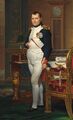
After Napoleon Bonaparte came to power in 1799, David aligned himself with the new regime, much as he had with Robespierre, painting the portrait Napoleon Crossing the Alps.[10] Again, in 1812, David painted Emperor Napoleon I in the portrait The Emperor Napoleon in His Study at the Tuileries.[11]
Gallery
-
 Arno Dorian interrogating Jacques-Louis while he paints
 -
 The Death of Marat (1793)
 -
 Napoleon Crossing the Alps (1801)
 -
-
 Leonidas at Thermopylae (1814)


Appearances
References
- ↑ 1.0 1.1 Assassin's Creed: Unity – Database: Jacques-Louis David
- ↑ Assassin's Creed: Unity – Database: Club des Jacobins
- ↑ Project Widow – "Woe is Robespierre"
- ↑ Assassin's Creed: Unity – Database: Louise-Suzanne Le Peletier
- ↑ 5.0 5.1 Assassin's Creed: Unity – The Assassination of Jean-Paul Marat
- ↑ Project Widow – "Marat the martyr"
- ↑ Assassin's Creed: Unity – Vicious Verses
- ↑ Project Widow – "The Festival of the Supreme Being"
- ↑ Cult of the Supreme Being: Revolutionaries Reinvent God
- ↑ Assassin's Creed: Unity – [citation needed]
- ↑ Assassin's Creed II – Glyph #2: "Sixty-Four Squares"