

Israel Putnam: Difference between revisions
imported>Amnestyyy |
imported>Altair25 No edit summary |
||
| Line 70: | Line 70: | ||
[[Category:Characters]] | [[Category:Characters]] | ||
[[Category:Assassin's Creed III characters]] | [[Category:Assassin's Creed III characters]] | ||
[[Category:Historical characters]] | [[Category:Historical characters]] | ||
Revision as of 19:17, 14 January 2013

|
He who increaseth knowledge, increaseth sorrow. This article contains spoilers, meaning it has information and facts concerning recent or upcoming releases from the Assassin's Creed series. If you do not want to know about these events, it is recommended to read on with caution, or not at all. |

|
"Good work, if a little… unrefined." This article is being nominated for . If you wish to share your own opinion about this article, please read the instructions within the nomination page before voting. |
- "Do not fire until you see the whites of their eyes!"
- ―Israel Putnam speaking to his men at the Battle of Bunker Hill.[src]
Israel Putnam (1718 – 1790) was an American general in the Continental Army, who fought with distinction at the Battle of Bunker Hill during the American Revolutionary War.
Around the time of the Battle of Bunker Hill, Putnam had contact with the Assassin Connor, who assisted him by assassinating Putnam's British counterpart, Jonathan Pitcairn, who led the Regulars at Bunker Hill.
A year later, Putnam was present during an attempted assassination of George Washington, which was also foiled by the Assassins, where he declared Connor a hero.
Biography
Early life
Putnam was born in Massachusetts, but later moved to Connecticut to take up farming. Following this, he joined the colonial militia during the French and Indian War, and earned a reputation for bravery and inspiring the soldiers around him.
In 1758, Putnam was captured by a group of Kanien'kehá:ka tribespeople, but was rescued just before he was to be executed. Several years later in 1762, he was shipwrecked in Cuba, where Putnam discovered cigars and introduced them to the colonies.
After the war ended, Putnam returned to Connecticut, where he was a vocal opponent of the British tax policies. He also founded the Connecticut branch of the Sons of Liberty.
When he heard about the battles of Lexington and Concord, Putnam immediately signed up for the Continental Army and was named Brigadier General of the Connecticut forces.[1]
Battle of Bunker Hill
- " The enemy advances and you tremble. They've better numbers, you say. Better weapons. Better training. But I do not fear, and neither should you. For what they have in material, they lack in conviction and care. But not us. We have discipline. We have order. And most importantly, we have passion. We believe!"
- ―Israel Putnam's speech before the battle[src]
During the Battle of Bunker Hill in 1775, Putnam was approached by the Assassin Ratonhnhaké:ton, better known as Connor, who was looking for the British Army major and Templar John Pitcairn.
In order to flush Pitcairn out, Putnam tasked the young Assassin with disabling two British frigates which were bombarding the hill from the harbor. Once the frigates were disabled, Putnam rallied his troops by delivering an inspiring speech, and Connor then set out to assassinate Pitcairn.
Traversing the battle and entering Pitcairn's camp, Connor succeeded in killing the major, but nevertheless Putnam was outnumbered and forced to retreat, granting the British a Pyrrhic victory.[1]

A year later, Connor was captured by the Templars and falsely accused of plotting to assassinate General George Washington, a crime the Templars themselves were planning to commit.
He later escaped execution and killed the true conspirator, Thomas Hickey, before he could strike Washington. When surrounded by armed guards after murdering Hickey, Putnam arrived to vouch for Connor's innocence, proclaiming him a hero to the Patriot cause.[1]
Later life and death
After helping prevent the assassination of Washington, Putnam's career began to decline. He lost the Battle of Long Island and was nearly captured after losing the Battle of Forts Clinton and Montgomery. Later, in December of 1779, Putnam suffered a paralyzing stroke, which ended his military career. He died eleven years later, in 1790.[2]
Personality and characteristics
- "What would you know about victory? I killed a she-wolf in her den, armed with only a knife. I escaped the Caughnawaga Indians who sought to burn me alive.So you'll excuse me if I choose not to follow your advice."
- ―Israel Putnam[src]

As a military officer, Putnam was strict and straightforward with his troops, admitting to them that the British had better weapons and training at the Battle of Bunker Hill. Before the battle however, he roused his soldiers with an inspiring speech, but later admitted to Connor that it was all a lie.
In addition, Putnam was loud and unrestrained. He would constantly shout at soldiers over insignificant issues and was pessimistic regarding the war, believing to have lost the Battle of Bunker Hill before it truly began.[1]
Trivia
- A bronze statue was erected in Redding, Connecticut to commemorate Putnam's famous escape from the British in 1777.
Gallery
-
 Putnam meeting Connor.
 -
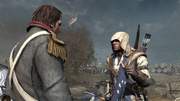 Putnam and Connor talking.
 -
 Putnam smoking a cigar.
 -
 Putnam with Connor in New York.


References
- ↑ 1.0 1.1 1.2 1.3 Assassin's Creed III
- ↑ Wikipedia: Israel Putnam