

Havana: Difference between revisions
imported>Kainzorus Prime No edit summary |
imported>Unrulyruby100 No edit summary |
||
| Line 2: | Line 2: | ||
{{WP-REAL}} | {{WP-REAL}} | ||
{{Stub}} | {{Stub}} | ||
[[File: | [[File:Lively Havana 3.png|thumb|250px|Havana.]] | ||
'''Havana''' is the capital and major port of the island country of [[Cuba]] in the [[Caribbean]]. | '''Havana''' is the capital and major port of the island country of [[Cuba]] in the [[Caribbean]]. | ||
During the late 17th and early 18th century, Cuba was a colony of [[Spain]]. At the time of the [[Golden Age of Piracy]], Havana was a common hangout for [[Piracy|pirates]], with many infamous pirates having laid anchor in the city. | During the late 17th and early 18th century, Cuba was a colony of [[Spain]]. At the time of the [[Golden Age of Piracy]], Havana was a common hangout for [[Piracy|pirates]], with many infamous pirates having laid anchor in the city, including [[Edward Kenway]]. During the early 1700's, [[Templars|Templar]] [[Grand Master]] [[Laureano de Torres y Ayala]] served as governor, and orchestrated Templar involvement in the Caribbean from his mansion in the city. At the same time, the [[Assassins|Assassin order]] maintained a presence in Havana, running an [[Assassin bureau]] headed by [[Rhona Dinsmore]].<ref>''[[Assassin's Creed IV: Black Flag]]''</ref> | ||
During the 18th century, the [[Philippe Olivier de Grandpré|de Grandpré]] business sent [[ships]] to Havana to import and export goods.<ref>''[[Assassin's Creed III: Liberation]]''</ref> | |||
In 2013, it was used as a simulated location created by [[Abstergo Industries]]' [[Abstergo Entertainment|entertainment branch]], for the console stage of their [[Animus]] technology. | In 2013, it was used as a simulated location created by [[Abstergo Industries]]' [[Abstergo Entertainment|entertainment branch]], for the console stage of their [[Animus]] technology. | ||
| Line 14: | Line 14: | ||
<gallery captionalign="center" position="center" spacing="small" widths="180"> | <gallery captionalign="center" position="center" spacing="small" widths="180"> | ||
AC4BFLaHavane.jpg|Concept art of Havana | AC4BFLaHavane.jpg|Concept art of Havana | ||
Edward in game ACIV.jpg|Edward Kenway in Havana | |||
Caribbean city ACIV.jpg|Concept art of the {{Wiki|Cathedral of Havana|cathedral}} | Caribbean city ACIV.jpg|Concept art of the {{Wiki|Cathedral of Havana|cathedral}} | ||
A Man They Call The Sage 9.png|The Cathedral of Havana | |||
Lively_Havana_1.png|Stede Bonnet and Edward at the port of Havana | |||
</gallery> | </gallery> | ||
Revision as of 09:30, 17 February 2014


Havana is the capital and major port of the island country of Cuba in the Caribbean.
During the late 17th and early 18th century, Cuba was a colony of Spain. At the time of the Golden Age of Piracy, Havana was a common hangout for pirates, with many infamous pirates having laid anchor in the city, including Edward Kenway. During the early 1700's, Templar Grand Master Laureano de Torres y Ayala served as governor, and orchestrated Templar involvement in the Caribbean from his mansion in the city. At the same time, the Assassin order maintained a presence in Havana, running an Assassin bureau headed by Rhona Dinsmore.[1]
During the 18th century, the de Grandpré business sent ships to Havana to import and export goods.[2]
In 2013, it was used as a simulated location created by Abstergo Industries' entertainment branch, for the console stage of their Animus technology.
Gallery
-
 Concept art of Havana
 -
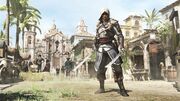 Edward Kenway in Havana
 -
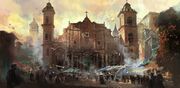 Concept art of the cathedral
 -
 The Cathedral of Havana
 -
 Stede Bonnet and Edward at the port of Havana


References