


Great Inagua: Difference between revisions
imported>A.gao.96 No edit summary |
imported>Doxe di Costantinopoli No edit summary |
||
| Line 11: | Line 11: | ||
|date = 1715 | |date = 1715 | ||
|hidea = yes|targets = [[Julien du Casse]]}} | |hidea = yes|targets = [[Julien du Casse]]}} | ||
'''Great Inagua''' is an island of [[the Bahamas]], which was home to a sizable [[Sugar plantations|plantation]] owned and operated by the [[France|French]] [[Templars|Templar]] [[Julien du Casse]]. | '''Great Inagua''' is an island of [[the Bahamas]], which in the early 18th century was home to a sizable [[Sugar plantations|plantation]] owned and operated by the [[France|French]] [[Templars|Templar]] [[Julien du Casse]]. | ||
In September 1715, in order to claim ''[[El Arca del Maestro]]'' for [[Nassau]]'s defenses, the [[Piracy|pirate]] [[Edward Kenway]] assassinated du Casse and subsequently took ownership of the island, including a manor overlooking the cove. | In September 1715, in order to claim ''[[El Arca del Maestro]]'' for [[Nassau]]'s defenses, the [[Piracy|pirate]] [[Edward Kenway]] assassinated du Casse and subsequently took ownership of the island, including a manor overlooking the cove. | ||
Over the next | Over the next 7 years, Kenway invested heavily in the development of a settlement on the island, improving the docks, beachfront, and the manor itself. Following the [[United Kingdom|British]] repossession of Nassau in 1718, Great Inagua became the bastion of the remaining pirates of the [[Caribbean|West Indies]]. | ||
In October 1722, before leaving the West Indies to return to [[United Kingdom|England]] with his [[Jennifer Scott|daughter]], Edward gifted the island to the [[Assassins]], who had elected to abandon their base in [[Tulum]] in the face of repeated [[Attacks on Tulum|attacks]] by both | In October 1722, before leaving the West Indies to return to [[United Kingdom|England]] with his [[Jennifer Scott|daughter]], Edward gifted the island to the [[Assassins]], who had elected to abandon their base in [[Tulum]] in the face of repeated [[Attacks on Tulum|attacks]] by both [[British Army|British]] and [[Spain|Spanish]] forces. | ||
==Gallery== | ==Gallery== | ||
Revision as of 00:04, 6 March 2017
Great Inagua is an island of the Bahamas, which in the early 18th century was home to a sizable plantation owned and operated by the French Templar Julien du Casse.
In September 1715, in order to claim El Arca del Maestro for Nassau's defenses, the pirate Edward Kenway assassinated du Casse and subsequently took ownership of the island, including a manor overlooking the cove.
Over the next 7 years, Kenway invested heavily in the development of a settlement on the island, improving the docks, beachfront, and the manor itself. Following the British repossession of Nassau in 1718, Great Inagua became the bastion of the remaining pirates of the West Indies.
In October 1722, before leaving the West Indies to return to England with his daughter, Edward gifted the island to the Assassins, who had elected to abandon their base in Tulum in the face of repeated attacks by both British and Spanish forces.
Gallery
-
 El Arca del Maestro and the Jackdaw in the cove of Great Inagua
 -
 The Jackdaw anchored in the cove
 -
 The general store
 -
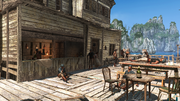 The tavern
 -
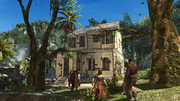 The brothel
 -
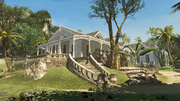 The manor
 -
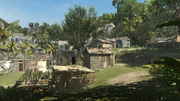 Overview of the settlement
 -
 Templar armor locked inside the manor


Reference