


William Johnson: Difference between revisions
imported>Odranoelluta Created page with "{{Era|AC3}} {{WP-REAL|Sir William Johnson, 1st Baronet}} {{Spoilerhd}} {{Stub}} '''Sir William Johnson''' was an {{wiki|Anglo-Irish}} official of the British Empire. Johns..." |
|||
| (299 intermediate revisions by 90 users not shown) | |||
| Line 1: | Line 1: | ||
{{Era| | {{Era|Individuals|Templars}}{{WP-REAL|Sir William Johnson, 1st Baronet}} | ||
{{WP-REAL|Sir William Johnson, 1st Baronet}} | {{Quote|I could have stopped it. I could have saved you all... |William Johnson, regarding his perceived threat of the colonists on the natives, 1774.|Assassin's Creed III|Hostile Negotiations}} | ||
{{ | {{Character Infobox | ||
{{ | |name = William Johnson | ||
'''Sir William Johnson''' was an {{ | |image = AC3 William Johnson render.png | ||
|birth = c. 1715<br>[[Meath|County Meath]], [[Ireland|Kingdom of Ireland]] | |||
|death = 11 July 1774 {{c|aged c. 59}}<br>[[John's Town]], [[New York]], {{Wiki|British America}} | |||
|species = [[Human]] | |||
|database = [[Database: William Johnson (Assassin's Creed III)|William Johnson (Assassin's Creed III)]]<br>[[Database: William Johnson (Rogue)|William Johnson (Rogue)]] | |||
|affiliates = [[British Army]]<br>[[Templars]] | |||
*[[American Rite of the Templar Order|Colonial Rite]] {{c|c. 1748 – death}} | |||
}} | |||
'''Sir William Johnson, 1st Baronet''' (c. 1715 – 1774) was an {{Wiki|Anglo-Irish people|Anglo-Irish}} official of the [[United Kingdom|British Empire]], businessman, and a member of the [[American Rite of the Templar Order|Colonial Rite]] of the [[Templars|Templar Order]]. During the [[Seven Years' War]], Johnson commanded [[Iroquois]] and colonial militia forces. Johnson also assisted in keeping Native Americans committed to the interests of the British. | |||
He was | As a member of the Templars, Johnson was in charge of managing the land and property acquired by the Colonial Rite. During a meeting with several clan leaders, Johnson was assassinated by the [[Assassins|Assassin]] [[Ratonhnhaké:ton]]. | ||
==Biography== | |||
===Early life=== | |||
Born in [[Ireland]] to Irish Catholic parents, Johnson learned at a young age that his opportunities were limited due to British anti-Catholic laws. After converting to Protestantism sometime in 1738, he moved to [[United States|British Colonial America]] to work for his uncle, Admiral {{Wiki|Peter Warren (Royal Navy officer)|Peter Warren}}.<ref name="DB Rogue">''[[Assassin's Creed: Rogue]]'' – [[Database: William Johnson (Rogue)|Database: William Johnson]]</ref> He left however, to live and work on his own, after he was unable to convince his uncle to build on the trading routes with the [[Kanien'kehá:ka]], which would boost business ventures and profits.<ref name="DB Rogue" /><ref name="DB AC3">''[[Assassin's Creed III]]'' – [[Database: William Johnson (Assassin's Creed III)|Database: William Johnson]]</ref> | |||
With what money he had obtained, Johnson bought a plot of land, built a mill, house, store, and farm on a major point in the trade route, calling the area "{{Wiki|Fort Johnson, New York|Mount Johnson}}". From humble beginnings, his placement along the Mohawk River quickly made him wealthy and among the nobles of the colonies.<ref name="DB AC3" /> | |||
In 1743, he moved once more, and obtained a much larger parcel of land, which he named "Fort Johnson".<ref name="DB AC3" /> During the interval time, he developed close relations with the [[Kanien'kehá:ka]], learning their language, and became familiar with their culture and customs,<ref name="DB Rogue" /><ref name="DB AC3" /> receiving the name "Warraghiyagey", which he translated as "A Man who undertakes great Things".<ref name="Wiki">{{WP|Sir William Johnson, 1st Baronet}}</ref> | |||
===Joining the Colonial Rite=== | |||
{{Quote|Master Johnson in New York has recently been appointed as the Colonel of the Warriors of the Six Nations. Not only is he well-established, but his relationship with the Mohawk may well benefit us in the future. I suggest we begin friendly overtures immediately.|Lawrence Washington in a letter to Christopher Gist, 1746.|Assassin's Creed: Rogue|War Letters}} | |||
In 1746, Johnson was appointed Colonel of the Warriors of the [[Iroquois|Six Nations]] in [[New York City]] due to his close relations with the natives. The Templars took notice of this, and [[Lawrence Washington]], believing Johnson could prove a valuable associate, instructed [[Christopher Gist]] to try and befriend him.<ref>''[[Assassin's Creed: Rogue]]'' – [[War Letters]]: "Front Company"</ref> | |||
By 1748, Johnson had been recruited into the Order by Washington, and the two worked together to build an infrastructure for the Templars in the colonies.<ref name="DB Rogue" /> Johnson also maintained correspondence with some of his fellow Templars across the globe, including [[Johann Joachim Winckelmann]], who asked him to send over his books on the history and mythology of the Native Americans so he could add them to his own research;<ref>''[[Assassin's Creed: Rogue]]'' – [[War Letters]]: "Art History"</ref> and [[John Harrison]], who requested Johnson's aid in strengthening the [[East India Company]]'s influence in the {{Wiki|Kingdom of Mysore}}.<ref>''[[Assassin's Creed: Rogue]]'' – [[War Letters]]: "The Kingdom of Mysore"</ref> | |||
In 1752, [[Thomas Hickey]] was assigned as Johnson's assistant and followed him into the Templar Order.<ref>''[[Assassin's Creed III]]'' – [[Database: Thomas Hickey]]</ref> In July 1754, Johnson was one of the many in attendance at the [[Albany Congress]], where he was observed by the Assassin [[Shay Cormac]]. As [[Benjamin Franklin]] spoke outside the city hall, Johnson approached Franklin and discussed the likelihood of British Parliament granting autonomy to the colonies.<ref name="We the People">''[[Assassin's Creed: Rogue]]'' – [[We the People]]</ref> | |||
[[File:We The People 5.png|thumb|250px|left|Johnson with Franklin at the Albany Congress]] | |||
Johnson then discussed the mysterious "[[Precursor box]]" that Franklin had been examining for a short time. Franklin was eager to make the artifact work with his lightning experiment, and Johnson promised that its counterpart, the [[Voynich manuscript]], would be delivered to him shortly. However, he was informed by a British captain that his colleague [[James Wardrop]] refused to give the manuscript away. After Franklin departed, Johnson furiously ordered that the captain return to [[Fort Frederick]] and demand that Wardrop hand over the manuscript.<ref name="We the People" /> | |||
===Search for the Precursor site=== | |||
{{Dialogue|Johnson|I'm told you're putting together an expedition.|Haytham|We believe there's a precursor site in the region. I require your knowledge of the land and its people to find it.|Johnson and Haytham upon their initial meeting, 1754.|Assassin's Creed III|Johnson's Errand}} | |||
Shortly after, at the direction of [[Charles Lee]], Johnson and Hickey traveled to [[Boston]] and stayed at the [[Green Dragon Tavern]], where they were to be recruited into an expedition by [[Haytham Kenway]], the newly-appointed [[Grand Master of the Templar Order|Grand Master]] of the Colonial Templars. Haytham and Lee met with Johnson at the tavern, where the former explained that he would need his knowledge of the land to locate a [[Grand Temple|Precursor site]]. However, Johnson revealed that his research had been stolen by bandits, so Haytham and Lee set out to retrieve it alongside Hickey.<ref name="Johnson's Errand">''[[Assassin's Creed III]]'' – [[Johnson's Errand]]</ref> | |||
[[File:ACIII-JohnsonsErrand 8.png|thumb|250px|Johnson examining the Grand Temple Key]] | |||
With his research recovered, Johnson studied his notes, maps and [[Grand Temple Key|Haytham's amulet]]; however, he was unable to pinpoint a precise location. The Templars concluded that they would need to befriend and earn the trust of the Kanien'kehá:ka people, in order to gain favor with them and information that would lead them to the Precursor site.<ref name="Johnson's Errand" /> | |||
Haytham and Lee subsequently gathered the remaining recruits, [[Benjamin Church]] and [[John Pitcairn]], and assembled them at the Green Dragon Tavern. Haytham then devised a plan to infiltrate [[Southgate Fort]] and assassinate [[Silas Thatcher]] to free his Kanien'kehá:ka slaves. Johnson and the others proceeded to ambush a slave cart transport, killing the escorts and disguising themselves in their uniforms, where they then escorted the cart to the fort.<ref name="Infiltrating Southgate">''[[Assassin's Creed III]]'' – [[Infiltrating Southgate]]</ref> | |||
Inside, Haytham stealthily freed the slaves while Johnson and the others blended with and distracted the guards. However, upon realizing that the slaves had escaped, Silas raised the alarm. To this, Johnson and the others triggered a battle, fending off the guards while Haytham and Church killed Silas, allowing them to free the remaining slaves.<ref name="Infiltrating Southgate" /> | |||
[[File:ACIII-BraddockExpedition 18.png|thumb|250px|left|Johnson at Charles Lee's induction into the Order]] | |||
In 1755, Johnson and his fellow Templars learned that Haytham had been in contact with a Kanien'kehá:ka woman, [[Kaniehtí:io]], and the two formulated a plan to kill General [[Edward Braddock]]. Johnson assisted in the attack of Braddock's [[Braddock Expedition|expedition]], allowing Haytham to kill the general. After finding the Precursor site, Haytham changed the Templars' overall plans to focus on establishing a permanent base in the colonies, as well as expanding their power and influence.<ref name="Braddock Expedition">''[[Assassin's Creed III]]'' – [[The Braddock Expedition (memory)|The Braddock Expedition]]</ref> | |||
{{-}} | |||
===The French and Indian War=== | |||
{{Dialogue|Charles Lee|We have... questions for your elders. Only tell us where your village is, boy, and you can go.|Johnson|Best do as he asks, child.|The Templars threatening Ratonhnhaké:ton, 1760.|Assassin's Creed III|Hide and Seek (III)}} | |||
In September of 1755, Johnson participated in the {{Wiki|Battle of Lake George}} to expel the [[France|French]].<ref name="Wiki" /> He also negotiated and recruited Iroquois warriors for the British side.<ref name="DB Rogue" /><ref name="DB AC3" /> For his efforts, Johnson was rewarded £5000 and given the honorary title of Baronet. He was also appointed {{Wiki|British Indian Department|Superintendent of Indian Affairs}}, acting as a liaison between the Iroquois and the British government.<ref name="DB AC3" /> | |||
[[File:Keep Your Friends Close 8.png|thumb|250px|Johnson meeting Shay Cormac]] | |||
In early 1756, Shay Cormac was found in the freezing waters of the [[Atlantic Ocean|Atlantic]] by men working for Johnson's fellow Templar [[George Monro]]. Finding the Voynich manuscript in his pocket, Monro assumed Shay had turned his back on the Assassins and decided to rescue him, despite Johnson's strong protests.<ref name="Armour and Sword">''[[Assassin's Creed: Rogue]]'' – [[Armour and Sword]]</ref> Later that year, Johnson, alongside Monro, Christopher Gist, and [[Jack Weeks]], met Shay after he had destroyed the poison reserves of the Assassin [[gang]]s of New York. Congratulating him for his success, the Templars and Shay went to celebrate in a tavern per Gist's suggestion.<ref name="Keep Your Friends Close">''[[Assassin's Creed: Rogue]]'' – [[Keep Your Friends Close]]</ref> | |||
In August 1757, during the [[Siege of Fort William Henry]], Johnson sent reinforcements to assist Monro and his men, who were being attacked by the French and their native allies, but they never arrived. After surviving the attack thanks to Shay's interference, Monro was escorted to Johnson's trading post at {{Wiki|Onaquaga}} for his protection.<ref name="Honour and Loyalty">''[[Assassin's Creed: Rogue]]'' – [[Honour and Loyalty]]</ref> However, later that year, Monro would be killed by the Assassins in [[Albany]]. The Templars decided to induct Shay into the Order in his place, and Johnson was present for the ceremony at [[Fort Arsenal]].<ref name="Scars">''[[Assassin's Creed: Rogue]]'' – [[Scars]]</ref> | |||
In the years since Haytham's discovery of the Grand Temple, Johnson had continued to lead several expeditions to the region in the hopes of uncovering more Precursor sites. However, these expeditions proved futile and outraged the natives populating the land.<ref name="ACF">''[[Assassin's Creed: Forsaken]]''</ref> | |||
[[File:ACIII-HideandSeek 8.png|thumb|250px|left|Johnson and his fellow Templars questioning Ratonhnhaké:ton]] | |||
In November 1760, Johnson joined Lee, Hickey and Church on one last expedition to try and find the Grand Temple, believing the site located by Haytham was not the correct one. While searching for [[Kanatahséton]], seeking to speak with the village elders, the Templars encountered a young boy, [[Ratonhnhaké:ton]], in the forest. Lee assaulted and forcibly demanded the village's location from the boy, to no avail. Johnson then knocked out Ratonhnhaké:ton with the butt of his [[musket]] and left him.<ref name="Hide and Seek">''[[Assassin's Creed III]]'' – [[Hide and Seek (III)|Hide and Seek]]</ref> | |||
Soon after, the Templars found Kanatahséton and attempted to negotiate with the tribe's elders, to no luck, prompting them to abandon their search. Shortly after their departure, the village was set ablaze by a British regiment on the orders of [[George Washington]], but because of their encounter in the forest, Ratonhnhaké:ton grew up believing it was the Templars who had orchestrated the attack.<ref name="Hide and Seek" /> | |||
In 1763, after the conclusion of the French and Indian War, Johnson remained in close relations with the Kanien'kehá:ka, and was donated more than three hundred square kilometers of land in gratitude.<ref name="DB AC3" /> With the land, Johnson had up to sixty slaves construct a new manor and homestead, which would become known as [[Johnson Hall]].<ref>''[[Assassin's Creed III]]'' – [[Database: Johnson Hall]]</ref> | |||
Johnson appeared in the famous 1770 painting ''{{Wiki|The Death of General Wolfe}}'' commemorating the British victory at the Battle of Quebec and the eponymous death of [[James Wolfe]], a copy of which later hung in the [[Davenport Homestead]].<ref name="AC3" /> However, Johnson, like most figures depicted in the painting, was not actually present during the event.<ref name="Wiki" /> | |||
===Treaty of Fort Stanwix=== | |||
During a territory dispute between the colonists and Iroquois people, Johnson negotiated with the Iroquois Confederacy a new boundary line and to prevent armed conflict. In the signing of the Treaty of Fort Stanwix in 1768, Johnson conceded more land for the colonists than the British actually authorized. This damaged Johnson's relations with several Iroquois clans and would later lead to a brief conflict known as the [[John Murray, 4th Earl of Dunmore|Dunmore]]'s War in Virginia.<ref name="DB AC3" /> | |||
===Boston Tea Party=== | |||
{{Dialogue2|Achilles|Johnson is dead?|Connor|No. He retreated when we destroyed the tea.|Only to hatch some new scheme, I'm sure... You should have killed him.|Connor and Achilles Davenport after the Boston Tea Party, 1774.|Assassin's Creed III|Hostile Negotiations}} | |||
In 1773, Johnson arranged for more negotiations and intended to purchase all of the Iroquois land under Templar control in order to protect the Mohawk people from conflict with the colonists.<ref name="Hostile Negotiations">''[[Assassin's Creed III]]'' – [[Hostile Negotiations]]</ref> Johnson had been gathering funds with the aid of Hickey's black-market connections,<ref name="Something on the Side">''[[Assassin's Creed III]]'' – [[Something on the Side]]</ref> by smuggling British [[tea]], which was heavily taxed at the time. Johnson gathered funds illegally by selling the smuggled tea crates through his contacts and lowered the tax return to the British Government. At the same time, he had his men go throughout the city of Boston as tax-collectors, stopping at people's houses and gathering more money from the civilians.<ref name="On Johnson's Trail">''[[Assassin's Creed III]]'' – [[On Johnson's Trail]]</ref> | |||
[[File:ACIII-Teaparty 9.png|thumb|250px|Johnson and Lee watching the Tea Party from afar]] | |||
Learning about this, Ratonhnhaké:ton, by now an Assassin known as Connor, hindered Johnson's plans by killing his tax collectors and tea smugglers with aid from [[Stephane Chapheau]].<ref name="The Angry Chef">''[[Assassin's Creed III]]'' – [[The Angry Chef]]</ref> At the same time, the citizens of Boston revolted against the British Parliament's taxation and destroyed a shipment of tea in defiance of the {{Wiki|Stamp Act 1765|Stamp Act}}. Connor assisted [[Paul Revere]] and [[William Molineux]] in throwing the tea crates into the harbor, believing that without his main source of income, Johnson would be defeated.<ref name="The Tea Party">''[[Assassin's Creed III]]'' – [[The Tea Party]]</ref> | |||
During this event, Johnson, Lee and Pitcairn watched in horror from a nearby harbor, having not expected to face any opposition to their plans since the [[American Brotherhood of Assassins|Colonial Assassins]]' [[Great Purge (1757-1763)|purge]] a decade prior.<ref name="The Tea Party" /> The incident prompted the Templars to host a meeting the following month, in January 1774, where they discussed the nascent [[American Revolution]], which they believed could benefit their plans to establish a [[New World Order]]. They also talked about the Assassin sabotaging their operations, whom Johnson and the others suspected to be the same Kanien'kehá:ka boy they had encountered in the forest years prior.<ref name="ACF" /> | |||
===Death=== | |||
{{Quote|So be it. I offered you an olive branch, and you knocked it from my hand. Perhaps you'll respond better to the sword.|Johnson threatening to kill the Iroquois leaders, 1774.|Assassin's Creed III|Hostile Negotiations}} | |||
[[File:ACIII-HostileNegotiations 9.png|thumb|250px|left|Johnson's final moments]] | |||
By July 1774, Johnson had managed to acquire the funds to purchase the Iroquois' land through other means, and hosted a meeting with the clan leaders at Johnson Hall to make the transaction. However, the leaders interpreted Johnson's intentions as an act of oppression and, refusing to be subjugated, declared that they were prepared to defend their lands by force. Realizing his attempts at peaceful negotiations were failing, Johnson decided to threaten the clan leaders and ordered his guards to prepare to open fire on them.<ref name="Hostile Negotiations" /> | |||
Connor, who had infiltrated the area, silently sneaked to the top of Johnson's manor, leapt down and assassinated him before he could kill any of the Iroquois leaders. With his final words, Johnson explained that his intention was to protect the natives and warned Connor that the colonists would become a threat to his people.<ref name="Hostile Negotiations" /> After his demise, Johnson was recorded to have died of a stroke.<ref name="DB AC3" /> | |||
==Personality and characteristics== | |||
{{Quote|My days are spent in congress with the locals, attempting to convince them that we are the ones they should trust, that the French are merely using them as tools, to be abandoned once they've won.|William Johnson, 1754.|Assassin's Creed III|Floating conversations}} | |||
Johnson could easily be seen as an intelligent man among the crowd, fluent in difficult arithmetical workings and negotiation. Throughout his life, he consistently gave out the etiquette of a noble, but unlike his leader, was relatively well-mannered to everyone, even in difficult situations. When speaking with the Iroquois leaders before his death, he seemed genuinely reluctant to have to resort to death threats, and even was well-mannered in so doing.<ref name="AC3">''[[Assassin's Creed III]]''</ref> | |||
[[File:ACIII-HostileNegotiations 6.png|thumb|250px|Johnson trying to negotiate with an Iroquois clan leader]] | |||
In most cases, he was also a very calm individual, not taking difficult times into much fear or irritation, just simply embracing them. Even when employing threats, he never raised his voice nor showed displays of altered concentration. This was probably the evidence of his abilities to negotiate, since the skill has the feature as a practical requirement.<ref name="AC3" /> Despite this, Johnson still displayed anger and impatience, as seen when James Wardrop refused to deliver the Voynich manuscript to him.<ref name="We the People" /> | |||
Johnson was an honorable man, dedicated, just as Haytham Kenway was, to the Templar vision and ideology. He truly believed in the righteousness of his cause and his duty to protect the natives from harm, though the Assassins and certain natives tended to view his methods as being "evil" or "wicked". Despite his sometimes questionable methods, his private conversations with Haytham showed that he certainly meant well for the people he aimed to protect, and also reveals his dedication to his role as a "protector". His fears were ultimately proven true, as history proved the Native Americans' fortunes were to worsen over the course of the following century.<ref name="AC3" /> | |||
After Johnson's assassination, Connor confided to his [[Mentor]] [[Achilles Davenport]] that although he thought the act would bring a sense of clarity or accomplishment, all he felt afterwards was regret; a sacrifice Achilles told him to hold fast to, as such things were never easy.<ref name="Midnight Ride">''[[Assassin's Creed III]]'' – [[The Midnight Ride]]</ref> Likewise, Haytham Kenway confessed in his [[Journal of Haytham E. Kenway|journal]] that Johnson had never been the "most good-humored of people"; in the end, he became a "bloody fool" who "made a pig's ear of the negotiations", resulting in his death.<ref name="ACF" /> | |||
==Gallery== | |||
<gallery captionalign="center" position="center" widths="180"> | |||
AC3 CH WilliamJohnson Final JeffSimpson.jpg|Concept art of Johnson by [[Jeff Simpson]] | |||
ACMWilliamJohnson.jpg|''[[Assassin's Creed: Memories]]'' art of Johnson | |||
DeathOfGeneralWolfe.jpg|Johnson, in green, as depicted in ''{{Wiki|The Death of General Wolfe}}'' | |||
ACRogue William Johnson render.png|William Johnson as he appears in ''Rogue'' | |||
We The People 3.png|Johnson speaking with Franklin about the colonies' unification | |||
ACIII-Surgeon 1.png|Johnson telling Haytham of his research's progress | |||
ACIII-BraddockExpedition 3.png|Johnson with his fellow Colonial Templars | |||
ACIII-InfiltratingSouthgate 5.png|Johnson and the others disguised as Redcoats | |||
Scars 14.png|Johnson at Shay's induction into the Templar Order | |||
ACIII-HostileNegotiations 7.png|Johnson trying to intimidate the Iroquois | |||
ACIII-HostileNegotiations 8.png|Connor assassinating Johnson | |||
</gallery> | |||
==Behind the scenes== | |||
William Johnson is a historical character who first appeared in the 2012 video game ''[[Assassin's Creed III]]'', where he was voiced by Canadian actor [[Julian Casey]]. [[Guy Sprung]] replaced Casey as Johnson's voice actor in 2014's ''[[Assassin's Creed: Rogue]]''. | |||
Johnson's presence at the Albany Congress in ''Rogue'' creates an issue with the games' timeline, as the Congress historically took place from 19 June to 11 July 1754, and Benjamin Franklin forwarded the {{Wiki|Albany Plan}} on 10 July. However, in both ''Assassin's Creed III'' and ''[[Assassin's Creed: Forsaken|Forsaken]]'', Johnson was in Boston at this time. For the sake of simplicity, the Assassin's Creed Wiki assumes that, in the games' universe, Franklin forwarded the Albany Plan earlier than he did in real-life. | |||
In the non-canonical [[Assassin's Creed III (mobile game)|mobile adaptation]] of ''[[Assassin's Creed III]]'', Johnson is hunted down by Connor not for forcing the Iroquois to sell their land, but for fear that he would retaliate for the Boston Tea Party, as he knew the names of the protest's organizers. Connor obtains Johnson's location from a contact in Boston, learning that he is meeting at the town hall with his allies. On the way to the town hall, he postpones his hunt to defend the Sons of Liberty at the Tea Party, before moving on to his destination. Infiltrating the hall, Connor locates the dining room where Johnson sits in conference with his allies; he climbs on top of a giant chandelier, swings it towards the Templar, and cuts it loose to send it crashing onto him, killing Johnson. | |||
==Appearances== | |||
*''[[Assassin's Creed III]]'' {{1st}} | |||
*''[[Assassin's Creed: Forsaken]]'' | |||
*''[[Assassin's Creed: Memories]]'' | |||
*''[[Assassin's Creed: Rogue]]'' | |||
==References== | ==References== | ||
{{Reflist} | {{Scroll box|content={{Reflist}}}} | ||
[[Category: | {{AC3}} | ||
[[Category: | {{ACRG}} | ||
[[Category: | {{ACM}} | ||
{{DEFAULTSORT:Johnson, William}} | |||
<!--[pt-br:Willian Johnson]--> | |||
[[Category:1715 births]] | |||
[[Category:1774 deaths]] | |||
[[Category:Individuals]] | |||
[[Category:Irish people]] | |||
[[Category:British Army personnel]] | |||
[[Category:Loyalists]] | |||
[[Category:Templars]] | |||
[[Category:British Templars]] | |||
[[Category:Colonial Templars]] | |||
[[Category:Individuals who held Pieces of Eden]] | |||
[[Category:Freemasons]] | |||
Latest revision as of 02:11, 13 May 2026
Sir William Johnson, 1st Baronet (c. 1715 – 1774) was an Anglo-Irish official of the British Empire, businessman, and a member of the Colonial Rite of the Templar Order. During the Seven Years' War, Johnson commanded Iroquois and colonial militia forces. Johnson also assisted in keeping Native Americans committed to the interests of the British.
As a member of the Templars, Johnson was in charge of managing the land and property acquired by the Colonial Rite. During a meeting with several clan leaders, Johnson was assassinated by the Assassin Ratonhnhaké:ton.
Biography[edit | edit source]
Early life[edit | edit source]
Born in Ireland to Irish Catholic parents, Johnson learned at a young age that his opportunities were limited due to British anti-Catholic laws. After converting to Protestantism sometime in 1738, he moved to British Colonial America to work for his uncle, Admiral Peter Warren.[1] He left however, to live and work on his own, after he was unable to convince his uncle to build on the trading routes with the Kanien'kehá:ka, which would boost business ventures and profits.[1][2]
With what money he had obtained, Johnson bought a plot of land, built a mill, house, store, and farm on a major point in the trade route, calling the area "Mount Johnson". From humble beginnings, his placement along the Mohawk River quickly made him wealthy and among the nobles of the colonies.[2]
In 1743, he moved once more, and obtained a much larger parcel of land, which he named "Fort Johnson".[2] During the interval time, he developed close relations with the Kanien'kehá:ka, learning their language, and became familiar with their culture and customs,[1][2] receiving the name "Warraghiyagey", which he translated as "A Man who undertakes great Things".[3]
Joining the Colonial Rite[edit | edit source]
- "Master Johnson in New York has recently been appointed as the Colonel of the Warriors of the Six Nations. Not only is he well-established, but his relationship with the Mohawk may well benefit us in the future. I suggest we begin friendly overtures immediately."
- ―Lawrence Washington in a letter to Christopher Gist, 1746.[src]-[m]
In 1746, Johnson was appointed Colonel of the Warriors of the Six Nations in New York City due to his close relations with the natives. The Templars took notice of this, and Lawrence Washington, believing Johnson could prove a valuable associate, instructed Christopher Gist to try and befriend him.[4]
By 1748, Johnson had been recruited into the Order by Washington, and the two worked together to build an infrastructure for the Templars in the colonies.[1] Johnson also maintained correspondence with some of his fellow Templars across the globe, including Johann Joachim Winckelmann, who asked him to send over his books on the history and mythology of the Native Americans so he could add them to his own research;[5] and John Harrison, who requested Johnson's aid in strengthening the East India Company's influence in the Kingdom of Mysore.[6]
In 1752, Thomas Hickey was assigned as Johnson's assistant and followed him into the Templar Order.[7] In July 1754, Johnson was one of the many in attendance at the Albany Congress, where he was observed by the Assassin Shay Cormac. As Benjamin Franklin spoke outside the city hall, Johnson approached Franklin and discussed the likelihood of British Parliament granting autonomy to the colonies.[8]

Johnson then discussed the mysterious "Precursor box" that Franklin had been examining for a short time. Franklin was eager to make the artifact work with his lightning experiment, and Johnson promised that its counterpart, the Voynich manuscript, would be delivered to him shortly. However, he was informed by a British captain that his colleague James Wardrop refused to give the manuscript away. After Franklin departed, Johnson furiously ordered that the captain return to Fort Frederick and demand that Wardrop hand over the manuscript.[8]
Search for the Precursor site[edit | edit source]
Shortly after, at the direction of Charles Lee, Johnson and Hickey traveled to Boston and stayed at the Green Dragon Tavern, where they were to be recruited into an expedition by Haytham Kenway, the newly-appointed Grand Master of the Colonial Templars. Haytham and Lee met with Johnson at the tavern, where the former explained that he would need his knowledge of the land to locate a Precursor site. However, Johnson revealed that his research had been stolen by bandits, so Haytham and Lee set out to retrieve it alongside Hickey.[9]

With his research recovered, Johnson studied his notes, maps and Haytham's amulet; however, he was unable to pinpoint a precise location. The Templars concluded that they would need to befriend and earn the trust of the Kanien'kehá:ka people, in order to gain favor with them and information that would lead them to the Precursor site.[9]
Haytham and Lee subsequently gathered the remaining recruits, Benjamin Church and John Pitcairn, and assembled them at the Green Dragon Tavern. Haytham then devised a plan to infiltrate Southgate Fort and assassinate Silas Thatcher to free his Kanien'kehá:ka slaves. Johnson and the others proceeded to ambush a slave cart transport, killing the escorts and disguising themselves in their uniforms, where they then escorted the cart to the fort.[10]
Inside, Haytham stealthily freed the slaves while Johnson and the others blended with and distracted the guards. However, upon realizing that the slaves had escaped, Silas raised the alarm. To this, Johnson and the others triggered a battle, fending off the guards while Haytham and Church killed Silas, allowing them to free the remaining slaves.[10]

In 1755, Johnson and his fellow Templars learned that Haytham had been in contact with a Kanien'kehá:ka woman, Kaniehtí:io, and the two formulated a plan to kill General Edward Braddock. Johnson assisted in the attack of Braddock's expedition, allowing Haytham to kill the general. After finding the Precursor site, Haytham changed the Templars' overall plans to focus on establishing a permanent base in the colonies, as well as expanding their power and influence.[11]
The French and Indian War[edit | edit source]
In September of 1755, Johnson participated in the Battle of Lake George to expel the French.[3] He also negotiated and recruited Iroquois warriors for the British side.[1][2] For his efforts, Johnson was rewarded £5000 and given the honorary title of Baronet. He was also appointed Superintendent of Indian Affairs, acting as a liaison between the Iroquois and the British government.[2]

In early 1756, Shay Cormac was found in the freezing waters of the Atlantic by men working for Johnson's fellow Templar George Monro. Finding the Voynich manuscript in his pocket, Monro assumed Shay had turned his back on the Assassins and decided to rescue him, despite Johnson's strong protests.[12] Later that year, Johnson, alongside Monro, Christopher Gist, and Jack Weeks, met Shay after he had destroyed the poison reserves of the Assassin gangs of New York. Congratulating him for his success, the Templars and Shay went to celebrate in a tavern per Gist's suggestion.[13]
In August 1757, during the Siege of Fort William Henry, Johnson sent reinforcements to assist Monro and his men, who were being attacked by the French and their native allies, but they never arrived. After surviving the attack thanks to Shay's interference, Monro was escorted to Johnson's trading post at Onaquaga for his protection.[14] However, later that year, Monro would be killed by the Assassins in Albany. The Templars decided to induct Shay into the Order in his place, and Johnson was present for the ceremony at Fort Arsenal.[15]
In the years since Haytham's discovery of the Grand Temple, Johnson had continued to lead several expeditions to the region in the hopes of uncovering more Precursor sites. However, these expeditions proved futile and outraged the natives populating the land.[16]

In November 1760, Johnson joined Lee, Hickey and Church on one last expedition to try and find the Grand Temple, believing the site located by Haytham was not the correct one. While searching for Kanatahséton, seeking to speak with the village elders, the Templars encountered a young boy, Ratonhnhaké:ton, in the forest. Lee assaulted and forcibly demanded the village's location from the boy, to no avail. Johnson then knocked out Ratonhnhaké:ton with the butt of his musket and left him.[17]
Soon after, the Templars found Kanatahséton and attempted to negotiate with the tribe's elders, to no luck, prompting them to abandon their search. Shortly after their departure, the village was set ablaze by a British regiment on the orders of George Washington, but because of their encounter in the forest, Ratonhnhaké:ton grew up believing it was the Templars who had orchestrated the attack.[17]
In 1763, after the conclusion of the French and Indian War, Johnson remained in close relations with the Kanien'kehá:ka, and was donated more than three hundred square kilometers of land in gratitude.[2] With the land, Johnson had up to sixty slaves construct a new manor and homestead, which would become known as Johnson Hall.[18]
Johnson appeared in the famous 1770 painting The Death of General Wolfe commemorating the British victory at the Battle of Quebec and the eponymous death of James Wolfe, a copy of which later hung in the Davenport Homestead.[19] However, Johnson, like most figures depicted in the painting, was not actually present during the event.[3]
Treaty of Fort Stanwix[edit | edit source]
During a territory dispute between the colonists and Iroquois people, Johnson negotiated with the Iroquois Confederacy a new boundary line and to prevent armed conflict. In the signing of the Treaty of Fort Stanwix in 1768, Johnson conceded more land for the colonists than the British actually authorized. This damaged Johnson's relations with several Iroquois clans and would later lead to a brief conflict known as the Dunmore's War in Virginia.[2]
Boston Tea Party[edit | edit source]
In 1773, Johnson arranged for more negotiations and intended to purchase all of the Iroquois land under Templar control in order to protect the Mohawk people from conflict with the colonists.[20] Johnson had been gathering funds with the aid of Hickey's black-market connections,[21] by smuggling British tea, which was heavily taxed at the time. Johnson gathered funds illegally by selling the smuggled tea crates through his contacts and lowered the tax return to the British Government. At the same time, he had his men go throughout the city of Boston as tax-collectors, stopping at people's houses and gathering more money from the civilians.[22]

Learning about this, Ratonhnhaké:ton, by now an Assassin known as Connor, hindered Johnson's plans by killing his tax collectors and tea smugglers with aid from Stephane Chapheau.[23] At the same time, the citizens of Boston revolted against the British Parliament's taxation and destroyed a shipment of tea in defiance of the Stamp Act. Connor assisted Paul Revere and William Molineux in throwing the tea crates into the harbor, believing that without his main source of income, Johnson would be defeated.[24]
During this event, Johnson, Lee and Pitcairn watched in horror from a nearby harbor, having not expected to face any opposition to their plans since the Colonial Assassins' purge a decade prior.[24] The incident prompted the Templars to host a meeting the following month, in January 1774, where they discussed the nascent American Revolution, which they believed could benefit their plans to establish a New World Order. They also talked about the Assassin sabotaging their operations, whom Johnson and the others suspected to be the same Kanien'kehá:ka boy they had encountered in the forest years prior.[16]
Death[edit | edit source]

By July 1774, Johnson had managed to acquire the funds to purchase the Iroquois' land through other means, and hosted a meeting with the clan leaders at Johnson Hall to make the transaction. However, the leaders interpreted Johnson's intentions as an act of oppression and, refusing to be subjugated, declared that they were prepared to defend their lands by force. Realizing his attempts at peaceful negotiations were failing, Johnson decided to threaten the clan leaders and ordered his guards to prepare to open fire on them.[20]
Connor, who had infiltrated the area, silently sneaked to the top of Johnson's manor, leapt down and assassinated him before he could kill any of the Iroquois leaders. With his final words, Johnson explained that his intention was to protect the natives and warned Connor that the colonists would become a threat to his people.[20] After his demise, Johnson was recorded to have died of a stroke.[2]
Personality and characteristics[edit | edit source]
Johnson could easily be seen as an intelligent man among the crowd, fluent in difficult arithmetical workings and negotiation. Throughout his life, he consistently gave out the etiquette of a noble, but unlike his leader, was relatively well-mannered to everyone, even in difficult situations. When speaking with the Iroquois leaders before his death, he seemed genuinely reluctant to have to resort to death threats, and even was well-mannered in so doing.[19]

In most cases, he was also a very calm individual, not taking difficult times into much fear or irritation, just simply embracing them. Even when employing threats, he never raised his voice nor showed displays of altered concentration. This was probably the evidence of his abilities to negotiate, since the skill has the feature as a practical requirement.[19] Despite this, Johnson still displayed anger and impatience, as seen when James Wardrop refused to deliver the Voynich manuscript to him.[8]
Johnson was an honorable man, dedicated, just as Haytham Kenway was, to the Templar vision and ideology. He truly believed in the righteousness of his cause and his duty to protect the natives from harm, though the Assassins and certain natives tended to view his methods as being "evil" or "wicked". Despite his sometimes questionable methods, his private conversations with Haytham showed that he certainly meant well for the people he aimed to protect, and also reveals his dedication to his role as a "protector". His fears were ultimately proven true, as history proved the Native Americans' fortunes were to worsen over the course of the following century.[19]
After Johnson's assassination, Connor confided to his Mentor Achilles Davenport that although he thought the act would bring a sense of clarity or accomplishment, all he felt afterwards was regret; a sacrifice Achilles told him to hold fast to, as such things were never easy.[25] Likewise, Haytham Kenway confessed in his journal that Johnson had never been the "most good-humored of people"; in the end, he became a "bloody fool" who "made a pig's ear of the negotiations", resulting in his death.[16]
Gallery[edit | edit source]
-
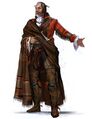 Concept art of Johnson by Jeff Simpson
 -
 Assassin's Creed: Memories art of Johnson
 -
 Johnson, in green, as depicted in The Death of General Wolfe
 -
 William Johnson as he appears in Rogue
 -
 Johnson speaking with Franklin about the colonies' unification
 -
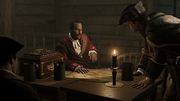 Johnson telling Haytham of his research's progress
 -
 Johnson with his fellow Colonial Templars
 -
 Johnson and the others disguised as Redcoats
 -
 Johnson at Shay's induction into the Templar Order
 -
 Johnson trying to intimidate the Iroquois
 -
 Connor assassinating Johnson


Behind the scenes[edit | edit source]
William Johnson is a historical character who first appeared in the 2012 video game Assassin's Creed III, where he was voiced by Canadian actor Julian Casey. Guy Sprung replaced Casey as Johnson's voice actor in 2014's Assassin's Creed: Rogue.
Johnson's presence at the Albany Congress in Rogue creates an issue with the games' timeline, as the Congress historically took place from 19 June to 11 July 1754, and Benjamin Franklin forwarded the Albany Plan on 10 July. However, in both Assassin's Creed III and Forsaken, Johnson was in Boston at this time. For the sake of simplicity, the Assassin's Creed Wiki assumes that, in the games' universe, Franklin forwarded the Albany Plan earlier than he did in real-life.
In the non-canonical mobile adaptation of Assassin's Creed III, Johnson is hunted down by Connor not for forcing the Iroquois to sell their land, but for fear that he would retaliate for the Boston Tea Party, as he knew the names of the protest's organizers. Connor obtains Johnson's location from a contact in Boston, learning that he is meeting at the town hall with his allies. On the way to the town hall, he postpones his hunt to defend the Sons of Liberty at the Tea Party, before moving on to his destination. Infiltrating the hall, Connor locates the dining room where Johnson sits in conference with his allies; he climbs on top of a giant chandelier, swings it towards the Templar, and cuts it loose to send it crashing onto him, killing Johnson.
Appearances[edit | edit source]
- Assassin's Creed III (first appearance)
- Assassin's Creed: Forsaken
- Assassin's Creed: Memories
- Assassin's Creed: Rogue
References[edit | edit source]

| ||||||||||||||||||||||||||||||||||
| |||||||||||||||||||||||||