

Merchant: Difference between revisions
imported>JazeBlack |
m Text replacement - "{{imageneed" to "{{Imageneed" Tag: Manual revert |
||
| (56 intermediate revisions by 25 users not shown) | |||
| Line 1: | Line 1: | ||
{{Era| | {{Era|Occupations}}{{WP-REAL}} | ||
[[File: | {{Update|''[[Assassin's Creed III: Liberation]], [[Assassin's Creed IV: Black Flag]], [[Assassin's Creed: Rogue]], [[Assassin's Creed: Unity]], [[Assassin's Creed: Origins]], [[Assassin's Creed: Odyssey]]'' and ''[[Assassin's Creed: Valhalla]]''}} | ||
''' | {{Revamp}} | ||
{{Imageneed|[[Assassin's Creed]], [[Assassin's Creed III: Liberation]], [[Assassin's Creed IV: Black Flag]], [[Assassin's Creed: Rogue]], [[Assassin's Creed: Unity]], [[Assassin's Creed: Odyssey]], and [[Assassin's Creed: Valhalla]]}} | |||
{{Quote|The world of merchants is like a card game where no one's in a hurry to show their hand.|Edward Kenway, 1725.|Assassin's Creed: Forgotten Temple|Assassin's Creed: Forgotten Temple Episode 24}} | |||
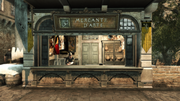
[[File:ACB Art Merchant Shop.png|thumb|250px|An art merchant's shop in [[Renaissance]] Rome]] | |||
A '''merchant''' is a person who buys and sells items and commodities. | |||
== | ==Types== | ||
*'''[[Art merchant]]s:''' Art merchants sold [[Treasure chest|treasure maps]] and [[painting gallery|paintings]] that, when hung in the [[Villa Auditore]] [[Painting gallery|art gallery]], increased [[Monteriggioni]]'s value.<ref name="AC2">''[[Assassin's Creed II]]''</ref> In [[Rome]], they also sold maps for [[flag]]s and [[feather]]s.<ref name="Brotherhood">''[[Assassin's Creed: Brotherhood]]''</ref> | |||
*'''[[Bank]]s:''' Banks kept a record of restoration efforts, and both collected and distributed funds that resulted from renovations.<ref name="Brotherhood" /> | |||
*'''[[Blacksmith]]s:''' Blacksmiths crafted and sold pieces of [[armor]] or weaponry. They also repaired broken armor, and sold various forms of ammunition; such as [[Hidden Gun|bullets]],<ref name="AC2" /> [[crossbow]] bolts,<ref name="Brotherhood" /> and [[Bombs|bomb ingredients]].<ref name="Revelations">''[[Assassin's Creed: Revelations]]''</ref> | |||
*'''[[Book shop]]s:''' Similarly to art merchants, book shops sold treasure maps, as well as a varied collection of books.<ref name="Revelations" /> | |||
*'''Cartographers:''' Cartographers sold maps which revealed the locations of wealth, gear and artifacts across the region.<ref name="ACV">''[[Assassin's Creed: Valhalla]]''</ref><ref name="ACM">''[[Assassin's Creed: Mirage]]''</ref> | |||
*'''[[Doctors]]:''' Doctors could treat injuries for a small fee. They also sold medicine and [[Poison Blade|poison vials]].<ref name="AC2" /> | |||
*'''[[Fast travel station|Fast travel booths]]:''' Fast travel booths allowed for easy travel to different locations throughout [[Italy]] for a sum, and acted similarly to fast forwarding a memory in the [[Animus]].<ref name="AC2" /> | |||
*Food merchants: These merchants sell a variety of food products ranging from fruit, vegetables, grains, meat and possibly dairy. | |||
*'''[[General store]]s:''' In the [[United States|American colonies]], general stores provided various kinds of items, including ranged and melee weapons, ammunition, maps, dyes, and [[hunting]] supplies.<ref name="AC3">''[[Assassin's Creed III]]''</ref> | |||
*'''[[Harbormaster]]s:''' Harbormasters sold upgrades for [[ships]].<ref name="AC3" /> They also bought goods such as sugar and [[rum]].<ref name="AC4">''[[Assassin's Creed IV: Black Flag]]''</ref> | |||
*'''Peddlers''' could be found riding [[Wagon|carts]] around tracks, selling consumables and paying for hunting spoils.<ref name="AC3" /> | |||
*'''[[Printer]]s:''' The men who produced pamphlets, books or [[wanted poster]]s could be paid to produce false propaganda.<ref name="AC3" /> | |||
*'''[[Tailor]]s:''' Tailors sold pouch upgrades to increase the amount of ammunition that could be carried at one time. They also offered several different options for [[Customization|clothes dyeing]].<ref name="AC2" /> After [[Leonardo da Vinci]] created their designs, tailors also began selling [[parachute]]s.<ref name="Brotherhood" /> | |||
== | ==Trading== | ||
[[Ezio Auditore da Firenze]] was also able to sell various items that he collected to the merchants of Rome. Virtually any item that could be stolen or looted could be sold for a portion of its value.<ref name="Brotherhood" /> | |||
Shops on [[Tiber Island]] also offered a selection of [[shop quests|special items]], which could be claimed in exchange for a number of rare items.<ref name="Brotherhood" /> Among these were: | |||
*'''Vatican treasure map''' – Art merchant | |||
*''' | *'''Seusenhofer armor pieces''' – Blacksmith | ||
*''' | *'''[[Captain's Sword]]''' – Blacksmith | ||
*''' | *'''Fast-acting poison''' – Doctor | ||
*''' | *'''Large pouch for crossbow bolts''' – Tailor | ||
*''' | |||
During the [[Golden Age of Piracy]], the [[Piracy|pirate]] [[Captains|captain]] and [[Assassins|Assassin]] [[Edward Kenway]] commanded a fleet from his hideout on [[Great Inagua]] that traded with many cities accessible by the [[Atlantic Ocean]].<ref name="AC4" /> | |||
The [[Kanien'kehá:ka]] Assassin [[Ratonhnhaké:ton]], Edward's grandson, was able to sell various hunting spoils at any general store in the colonial cities and the [[Frontier]] for a profit.<ref name="AC3" /> | |||
==Gallery== | |||
<gallery captionalign="center" position="center" widths="180"> | |||
AC2 Monteriggioni Art Merchant.png|Monteriggioni art merchant's shop | |||
AC2 Monteriggioni Blacksmith.png|Monteriggioni blacksmith's shop | |||
AC2 Monteriggioni Doctor.png|Monteriggioni doctor's shop | |||
AC2 Monteriggioni Tailor.png|Monteriggioni tailor's shop | |||
ACB Blacksmith Shop.png|A blacksmith's shop | |||
ACB Doctor Shop.png|A doctor's shop | |||
ACB Tailor Shop.png|A tailor's shop | |||
Ezio-bookshop.png|A book shop | |||
TJM 1.png|Ezio conversing with a rug merchant | |||
AC3 General Store Front.png|Front of a general store | |||
AC3 General Store.png|Interior of a general store | |||
A Spoonful of Syrup 01.jpg|A merchant selling [[Starrick's Soothing Syrup]] in [[Victorian era|Victorian]] [[London]] | |||
ACO Weaver.png|A weaver's shop in Ptolemaic Egypt | |||
ACO Blacksmith.jpg|A blacksmith shop in Ptolemaic Egypt | |||
ACOd-ship-merchantwood.jpg|A merchant ship carrying wood in 5th-century BCE Greece | |||
ACV Lunden - Merchant Shop.png|A merchant store in 9th-century Lunden | |||
ACMirage - Trader.png|A trader in 9th-century Baghdad | |||
ACMir Cartographer.jpg|A cartographer in Baghdad | |||
</gallery> | |||
==Trivia== | == Trivia == | ||
*In the PC version of ''[[Assassin's Creed]]'', there | *Merchant stalls in [[Altaïr Ibn-La'Ahad]]'s [[Third Crusade|time period]] served to be a handy escape option, as he could [[Freerunning|dive]] through them to avoid running through a crowd of citizens. | ||
**In the PC version of ''[[Assassin's Creed]]'', there was also a secondary mission called "[[Investigation|Merchant Stand Destruction]]", in which Altaïr needed to destroy a set number of merchant stands within a time limit. The explanation for this was that the targeted merchants were knowingly selling below par products that were causing illnesses or they were acting as spies on the populace on orders from the Templars. | |||
* In the Xbox 360 version of ''Assassin's Creed'', the '''"Gifted Escapist"''' [[Assassin's Creed achievements|achievement]] was unlocked for diving through twenty merchant stands. | |||
*Should Ezio walk under a merchant stall banner that indicated its type, the banner would move, even though he was too short for his head to touch it. | |||
*Should Ezio walk under | |||
== | ==Appearances== | ||
{{Incomplete list}} | |||
*''[[Assassin's Creed]]'' {{1st}} | |||
*''[[Assassin's Creed: Altaïr's Chronicles]]'' | |||
*''[[Assassin's Creed: Bloodlines]]'' | |||
*''[[Assassin's Creed II]]'' | |||
**''[[Bonfire of the Vanities (DLC)|Bonfire of the Vanities]]'' | |||
*''[[Assassin's Creed: Brotherhood]]'' | |||
**''[[The Da Vinci Disappearance]]'' | |||
**''[[Copernicus Conspiracy]]'' | |||
*''[[Assassin's Creed: Revelations]]'' | |||
*''[[Assassin's Creed III]]'' | |||
**''[[The Tyranny of King Washington]]'' | |||
*''[[Assassin's Creed III: Liberation]]'' | |||
*''[[Assassin's Creed IV: Black Flag]]'' | |||
**''[[Freedom Cry]]'' | |||
*''[[Assassin's Creed: Rogue]]'' | |||
*''[[Assassin's Creed: Unity]]'' | |||
**''[[Dead Kings]]'' | |||
*''[[Assassin's Creed: Syndicate]]'' | |||
*''[[Assassin's Creed: Origins]]'' | |||
**''[[The Hidden Ones (DLC)|The Hidden Ones]]'' | |||
**''[[The Curse of the Pharaohs]]'' | |||
*''[[Assassin's Creed: Odyssey]]'' | |||
**''[[Legacy of the First Blade]]'' | |||
**''[[The Fate of Atlantis]]'' | |||
*''[[Assassin's Creed: Valhalla]]'' | |||
**''[[Wrath of the Druids]]'' | |||
**''[[The Siege of Paris]]'' | |||
*''[[Assassin's Creed: Brotherhood of Venice]]'' {{Mo}} | |||
*''[[Assassin's Creed: Forgotten Temple]]'' | |||
*''[[Assassin's Creed: Mirage]]'' | |||
*''[[Assassin's Creed: Nexus VR]]'' {{Mdat}} | |||
*''[[Assassin's Creed: Shadows]]'' | |||
{{ | ==References== | ||
{{Reflist}} | |||
{{AC2}} | |||
{{ACBH}} | {{ACBH}} | ||
[[Category:Occupations]] | |||
[[Category:Merchants| ]] | |||
[[Category: | |||
[[Category: | |||
Latest revision as of 16:40, 4 August 2026

|
Patience, brothers. Soon we will reveal the secrets of Assassin's Creed III: Liberation, Assassin's Creed IV: Black Flag, Assassin's Creed: Rogue, Assassin's Creed: Unity, Assassin's Creed: Origins, Assassin's Creed: Odyssey and Assassin's Creed: Valhalla. This article has been identified as being out of date. Please update the article to reflect recent releases and then remove this template once done. |

|
Ezio, my friend! How may I be of service? This article is in desperate need of a revamp. Please improve it in any way necessary in order for it to achieve a higher standard of quality in accordance with our Manual of Style. |

|
Where are the paintings? This article is in need of more images and/or better quality pictures from Assassin's Creed, Assassin's Creed III: Liberation, Assassin's Creed IV: Black Flag, Assassin's Creed: Rogue, Assassin's Creed: Unity, Assassin's Creed: Odyssey, and Assassin's Creed: Valhalla in order to achieve a higher status. You can help the Assassin's Creed Wiki by uploading better images on this page. |

A merchant is a person who buys and sells items and commodities.
Types[edit | edit source]
- Art merchants: Art merchants sold treasure maps and paintings that, when hung in the Villa Auditore art gallery, increased Monteriggioni's value.[1] In Rome, they also sold maps for flags and feathers.[2]
- Banks: Banks kept a record of restoration efforts, and both collected and distributed funds that resulted from renovations.[2]
- Blacksmiths: Blacksmiths crafted and sold pieces of armor or weaponry. They also repaired broken armor, and sold various forms of ammunition; such as bullets,[1] crossbow bolts,[2] and bomb ingredients.[3]
- Book shops: Similarly to art merchants, book shops sold treasure maps, as well as a varied collection of books.[3]
- Cartographers: Cartographers sold maps which revealed the locations of wealth, gear and artifacts across the region.[4][5]
- Doctors: Doctors could treat injuries for a small fee. They also sold medicine and poison vials.[1]
- Fast travel booths: Fast travel booths allowed for easy travel to different locations throughout Italy for a sum, and acted similarly to fast forwarding a memory in the Animus.[1]
- Food merchants: These merchants sell a variety of food products ranging from fruit, vegetables, grains, meat and possibly dairy.
- General stores: In the American colonies, general stores provided various kinds of items, including ranged and melee weapons, ammunition, maps, dyes, and hunting supplies.[6]
- Harbormasters: Harbormasters sold upgrades for ships.[6] They also bought goods such as sugar and rum.[7]
- Peddlers could be found riding carts around tracks, selling consumables and paying for hunting spoils.[6]
- Printers: The men who produced pamphlets, books or wanted posters could be paid to produce false propaganda.[6]
- Tailors: Tailors sold pouch upgrades to increase the amount of ammunition that could be carried at one time. They also offered several different options for clothes dyeing.[1] After Leonardo da Vinci created their designs, tailors also began selling parachutes.[2]
Trading[edit | edit source]
Ezio Auditore da Firenze was also able to sell various items that he collected to the merchants of Rome. Virtually any item that could be stolen or looted could be sold for a portion of its value.[2]
Shops on Tiber Island also offered a selection of special items, which could be claimed in exchange for a number of rare items.[2] Among these were:
- Vatican treasure map – Art merchant
- Seusenhofer armor pieces – Blacksmith
- Captain's Sword – Blacksmith
- Fast-acting poison – Doctor
- Large pouch for crossbow bolts – Tailor
During the Golden Age of Piracy, the pirate captain and Assassin Edward Kenway commanded a fleet from his hideout on Great Inagua that traded with many cities accessible by the Atlantic Ocean.[7]
The Kanien'kehá:ka Assassin Ratonhnhaké:ton, Edward's grandson, was able to sell various hunting spoils at any general store in the colonial cities and the Frontier for a profit.[6]
Gallery[edit | edit source]
-
 Monteriggioni art merchant's shop
 -
 Monteriggioni blacksmith's shop
 -
 Monteriggioni doctor's shop
 -
 Monteriggioni tailor's shop
 -
 A blacksmith's shop
 -
 A doctor's shop
 -
 A tailor's shop
 -
 A book shop
 -
 Ezio conversing with a rug merchant
 -
 Front of a general store
 -
 Interior of a general store
 -

-
 A weaver's shop in Ptolemaic Egypt
 -
 A blacksmith shop in Ptolemaic Egypt
 -
 A merchant ship carrying wood in 5th-century BCE Greece
 -
 A merchant store in 9th-century Lunden
 -
 A trader in 9th-century Baghdad
 -
 A cartographer in Baghdad


Trivia[edit | edit source]
- Merchant stalls in Altaïr Ibn-La'Ahad's time period served to be a handy escape option, as he could dive through them to avoid running through a crowd of citizens.
- In the PC version of Assassin's Creed, there was also a secondary mission called "Merchant Stand Destruction", in which Altaïr needed to destroy a set number of merchant stands within a time limit. The explanation for this was that the targeted merchants were knowingly selling below par products that were causing illnesses or they were acting as spies on the populace on orders from the Templars.
- In the Xbox 360 version of Assassin's Creed, the "Gifted Escapist" achievement was unlocked for diving through twenty merchant stands.
- Should Ezio walk under a merchant stall banner that indicated its type, the banner would move, even though he was too short for his head to touch it.
Appearances[edit | edit source]
 This list is incomplete. You can help the Assassin's Creed Wiki by expanding it. This list is incomplete. You can help the Assassin's Creed Wiki by expanding it.
|
|---|
- Assassin's Creed (first appearance)
- Assassin's Creed: Altaïr's Chronicles
- Assassin's Creed: Bloodlines
- Assassin's Creed II
- Assassin's Creed: Brotherhood
- Assassin's Creed: Revelations
- Assassin's Creed III
- Assassin's Creed III: Liberation
- Assassin's Creed IV: Black Flag
- Assassin's Creed: Rogue
- Assassin's Creed: Unity
- Assassin's Creed: Syndicate
- Assassin's Creed: Origins
- Assassin's Creed: Odyssey
- Assassin's Creed: Valhalla
- Assassin's Creed: Brotherhood of Venice (mentioned only)
- Assassin's Creed: Forgotten Temple
- Assassin's Creed: Mirage
- Assassin's Creed: Nexus VR (mentioned in Database entry only)
- Assassin's Creed: Shadows
References[edit | edit source]
| |||||||||||||||||||||||||||||||||||||
- Articles that need updating
- Articles revamp
- Articles needing images from Assassin's Creed
- Articles needing images from AC3 Liberation
- Articles needing images from Assassin's Creed IV: Black Flag
- Articles needing images from AC Rogue
- Articles needing images from AC Unity
- Articles needing images from AC Odyssey
- Articles needing images from AC Valhalla
- Articles with incomplete lists
- Occupations
- Merchants