

Luxembourg Palace: Difference between revisions
imported>Crookandcharlatan This one counts, right? |
mNo edit summary |
||
| (18 intermediate revisions by 10 users not shown) | |||
| Line 1: | Line 1: | ||
{{Era| | {{Era|Landmarks}}{{WP-REAL}} | ||
{{WP-REAL}} | {{Quote|In the playground of the wealthy, assembled by the Medici clan. The grand foyer will transport, to the highest social ranks.|A riddle by [[Nostradamus]] describing the Luxembourg Palace.|Assassin's Creed: Unity}} | ||
{{Landmark Infobox | {{Landmark Infobox | ||
|image = ACU Luxembourg | |image = ACU Palais du Luxembourg.png | ||
|description = A grand [[Paris]]ian palace that serves as the seat of the {{Wiki|Senate (France)|French Senate}}. | |description = A grand [[Paris]]ian palace that serves as the seat of the {{Wiki|Senate (France)|French Senate}}. | ||
|location = Paris, [[France]] | |location = [[Le Quartier Latin]], Paris, [[France]] | ||
|architect = Salomon de Brosse | |architect = [[Salomon de Brosse]] | ||
|dateconstructed = 1615 – 1645 | |dateconstructed = 1615 – 1645 | ||
|functions = Residence<br>Museum<br>Prison | |functions = Residence<br>Museum<br>Prison | ||
|features = [[ | |features = [[Viewpoint]] | ||
}} | }} | ||
'''Luxembourg Palace''' (French: ''Palais du Luxembourg'') is a palace located in [[Paris]], [[France]]. Originally conceived as a royal residence for [[Marie de' Medici]], it went on to become a museum, a prison, and finally | '''Luxembourg Palace''' (French: ''Palais du Luxembourg'') is a palace located in [[Paris]], [[France]]. Originally conceived as a royal residence for [[Marie de' Medici]], it went on to become a museum, a prison, and finally the seat of the {{Wiki|Senate (France)|French Senate}}, a function it still upholds today. | ||
==History== | ==History== | ||
In 1612, Marie de' Medici, widow of [[Henry IV of France|King Henry IV]], purchased an extensive domain from the Duke of Piney-Luxembourg, with the intention of erecting a new palace for herself. The residence was constructed along designs of the French architect Salomon de Brosse. Although the proprietress referred to her new home as the Medici Palace, the Parisians insisted on calling it the Luxembourg Palace, due to their dislike of the queen.<ref name=" | In 1612, Marie de' Medici, widow of [[Henry IV of France|King Henry IV]], purchased an extensive domain from the Duke of Piney-Luxembourg, with the intention of erecting a new palace for herself. The residence was constructed along designs of the French architect [[Salomon de Brosse]]. Although the proprietress referred to her new home as the Medici Palace, the Parisians insisted on calling it the Luxembourg Palace, due to their dislike of the queen.<ref name="Database">''[[Assassin's Creed: Unity]]'' – [[Database: Palais et Jardin du Luxembourg]]</ref> | ||
In 1750, the Luxembourg Palace became the first museum in Paris, allowing visitors to glimpse the royal collection.<ref name=" | In 1750, the Luxembourg Palace became the first museum in Paris, allowing visitors to glimpse the royal collection.<ref name="Database" /> [[Louis XVI of France|King Louis XVI]] would also gift the palace to his [[Louis XVIII of France|brother]] in 1778.<ref name="PW">''[[Project Widow]]''</ref> When the [[French Revolution]] broke out, the collection was supposed to be transferred to the [[Louvre]], but the local nobility kept some pieces to themselves. In response, the [[French Assassins|Parisian Brotherhood]] sent agents to procure the stolen art, ensuring it would end up in the Louvre as intended.<ref name="ACU">''Assassin's Creed: Unity''</ref> | ||
In 1792, [[Templars|Templar]] [[Marie Lévesque]] hoarded large amounts of grain to sow chaos and discontent amongst the people, hiding the stolen food in the palace's wine cellars. On October the 31st, she organized a gala at the palace, with the intention of having the visitors discover the grain. The citizens of Paris would believe the royal family had been hoarding food in the time of famine, which would add to the growing anti-Royalist sentiment. However, Marie's plans were sabotaged when she was assassinated at her own party by the [[Assassins|Assassin]] [[Arno Dorian]].<ref name="ACU"/> | In 1792, [[Templars|Templar]] [[Marie Lévesque]] hoarded large amounts of grain to sow chaos and discontent amongst the people, hiding the stolen food in the palace's wine cellars. On October the 31st, she organized a gala at the palace, with the intention of having the visitors discover the grain. The citizens of Paris would believe the royal family had been hoarding food in the time of famine, which would add to the growing anti-Royalist sentiment. However, Marie's plans were sabotaged when she was assassinated at her own party by the [[Assassins|Assassin]] [[Arno Dorian]].<ref name="ACU"/> | ||
Soon after, in 1793, the Luxembourg Palace was briefly converted into the "Maison Nationale de Sûreté", or national prison, as the other prisons could no longer | Soon after, in 1793, the Luxembourg Palace was briefly converted into the "Maison Nationale de Sûreté", or national prison, as the other prisons could no longer accommodate the large number of convicts.<ref name="Database" /> Some historians believe that this was a symbolic move, due to the palace's association with the royal family.<ref name="PW"/> [[Georges Danton]], [[Camille Desmoulins]], [[Antoine Lavoisier]], and many others were imprisoned there prior to their execution by guillotine.<ref name="ACU"/> | ||
In 1801, [[Napoleon Bonaparte]] offered the building to the French Senate, which it still houses today. In 1836, the architect Alphonse de Gisors oversaw transformations that modified the overall structure to a great extent. The gardens still remain a favorite among Parisians.<ref name=" | In 1801, [[Napoleon Bonaparte]] offered the building to the French Senate, which it still houses today. In 1836, the architect [[Alphonse de Gisors]] oversaw transformations that modified the overall structure to a great extent. The gardens still remain a favorite among Parisians.<ref name="Database" /> | ||
==Trivia== | ==Trivia== | ||
| Line 27: | Line 27: | ||
==Gallery== | ==Gallery== | ||
<gallery captionalign="center" position="center | <gallery captionalign="center" position="center" widths="180"> | ||
ACU Luxembourg Palace.png|Luxembourg Palace at night | |||
ACU-Royalty concept.jpg|Concept art of the palace | ACU-Royalty concept.jpg|Concept art of the palace | ||
ACU Luxembourg Palace - Concept Art.jpg|Concept art of the palace's inner courtyard | ACU Luxembourg Palace - Concept Art.jpg|Concept art of the palace's inner courtyard | ||
| Line 34: | Line 35: | ||
ACU Luxembourg Palace Trophy Room - Concept Art.jpg|Concept art of the palace's trophy room | ACU Luxembourg Palace Trophy Room - Concept Art.jpg|Concept art of the palace's trophy room | ||
ACU Festivities - Concept Art.jpg|Concept art of a party at the palace | ACU Festivities - Concept Art.jpg|Concept art of a party at the palace | ||
PW Palais de Luxembourg.jpg|An illustration of the palace | |||
ACU It Belongs in a Museum 2.png|Arno overlooking the entrance to Luxembourg Palace | |||
ACU It Belongs in a Museum 4.png|A view of Luxembourg Palace from the east | |||
ACU It Belongs in a Museum 5.png|The southwest entrance of Luxembourg Palace | |||
</gallery> | </gallery> | ||
==Appearances== | |||
*''[[Assassin's Creed: Unity]]'' | |||
==References== | ==References== | ||
| Line 41: | Line 49: | ||
[[Category:Prisons]] | [[Category:Prisons]] | ||
[[Category:Landmarks in Paris]] | [[Category:Landmarks in Paris]] | ||
[[Category:Viewpoints]] | |||
Latest revision as of 20:32, 2 May 2026
- "In the playground of the wealthy, assembled by the Medici clan. The grand foyer will transport, to the highest social ranks."
- ―A riddle by Nostradamus describing the Luxembourg Palace.[src]
Luxembourg Palace (French: Palais du Luxembourg) is a palace located in Paris, France. Originally conceived as a royal residence for Marie de' Medici, it went on to become a museum, a prison, and finally the seat of the French Senate, a function it still upholds today.
History[edit | edit source]
In 1612, Marie de' Medici, widow of King Henry IV, purchased an extensive domain from the Duke of Piney-Luxembourg, with the intention of erecting a new palace for herself. The residence was constructed along designs of the French architect Salomon de Brosse. Although the proprietress referred to her new home as the Medici Palace, the Parisians insisted on calling it the Luxembourg Palace, due to their dislike of the queen.[1]
In 1750, the Luxembourg Palace became the first museum in Paris, allowing visitors to glimpse the royal collection.[1] King Louis XVI would also gift the palace to his brother in 1778.[2] When the French Revolution broke out, the collection was supposed to be transferred to the Louvre, but the local nobility kept some pieces to themselves. In response, the Parisian Brotherhood sent agents to procure the stolen art, ensuring it would end up in the Louvre as intended.[3]
In 1792, Templar Marie Lévesque hoarded large amounts of grain to sow chaos and discontent amongst the people, hiding the stolen food in the palace's wine cellars. On October the 31st, she organized a gala at the palace, with the intention of having the visitors discover the grain. The citizens of Paris would believe the royal family had been hoarding food in the time of famine, which would add to the growing anti-Royalist sentiment. However, Marie's plans were sabotaged when she was assassinated at her own party by the Assassin Arno Dorian.[3]
Soon after, in 1793, the Luxembourg Palace was briefly converted into the "Maison Nationale de Sûreté", or national prison, as the other prisons could no longer accommodate the large number of convicts.[1] Some historians believe that this was a symbolic move, due to the palace's association with the royal family.[2] Georges Danton, Camille Desmoulins, Antoine Lavoisier, and many others were imprisoned there prior to their execution by guillotine.[3]
In 1801, Napoleon Bonaparte offered the building to the French Senate, which it still houses today. In 1836, the architect Alphonse de Gisors oversaw transformations that modified the overall structure to a great extent. The gardens still remain a favorite among Parisians.[1]
Trivia[edit | edit source]
- Marie de' Medici had instructed the original architect to design the Luxembourg Palace to look similar to the Palazzo Pitti from her native Florence.
Gallery[edit | edit source]
-
 Luxembourg Palace at night
 -
 Concept art of the palace
 -
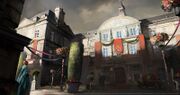 Concept art of the palace's inner courtyard
 -
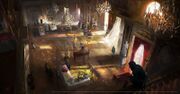 Concept art of one of the palace's ballrooms
 -
 Concept art of one of the palace's ballrooms
 -
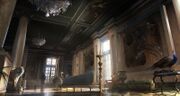 Concept art of the palace's trophy room
 -
 Concept art of a party at the palace
 -
 An illustration of the palace
 -
 Arno overlooking the entrance to Luxembourg Palace
 -
 A view of Luxembourg Palace from the east
 -
 The southwest entrance of Luxembourg Palace


Appearances[edit | edit source]
References[edit | edit source]
- ↑ 1.0 1.1 1.2 1.3 Assassin's Creed: Unity – Database: Palais et Jardin du Luxembourg
- ↑ 2.0 2.1 Project Widow
- ↑ 3.0 3.1 3.2 Assassin's Creed: Unity