


Louis-Michel le Peletier: Difference between revisions
imported>Bovkaffe No edit summary |
|||
| (55 intermediate revisions by 31 users not shown) | |||
| Line 1: | Line 1: | ||
{{Era| | {{Era|Individuals|Templars}}{{WP-REAL|Louis-Michel le Peletier, marquis de Saint-Fargeau}} | ||
{{WP-REAL|Louis-Michel le Peletier, marquis de Saint-Fargeau | {{Quote|Ah, dear Louis. He went from abolishing the death penalty to calling for the King's head in two short years.|Marquis de Sade describing le Peletier to Arno Dorian, 1793.|Assassin's Creed: Unity|A Dinner Engagement}} | ||
{{Quote|Ah, dear Louis. He went from abolishing the death penalty to calling for the King's head in two short years.| | |||
{{Character Infobox | {{Character Infobox | ||
|name = Louis-Michel le Peletier | |||
|image = ACU Louis Michel Le Peletier.png | |image = ACU Louis Michel Le Peletier.png | ||
|birth = 29 May 1760<br>[[Paris]], [[ | |birth = 29 May 1760<br>[[Paris]], [[Kingdom of France]] | ||
|death = 20 January 1793 | |death = 20 January 1793 {{c|aged 32}}<br>Paris, [[France|French Republic]] | ||
|affiliates = [[Templars]] {{C|c. | |species = [[Human]] | ||
|database = [[Database: Louis-Michel Le Peletier|Louis-Michel Le Peletier]] | |||
|affiliates = [[Templars]] | |||
'''Louis-Michel le Peletier, Marquis de Saint-Fargeau''' (1760 – 1793) | *[[Parisian Rite of the Templar Order|French Rite]] {{C|c. 1779 – death}} | ||
[[National Convention]] | |||
}} | |||
'''Louis-Michel le Peletier, Marquis de Saint-Fargeau''' (1760 – 1793) was a [[France|French]] nobleman and politician active during the [[French Revolution]], and a member of the [[Parisian Rite of the Templar Order|Parisian Rite]] of the [[Templars|Templar Order]]. | |||
An advisor of [[Grand Master of the Templar Order|Grand Master]] [[François de la Serre]] from a young age, he eventually sided with [[François-Thomas Germain]] and plotted against de la Serre. Le Peletier was responsible for casting the final vote that condemned King [[Louis XVI of France|Louis XVI]] to death. On the night before the [[Execution of Louis XVI|execution]], le Peletier was killed inside the [[Palais-Royal]] by the [[Assassins|Assassin]] [[Arno Dorian]]. | |||
==Biography== | ==Biography== | ||
===Early life=== | ===Early life=== | ||
Le Peletier was born in [[Paris]] in 1760 | Le Peletier was born in [[Paris]] in 1760 to a noble family and joined the Templar Order at a young age. A promising youth, he became a member of the {{Wiki|Parlement|Paris Parliament}} in 1779. Despite being under the age limit, he was admitted with special permission, most likely because of Templar involvement.<ref name="Database">''[[Assassin's Creed: Unity]]'' – [[Database: Louis-Michel Le Peletier]]</ref> | ||
By 1789, le Peletier had become an advisor for Grand Master François de la Serre along with [[Charles Gabriel Sivert]], [[Marie Lévesque]], and [[Chrétien Lafrenière]]. Le Peletier and the others often disagreed with de la Serre, and all of them, excluding Lafrenière, held him in low regard and secretly coveted for themselves and their own families to take the mantle of Grand Master.<ref>[[Assassin's Creed: Unity (novel)|''Assassin's Creed: Unity'' novel]]</ref> | |||
===Joining Germain and early revolution=== | ===Joining Germain and early revolution=== | ||
Around 1774, le Peletier's fellow Templar François-Thomas Germain was expelled from the Templar Order due to his radical ideas. Inspired by the writings of [[Jacques de Molay]], Germain envisioned a [[Capitalism|capitalist]] society in which the nobility was stripped of its power, and the rising middle class would gain power. This way, the Templars would be able to exert control over the populace more subtly. Eventually, le Peletier secretly joined Germain's faction of the Order along with Lévesque and Sivert.<ref>''Assassin's Creed: Unity'' – [[The Temple]]</ref> | |||
Le Peletier continued to rise in the Parliament until 1789, when he was elected to the [[Estates-General of 1789|Estates-General]] as a deputy for the nobility's Second Estate. | Le Peletier continued to rise in the Parliament until 1789, when he was elected to the [[Estates-General of 1789|Estates-General]] as a deputy for the nobility's Second Estate. Le Peletier abandoned his aristocratic origins, symbolically giving up his titles of nobility. Through supporting the [[Third Estate]], he became an ardent defender of the people's cause.<ref name="Database"/> | ||
As the revolution broke out, Germain had his followers create as much chaos as possible by exploiting dissatisfaction with the monarchy. However, they were not told about the purpose of their activities. Being a lawyer, le Peletier took part in writing a draft of a criminal code, including a point for the abolition of death penalty. Although the idea was dismissed, it led to le Peletier serving as the president of the | [[File:High Society 7.png|thumb|250px|left|Le Peletier talking to Lafrenière and Lévesque at the soirée]] | ||
On 5 May, le Peletier attended the [[Initiation into the Templar Order|induction]] soirée for de la Serre's daughter [[Élise de la Serre|Élise]] at the [[Palace of Versailles]] with Lévesque, Sivert, and Lafrenière. After Lafrenière remarked that they had not seen each other in a long time, le Peletier tried to recall the last time they had all been together but was quickly stopped by Lévesque. Later during the soirée, Sivert and his fellow Templar, the [[Roi des Thunes]], killed de la Serre in the palace gardens, framing the Grand Master's adopted son Arno Dorian for the murder.<ref>''Assassin's Creed: Unity'' – [[High Society]]</ref> | |||
As the revolution broke out, Germain had his followers create as much chaos as possible by exploiting dissatisfaction with the [[monarchy]]. However, they were not told about the purpose of their activities.<ref name="TheJacobinClub">''Assassin's Creed: Unity'' – [[The Jacobin Club]]</ref> Being a lawyer, le Peletier took part in writing a draft of a criminal code, including a point for the abolition of death penalty. Although the idea was dismissed, it led to le Peletier serving as the president of the {{Wiki|National Constituent Assembly (France)|National Constituent Assembly}} from 21 June to 5 July 1790.<ref name="Database"/> | |||
===Meeting with Germain and condemning Louis=== | ===Meeting with Germain and condemning Louis=== | ||
{{Dialogue|Germain|The King must be seen as a criminal and a traitor. Only then, when he is executed like a common villain, can we show the world Jacques de Molay's great truth.|Le Peletier|You may show the world what truths you like, Grand Master. What I do, I do for the good of France.|Le Peletier with Germain at the Templar meeting, 1791.|Assassin's Creed: Unity}} | {{Dialogue|Germain|The King must be seen as a criminal and a traitor. Only then, when he is executed like a common villain, can we show the world Jacques de Molay's great truth.|Le Peletier|You may show the world what truths you like, Grand Master. What I do, I do for the good of France.|Le Peletier with François-Thomas Germain at the Templar meeting, 1791.|Assassin's Creed: Unity|A Dinner Engagement}} | ||
On the evening of 31 March 1791, le Peletier and Lévesque went to the [[Hôtel de Beauvais]] to meet with Germain, who would explain the reason behind their orders. Since Lafrenière had discovered their betrayal of de la Serre, Lévesque feared that he would retaliate. Their fellow Templar [[Aloys la Touche]] informed them however, that Lafrenière had been killed hours earlier. Arno, now an Assassin, had been manipulated by Germain into killing Lafrenière, who had intended to strike at Germain's faction. | On the evening of 31 March 1791, le Peletier and Lévesque went to the [[Hôtel de Beauvais]] to meet with Germain, who would explain the reason behind their orders. Since Lafrenière had discovered their betrayal of de la Serre, Lévesque feared that he would retaliate. Their fellow Templar [[Aloys la Touche]] informed them however, that Lafrenière had been killed hours earlier. Arno, now an [[Assassins|Assassin]], had been manipulated by Germain into killing Lafrenière, who had intended to strike at Germain's faction.<ref name="TheJacobinClub"/> | ||
[[File:A Dinner Engagement 13.png|thumb|250px|Le Peletier at the vote for Louis' execution]] | [[File:A Dinner Engagement 13.png|thumb|250px|Le Peletier at the vote for Louis' execution]] | ||
At the meeting, [[Frédéric Rouille]] presented evidence that King Louis had been plotting against the revolution. At Germain's request, le Peletier ensured that this evidence would become public. While a member of the [[National Convention]], le Peletier worked covertly on a draft about education, suggesting that males and females were taught revolutionary ideas in state-run schools. Renouncing his opposition to the death penalty, he cast the deciding 361st vote for Louis' execution in 1793. | At the meeting, [[Frédéric Rouille]] presented evidence that King Louis had been plotting against the revolution. At Germain's request, le Peletier ensured that this evidence would become public.<ref name="TheJacobinClub"/> While a member of the [[National Convention]], le Peletier worked covertly on a draft about education, suggesting that males and females were taught revolutionary ideas in state-run schools.<ref name="Database"/> Renouncing his opposition to the death penalty, he cast the deciding 361st vote for Louis' execution in 1793.<ref name="ADinnerEngagement">''Assassin's Creed: Unity'' – [[A Dinner Engagement]]</ref> | ||
Pleased with le Peletier's vote, Germain claimed that he looked forward to witnessing Louis' death. Le Peletier then assured the Grand Master that he would personally see to it that he was given a proper viewing spot at the execution. | While reporting back to Germain, he claimed to have voted in accordance with what he belived best for France, rather than the Grand Master's visions sparked by de Molay. Pleased with le Peletier's vote, Germain claimed that he looked forward to witnessing Louis' death. Le Peletier then assured the Grand Master that he would personally see to it that he was given a proper viewing spot at the execution.<ref name="ADinnerEngagement"/> | ||
===Death=== | ===Death=== | ||
{{Quote|So. I thank you at least for sparing my daughter the sight of this. All that I've done has been for the good of my country, my people, and my family. Ah. But you are unmoved. So be it. If it must be done, let it be done swiftly. Do it!|Le Peletier | {{Quote|So. I thank you at least for sparing my daughter the sight of this. All that I've done has been for the good of my country, my people, and my family. Ah. But you are unmoved. So be it. If it must be done, let it be done swiftly. Do it!|Le Peletier's final words to Arno, 1793.|Assassin's Creed: Unity|A Dinner Engagement}} | ||
In celebration of the King's imminent execution, le Peletier attended a party at the Palais-Royal with his daughter | In celebration of the King's imminent execution, le Peletier attended a party at the Palais-Royal with his daughter [[Louise-Suzanne le Peletier|Louise-Suzanne]], dining at the Café Fevrier. Unbeknownst to him, Arno was also present. As le Peletier called for a bottle of [[wine]], Arno placed a bottle cut with {{Wiki|Lead(II) acetate|lead sugar}} at the bar. This bottle was served to le Peletier, who soon began to feel the [[poison]]'s effects.<ref name="ADinnerEngagement"/> | ||
Telling his daughter to find her nurse, le Peletier went into a hallway, where Arno confronted him. There, he told Arno that he was glad to see his daughter spared the sight of his death. He then claimed that all of his actions were done for the good of France, its people, and his own family. Noting that Arno was unmoved by this, he told the Assassin to kill him quickly. Arno complied, stabbing him with his [[Hidden Blade]]. The Assassin then saw a vision of le Peletier's memories, through which he discovered that Germain would be present at the [[Place de la Concorde|Place de la Révolution]] the following morning.<ref name="ADinnerEngagement"/> | |||
===Legacy=== | |||
Following his death, le Peletier was initially buried in the [[Panthéon]] of Paris as a national hero.<ref name="Database"/> [[Jacques-Louis David]] would also paint a portrait, ''{{Wiki|The Last Moments of Michel Lepeletier}}'', which Louise-Suzanne later acquired and destroyed as well as any reproductions of it.<ref>''Assassin's Creed: Unity'' – [[Database: Louise-Suzanne Le Peletier]]</ref> | |||
==Personality and traits== | |||
Le Peletier was unusual compared to the other Templars in Germain's faction in that he seemed to believe in the revolution and the execution of King Louis by their own merits, and not merely as a means of advancing Templar control over France as advocated by Jacques de Molay. He could also be rather fastidious, insisting on clean windows in his office and hating drafty rooms.<ref name="ADinnerEngagement"/> | |||
Additionally, le Peletier was a loving father, sending his daughter Louise-Suzanne home when he was poisoned and showing relief in his final moments that she would be spared the sight of his death.<ref name="ADinnerEngagement"/> | |||
==Behind the scenes== | |||
Historically, while le Peletier did vote to execute the King, his vote was not a tie-breaker, as the votes had a majority of 387 for death over 334 against execution.<ref>{{Cite web|url=https://books.google.co.in/books?id=0sigPXBq4IEC&pg=PA194|title=The King's Trial: The French Revolution Vs. Louis XVI|author=Jordan, David P.|date=1 January 1979|publisher=''{{Wiki|University of California Press}}''|accessdate=13 March 2022}}, p. 194</ref> However, because le Peletier had voted for Louis' death, the Royalist soldier and ''{{Wiki|Gardes du Corps du Roi (France)|Garde du corps}}'' member Philippe Nicolas Marie de Pâris assassinated him on the eve of the execution.<ref>{{WP|Louis-Michel le Peletier, marquis de Saint-Fargeau}}</ref> | |||
Le Peletier and Germain are the only main targets in ''[[Assassin's Creed: Unity]]'' to speak with Arno and explain their motives before being killed, though it is entirely possible to assassinate le Peletier before he has the chance to confess. | |||
==Gallery== | |||
<gallery captionalign="center" position="center" widths="180"> | |||
Le Peletier Assassination Profile.jpg|Le Peletier's assassination profile | |||
A Dinner Engagement 12.png|Le Peletier and Marie Lévesque meeting with Germain | |||
A Dinner Engagement 14.png|Le Peletier informing Germain of King Louis' fate | |||
A Dinner Engagement 7.png|Le Peletier meeting [[Jean-Lambert Tallien]] | |||
</gallery> | |||
==Appearances== | |||
*''[[Assassin's Creed: Unity]]'' {{1st}} | |||
*[[Assassin's Creed: Unity (novel)|''Assassin's Creed: Unity'' novel]] | |||
== | ==References== | ||
{{Reflist}} | |||
{{ACU}} | {{ACU}} | ||
{{DEFAULTSORT:Peletier | {{DEFAULTSORT:Peletier, Louis-Michel le}} | ||
<!--[de:Louis-Michel Le Peletier] | |||
[es:Louis-Michel le Peletier] | |||
[fr:Louis-Michel Le Peletier] | |||
[it:Louis-Michel le Peletier] | |||
[pl:Louis-Michel le Peletier] | |||
[ru:Луи Мишель Лепелетье] | |||
[zh:路易-米歇尔·勒佩莱蒂耶]--> | |||
[[Category:1760 births]] | [[Category:1760 births]] | ||
[[Category:1793 deaths]] | [[Category:1793 deaths]] | ||
[[Category:Individuals]] | [[Category:Individuals]] | ||
[[Category: | [[Category:French people]] | ||
[[Category:Parisians]] | |||
[[Category:Lawyers]] | [[Category:Lawyers]] | ||
[[Category:Politicians]] | |||
[[Category:Regicides]] | |||
[[Category:Marquesses]] | [[Category:Marquesses]] | ||
[[Category:Freemasons]] | [[Category:Freemasons]] | ||
[[Category:National Convention]] | [[Category:National Convention]] | ||
[[Category:Templars]] | [[Category:Templars]] | ||
[[Category: | [[Category:French Templars]] | ||
Latest revision as of 18:04, 11 May 2026
Louis-Michel le Peletier, Marquis de Saint-Fargeau (1760 – 1793) was a French nobleman and politician active during the French Revolution, and a member of the Parisian Rite of the Templar Order.
An advisor of Grand Master François de la Serre from a young age, he eventually sided with François-Thomas Germain and plotted against de la Serre. Le Peletier was responsible for casting the final vote that condemned King Louis XVI to death. On the night before the execution, le Peletier was killed inside the Palais-Royal by the Assassin Arno Dorian.
Biography[edit | edit source]
Early life[edit | edit source]
Le Peletier was born in Paris in 1760 to a noble family and joined the Templar Order at a young age. A promising youth, he became a member of the Paris Parliament in 1779. Despite being under the age limit, he was admitted with special permission, most likely because of Templar involvement.[1]
By 1789, le Peletier had become an advisor for Grand Master François de la Serre along with Charles Gabriel Sivert, Marie Lévesque, and Chrétien Lafrenière. Le Peletier and the others often disagreed with de la Serre, and all of them, excluding Lafrenière, held him in low regard and secretly coveted for themselves and their own families to take the mantle of Grand Master.[2]
Joining Germain and early revolution[edit | edit source]
Around 1774, le Peletier's fellow Templar François-Thomas Germain was expelled from the Templar Order due to his radical ideas. Inspired by the writings of Jacques de Molay, Germain envisioned a capitalist society in which the nobility was stripped of its power, and the rising middle class would gain power. This way, the Templars would be able to exert control over the populace more subtly. Eventually, le Peletier secretly joined Germain's faction of the Order along with Lévesque and Sivert.[3]
Le Peletier continued to rise in the Parliament until 1789, when he was elected to the Estates-General as a deputy for the nobility's Second Estate. Le Peletier abandoned his aristocratic origins, symbolically giving up his titles of nobility. Through supporting the Third Estate, he became an ardent defender of the people's cause.[1]

On 5 May, le Peletier attended the induction soirée for de la Serre's daughter Élise at the Palace of Versailles with Lévesque, Sivert, and Lafrenière. After Lafrenière remarked that they had not seen each other in a long time, le Peletier tried to recall the last time they had all been together but was quickly stopped by Lévesque. Later during the soirée, Sivert and his fellow Templar, the Roi des Thunes, killed de la Serre in the palace gardens, framing the Grand Master's adopted son Arno Dorian for the murder.[4]
As the revolution broke out, Germain had his followers create as much chaos as possible by exploiting dissatisfaction with the monarchy. However, they were not told about the purpose of their activities.[5] Being a lawyer, le Peletier took part in writing a draft of a criminal code, including a point for the abolition of death penalty. Although the idea was dismissed, it led to le Peletier serving as the president of the National Constituent Assembly from 21 June to 5 July 1790.[1]
Meeting with Germain and condemning Louis[edit | edit source]
- Germain: "The King must be seen as a criminal and a traitor. Only then, when he is executed like a common villain, can we show the world Jacques de Molay's great truth."
- Le Peletier: "You may show the world what truths you like, Grand Master. What I do, I do for the good of France."
- —Le Peletier with François-Thomas Germain at the Templar meeting, 1791.[src]-[m]
On the evening of 31 March 1791, le Peletier and Lévesque went to the Hôtel de Beauvais to meet with Germain, who would explain the reason behind their orders. Since Lafrenière had discovered their betrayal of de la Serre, Lévesque feared that he would retaliate. Their fellow Templar Aloys la Touche informed them however, that Lafrenière had been killed hours earlier. Arno, now an Assassin, had been manipulated by Germain into killing Lafrenière, who had intended to strike at Germain's faction.[5]

At the meeting, Frédéric Rouille presented evidence that King Louis had been plotting against the revolution. At Germain's request, le Peletier ensured that this evidence would become public.[5] While a member of the National Convention, le Peletier worked covertly on a draft about education, suggesting that males and females were taught revolutionary ideas in state-run schools.[1] Renouncing his opposition to the death penalty, he cast the deciding 361st vote for Louis' execution in 1793.[6]
While reporting back to Germain, he claimed to have voted in accordance with what he belived best for France, rather than the Grand Master's visions sparked by de Molay. Pleased with le Peletier's vote, Germain claimed that he looked forward to witnessing Louis' death. Le Peletier then assured the Grand Master that he would personally see to it that he was given a proper viewing spot at the execution.[6]
Death[edit | edit source]
In celebration of the King's imminent execution, le Peletier attended a party at the Palais-Royal with his daughter Louise-Suzanne, dining at the Café Fevrier. Unbeknownst to him, Arno was also present. As le Peletier called for a bottle of wine, Arno placed a bottle cut with lead sugar at the bar. This bottle was served to le Peletier, who soon began to feel the poison's effects.[6]
Telling his daughter to find her nurse, le Peletier went into a hallway, where Arno confronted him. There, he told Arno that he was glad to see his daughter spared the sight of his death. He then claimed that all of his actions were done for the good of France, its people, and his own family. Noting that Arno was unmoved by this, he told the Assassin to kill him quickly. Arno complied, stabbing him with his Hidden Blade. The Assassin then saw a vision of le Peletier's memories, through which he discovered that Germain would be present at the Place de la Révolution the following morning.[6]
Legacy[edit | edit source]
Following his death, le Peletier was initially buried in the Panthéon of Paris as a national hero.[1] Jacques-Louis David would also paint a portrait, The Last Moments of Michel Lepeletier, which Louise-Suzanne later acquired and destroyed as well as any reproductions of it.[7]
Personality and traits[edit | edit source]
Le Peletier was unusual compared to the other Templars in Germain's faction in that he seemed to believe in the revolution and the execution of King Louis by their own merits, and not merely as a means of advancing Templar control over France as advocated by Jacques de Molay. He could also be rather fastidious, insisting on clean windows in his office and hating drafty rooms.[6]
Additionally, le Peletier was a loving father, sending his daughter Louise-Suzanne home when he was poisoned and showing relief in his final moments that she would be spared the sight of his death.[6]
Behind the scenes[edit | edit source]
Historically, while le Peletier did vote to execute the King, his vote was not a tie-breaker, as the votes had a majority of 387 for death over 334 against execution.[8] However, because le Peletier had voted for Louis' death, the Royalist soldier and Garde du corps member Philippe Nicolas Marie de Pâris assassinated him on the eve of the execution.[9]
Le Peletier and Germain are the only main targets in Assassin's Creed: Unity to speak with Arno and explain their motives before being killed, though it is entirely possible to assassinate le Peletier before he has the chance to confess.
Gallery[edit | edit source]
-
 Le Peletier's assassination profile
 -
 Le Peletier and Marie Lévesque meeting with Germain
 -
 Le Peletier informing Germain of King Louis' fate
 -
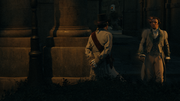 Le Peletier meeting Jean-Lambert Tallien


Appearances[edit | edit source]
- Assassin's Creed: Unity (first appearance)
- Assassin's Creed: Unity novel
References[edit | edit source]
- ↑ 1.0 1.1 1.2 1.3 1.4 Assassin's Creed: Unity – Database: Louis-Michel Le Peletier
- ↑ Assassin's Creed: Unity novel
- ↑ Assassin's Creed: Unity – The Temple
- ↑ Assassin's Creed: Unity – High Society
- ↑ 5.0 5.1 5.2 Assassin's Creed: Unity – The Jacobin Club
- ↑ 6.0 6.1 6.2 6.3 6.4 6.5 Assassin's Creed: Unity – A Dinner Engagement
- ↑ Assassin's Creed: Unity – Database: Louise-Suzanne Le Peletier
- ↑ Jordan, David P. (1 January 1979). The King's Trial: The French Revolution Vs. Louis XVI. University of California Press. Retrieved on 13 March 2022., p. 194
- ↑
 Louis-Michel le Peletier, marquis de Saint-Fargeau on Wikipedia