


Charles Gabriel Sivert: Difference between revisions
imported>Bovkaffe No edit summary |
m Text replacement - "\[\[fr:(.+)\]\]" to "<!--[fr:$1]-->" |
||
| (45 intermediate revisions by 24 users not shown) | |||
| Line 1: | Line 1: | ||
{{Era| | {{Era|Individuals|Templars}} | ||
{{ | {{Quote|Petty nobles are ripe enough fruits, but the Church has been leeching off the people for centuries. If we crack their vaults, the Grand Master cannot fail to recognize our work.|Charles Gabriel Sivert, 1791.|Assassin's Creed: Unity|Confession}} | ||
{{WP-REAL|:fr:Charles Gabriel Sivert}} | |||
{{Character Infobox | {{Character Infobox | ||
|image = ACU Sivert Render.png | |image = [[ACU Charles Gabriel Sivert Render.png]] | ||
|birth = 1 December 1725<br>[[Louisbourg]], {{Wiki | |birth = 1 December 1725<br>[[Louisbourg]], {{Wiki|Île-Royale}}, {{Wiki|New France}} | ||
|death = 5 January 1791 | |death = 5 January 1791 {{c|aged 65}}<br>[[Paris]], [[Kingdom of France]] | ||
|species = [[Human]] | |||
|database = [[Database: Charles Gabriel Sivert|Charles Gabriel Sivert]] | |||
|affiliates = [[French Army]]<br>[[French Navy]]<br>[[Templars]] | |affiliates = [[French Army]]<br>[[French Navy]]<br>[[Templars]] | ||
*[[Parisian Rite of the Templar Order|French Rite]] | |||
}} | |||
'''Charles Gabriel Sébastien Sivert, Baron de l'Espérance''' (1725 – 1791) was a | '''Charles Gabriel Sébastien Sivert, Baron de l'Espérance''' (1725 – 1791) was a brigadier general in the [[France|French]] military, the colonial governor of {{Wiki|Saint Pierre and Miquelon}} before his retirement in 1789, and a member of the [[Parisian Rite of the Templar Order|Parisian Rite]] of the [[Templars|Templar Order]]. | ||
Serving as an advisor to [[Grand Master of the Templar Order|Grand Master]] [[François de la Serre]], he later joined the excommunicated Templar [[François-Thomas Germain]] in overthrowing the former. In 1789, Sivert and his fellow Templar, the [[Roi des Thunes]], assassinated de la Serre during a party at the [[Palace of Versailles]], and framed the Grand Master's adoptive son, [[Arno Dorian]], for the crime. However, two years later, Sivert would be hunted down and killed by a vengeful Arno, who had joined the [[Assassins]]. | |||
==Biography== | ==Biography== | ||
===Early life=== | ===Early life=== | ||
Sivert was born on 1 December 1725 in [[Louisbourg]], {{Wiki|New France}}. His father, Charles-Léopold-Ébérard de l'Espérance, was a lieutenant in the [[Switzerland|Swiss]] Régiment de Karrer. Like him, Sivert chose a career in the army, serving in New France and the [[Caribbean|West Indies]]. At some point, Sivert joined the Templar Order | Sivert was born on 1 December 1725 in [[Louisbourg]], {{Wiki|New France}}. His father, Charles-Léopold-Ébérard de l'Espérance, was a lieutenant in the [[Switzerland|Swiss]] Régiment de Karrer. Like him, Sivert chose a career in the army, serving in New France and the [[Caribbean|West Indies]]. At some point, Sivert joined the Templar Order and ran an artifact smuggling operation. Through this, he funded Grand Master [[Haytham Kenway]]'s [[American Rite of the Templar Order|operations]] in the [[United States|colonies]], and was involved in a disastrous attempt to recover an unknown object.<ref name="Database">''[[Assassin's Creed: Unity]]'' – [[Database: Charles Gabriel Sivert]]</ref> | ||
In 1748, Sivert freed the French naval officer [[Jean-Jacques Blaise d'Abbadie]] from [[United Kingdom|British]] captivity through the {{Wiki|Treaty of Aix-la-Chapelle (1748)|Treaty of Aix-la-Chapelle}}. He then arranged for d'Abbadie to be employed in the naval bureaucracy to serve as his | In 1748, Sivert freed the French naval officer [[Jean-Jacques Blaise d'Abbadie]] from [[United Kingdom|British]] captivity through the {{Wiki|Treaty of Aix-la-Chapelle (1748)|Treaty of Aix-la-Chapelle}}. He then arranged for d'Abbadie to be employed in the naval bureaucracy to serve as his eyes and ears. Writing to the officer and revealing his involvement, Sivert nevertheless refused to reveal who he served, believing d'Abbadie to be "deeply stupid". D'Abbadie obeyed, and his position and prominence grew.<ref name="War Letters">''[[Assassin's Creed: Rogue]]'' – [[War Letters]]: "The Clerk"</ref> | ||
By 1756, Sivert's actions had caught the attention of the [[American Brotherhood of Assassins|Colonial Assassins]] and, alongside several other high-ranking Templars, he was listed as a target in the [[Davenport Homestead]]'s manor.<ref name="Freewill">''[[Assassin's Creed: Rogue]]'' – [[Freewill]]</ref> | |||
By | |||
Sivert | ===Templar coup=== | ||
{{Dialogue|Roi des Thunes|"The intrigues of rats?" Pompous fool! If I could lay my hands on him...|Sivert|My master would be pleased to arrange that. Brother.|Sivert recruiting the Roi des Thunes for the coup against François de la Serre, 1789.|Assassin's Creed: Unity|Le Roi Est Mort}} | |||
By 1778, Sivert had become an advisor to the French Grand Master [[François de la Serre]], along with [[Chrétien Lafrenière]], [[Marie Lévesque]], and [[Louis-Michel le Peletier]]. Feeling underappreciated by de la Serre, Sivert joined the exiled Templar [[François-Thomas Germain]]'s extremist faction of the Order along with Lévesque and le Peletier.<ref name="ACU">''[[Assassin's Creed: Unity]]''</ref> | |||
Sivert | [[File:High Society 14.png|left|thumb|250px|Sivert framing Arno for de la Serre's murder]] | ||
Sivert was responsible for personally recruiting the [[Roi des Thunes]] and his enforcer [[Aloys la Touche]] into Germain's faction, after the former was denied membership in the Templar Order by de la Serre. Germain subsequently tasked Sivert and the Roi des Thunes with killing de la Serre.<ref name="Roi Est Mort">''[[Assassin's Creed: Unity]]'' – [[Le Roi Est Mort]]</ref> After months of planning, they enacted their plot on 5 May 1789, when a party was held at the [[Palace of Versailles]] in honor of de la Serre's daughter, [[Élise de la Serre|Élise]], joining the Order.<ref name="High Society">''[[Assassin's Creed: Unity]]'' – [[High Society]]</ref> | |||
Sivert lured the Grand Master out to the palace gardens, where he assaulted him. However, de la Serre fought off Sivert, wounding the latter's face and blinding his left eye. Nonetheless, the Roi des Thunes snuck up from behind and struck de la Serre with a [[Templar pin|poisoned pin]] crafted by Germain, killing him instantly. As the two Templars made their escape, Sivert called out to a [[Soldier|guard]] and framed [[Arno Dorian]], who had witnessed the murder of his adoptive father.<ref name="High Society" /> | |||
===Death=== | |||
{{Dialogue|Arpinon|Your confidence is infectious, Sivert. My boys will have the wagon ready.|Sivert|Here are the details—make sure it goes smoothly.|Sivert conspiring with Arpinon, 1791.|Assassin's Creed: Unity|Graduation (Unity)}} | |||
On 4 January 1791, Sivert met up with a fellow Templar named [[Arpinon]] to smuggle stolen goods from the [[Conciergerie]]. After Sivert's departure, Arpinon was killed by the [[Master Assassin]] [[Pierre Bellec]]. Fortunately for Sivert, he was not a target of the [[Assassins]] at that time.<ref name="Graduation">''[[Assassin's Creed: Unity]]'' – [[Graduation (Unity)|Graduation]]</ref> | |||
The following day, Sivert was stalked by Arno, who had escaped imprisonment and joined the Assassins. Arno tailed the Templar to [[Notre-Dame]], where Sivert was supposed to meet one of his accomplices, [[Duchesneau]]. Arno assassinated Duchesneau and snuck into a confession booth, where Sivert had arranged to meet his accomplice.<ref name="Confession">''[[Assassin's Creed: Unity]]'' – [[Confession]]</ref> | |||
==Gallery== | [[File:ACU Confession 3.jpg|thumb|250px|Sivert being assassinated by Arno]] | ||
<gallery captionalign="center" position="center | Posing as Duchesneau, Arno received information about he smuggling of goods from the church, a more efficient source of obtaining funds than from the nobility. Once Sivert revealed all that he knew, Arno assassinated him with his [[Hidden Blade]], by stabbing him in the cheek through the confessional window. Through Sivert's memories, Arno learned of the Roi des Thunes' involvement in de la Serre's murder. He also claimed Sivert's [[round axe]] as a trophy.<ref name="Confession" /> | ||
==Behind the scenes== | |||
Charles Gabriel Sivert is a historical character introduced in ''[[Assassin's Creed: Unity]]'', where he is voiced by the Canadian actor [[Alain Goulem]]. In ''[[Assassin's Creed: Rogue]]'', which was released concurrently with ''Unity'', his name appears on a board of Templar targets in the Davenport Homestead. | |||
Historically, Sivert died in Versailles.<ref name="Wiki">{{WP|:fr:Charles Gabriel Sivert|Charles Gabriel Sivert}}</ref> | |||
== Gallery== | |||
<gallery captionalign="center" position="center" widths="180"> | |||
ACU Charles-Gabriel Sivert - Concept Art.jpg|Concept art of Sivert | ACU Charles-Gabriel Sivert - Concept Art.jpg|Concept art of Sivert | ||
Hoarders Sivert and Levesque.png|Sivert and Lévesque witnessing Germain's expulsion | Sivert - Head Renders.jpg|Head renders of Sivert | ||
ACU Sivert Render.png|Database image of Sivert | |||
Le Roi Est Mort 18.png|The Roi des Thunes and Sivert reporting de la Serre's death | Hoarders Sivert and Levesque.png|Sivert and Marie Lévesque witnessing Germain's expulsion | ||
Le Roi Est Mort 18.png|The Roi des Thunes and Sivert reporting de la Serre's death | |||
ACU Graduation 4.png|Sivert meeting with Arpinon | ACU Graduation 4.png|Sivert meeting with Arpinon | ||
</gallery> | </gallery> | ||
==Appearances== | |||
*''[[Assassin's Creed: Rogue]]'' {{1stm}} | |||
*''[[Assassin's Creed: Unity]]'' {{1st}} | |||
*[[Assassin's Creed: Unity (novel)|''Assassin's Creed: Unity'' novel]] | |||
==References== | ==References== | ||
| Line 43: | Line 65: | ||
{{ACU}} | {{ACU}} | ||
{{DEFAULTSORT:Sivert, Charles Gabriel}} | {{DEFAULTSORT:Sivert, Charles Gabriel}} | ||
<!--[fr:Charles Gabriel Sivert]--> | |||
[[Category:1725 births]] | [[Category:1725 births]] | ||
[[Category:1791 deaths]] | [[Category:1791 deaths]] | ||
[[Category:Individuals]] | [[Category:Individuals]] | ||
[[Category: | [[Category:French people]] | ||
[[Category: | [[Category:Parisians]] | ||
[[Category:Smugglers]] | [[Category:Smugglers]] | ||
[[Category:Barons]] | [[Category:Barons]] | ||
[[Category:Governors]] | [[Category:Governors]] | ||
[[Category:Generals]] | |||
[[Category:French Navy personnel]] | [[Category:French Navy personnel]] | ||
[[Category:French Army]] | [[Category:French Army personnel]] | ||
[[Category:Templars]] | [[Category:Templars]] | ||
[[Category: | [[Category:French Templars]] | ||
Latest revision as of 00:19, 12 May 2026
Charles Gabriel Sébastien Sivert, Baron de l'Espérance (1725 – 1791) was a brigadier general in the French military, the colonial governor of Saint Pierre and Miquelon before his retirement in 1789, and a member of the Parisian Rite of the Templar Order.
Serving as an advisor to Grand Master François de la Serre, he later joined the excommunicated Templar François-Thomas Germain in overthrowing the former. In 1789, Sivert and his fellow Templar, the Roi des Thunes, assassinated de la Serre during a party at the Palace of Versailles, and framed the Grand Master's adoptive son, Arno Dorian, for the crime. However, two years later, Sivert would be hunted down and killed by a vengeful Arno, who had joined the Assassins.
Biography[edit | edit source]
Early life[edit | edit source]
Sivert was born on 1 December 1725 in Louisbourg, New France. His father, Charles-Léopold-Ébérard de l'Espérance, was a lieutenant in the Swiss Régiment de Karrer. Like him, Sivert chose a career in the army, serving in New France and the West Indies. At some point, Sivert joined the Templar Order and ran an artifact smuggling operation. Through this, he funded Grand Master Haytham Kenway's operations in the colonies, and was involved in a disastrous attempt to recover an unknown object.[1]
In 1748, Sivert freed the French naval officer Jean-Jacques Blaise d'Abbadie from British captivity through the Treaty of Aix-la-Chapelle. He then arranged for d'Abbadie to be employed in the naval bureaucracy to serve as his eyes and ears. Writing to the officer and revealing his involvement, Sivert nevertheless refused to reveal who he served, believing d'Abbadie to be "deeply stupid". D'Abbadie obeyed, and his position and prominence grew.[2]
By 1756, Sivert's actions had caught the attention of the Colonial Assassins and, alongside several other high-ranking Templars, he was listed as a target in the Davenport Homestead's manor.[3]
Templar coup[edit | edit source]
By 1778, Sivert had become an advisor to the French Grand Master François de la Serre, along with Chrétien Lafrenière, Marie Lévesque, and Louis-Michel le Peletier. Feeling underappreciated by de la Serre, Sivert joined the exiled Templar François-Thomas Germain's extremist faction of the Order along with Lévesque and le Peletier.[4]

Sivert was responsible for personally recruiting the Roi des Thunes and his enforcer Aloys la Touche into Germain's faction, after the former was denied membership in the Templar Order by de la Serre. Germain subsequently tasked Sivert and the Roi des Thunes with killing de la Serre.[5] After months of planning, they enacted their plot on 5 May 1789, when a party was held at the Palace of Versailles in honor of de la Serre's daughter, Élise, joining the Order.[6]
Sivert lured the Grand Master out to the palace gardens, where he assaulted him. However, de la Serre fought off Sivert, wounding the latter's face and blinding his left eye. Nonetheless, the Roi des Thunes snuck up from behind and struck de la Serre with a poisoned pin crafted by Germain, killing him instantly. As the two Templars made their escape, Sivert called out to a guard and framed Arno Dorian, who had witnessed the murder of his adoptive father.[6]
Death[edit | edit source]
On 4 January 1791, Sivert met up with a fellow Templar named Arpinon to smuggle stolen goods from the Conciergerie. After Sivert's departure, Arpinon was killed by the Master Assassin Pierre Bellec. Fortunately for Sivert, he was not a target of the Assassins at that time.[7]
The following day, Sivert was stalked by Arno, who had escaped imprisonment and joined the Assassins. Arno tailed the Templar to Notre-Dame, where Sivert was supposed to meet one of his accomplices, Duchesneau. Arno assassinated Duchesneau and snuck into a confession booth, where Sivert had arranged to meet his accomplice.[8]

Posing as Duchesneau, Arno received information about he smuggling of goods from the church, a more efficient source of obtaining funds than from the nobility. Once Sivert revealed all that he knew, Arno assassinated him with his Hidden Blade, by stabbing him in the cheek through the confessional window. Through Sivert's memories, Arno learned of the Roi des Thunes' involvement in de la Serre's murder. He also claimed Sivert's round axe as a trophy.[8]
Behind the scenes[edit | edit source]
Charles Gabriel Sivert is a historical character introduced in Assassin's Creed: Unity, where he is voiced by the Canadian actor Alain Goulem. In Assassin's Creed: Rogue, which was released concurrently with Unity, his name appears on a board of Templar targets in the Davenport Homestead.
Historically, Sivert died in Versailles.[9]
Gallery[edit | edit source]
-
 Concept art of Sivert
 -
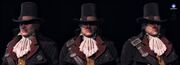 Head renders of Sivert
 -
 Database image of Sivert
 -
 Sivert and Marie Lévesque witnessing Germain's expulsion
 -
 The Roi des Thunes and Sivert reporting de la Serre's death
 -
 Sivert meeting with Arpinon


Appearances[edit | edit source]
- Assassin's Creed: Rogue (first mentioned)
- Assassin's Creed: Unity (first appearance)
- Assassin's Creed: Unity novel
References[edit | edit source]
- ↑ Assassin's Creed: Unity – Database: Charles Gabriel Sivert
- ↑ Assassin's Creed: Rogue – War Letters: "The Clerk"
- ↑ Assassin's Creed: Rogue – Freewill
- ↑ Assassin's Creed: Unity
- ↑ Assassin's Creed: Unity – Le Roi Est Mort
- ↑ 6.0 6.1 Assassin's Creed: Unity – High Society
- ↑ Assassin's Creed: Unity – Graduation
- ↑ 8.0 8.1 Assassin's Creed: Unity – Confession
- ↑
 Charles Gabriel Sivert on Wikipedia