
Victor

Victor was a French blacksmith who lived in Versailles during the late 18th century.
Biography[edit | edit source]
In 1789, Victor defeated Arno Dorian in a game of pharaoh, winning his prized pocket watch. Arno later broke into Victor's house and stole the watch back. As the blacksmith discovered him, he tripped Arno on his way out, allowing Victor's brother Hugo to take the watch. While Arno chased after Hugo, Victor attempted to tackle the thief, but Arno was able to take the watch back and escape to his adoptive father's house. The brothers soon caught up with him, insisting that François de la Serre's majordomo Olivier report Arno to the marshalcy. François himself intervened, however, and the brothers left with nothing.[1] Later that day, Victor and Hugo infiltrated the Estates-General, intending to take the watch back. After a duel with Arno, the two were wounded, and Arno escaped from the guards who arrived on the scene.[2]
In 1793, during the Reign of Terror, Victor and Hugo were accused of being enemies of the state and sentenced to death by guillotining. Luckily for the two, Arno had arrived to kill the man in charge of the execution, Aloys la Touche. As Arno joined them, Victor expressed surprise at the fact that he did not want them dead. He reminded the brothers that they had not committed any proper capital offenses, telling them to let him go first. As Arno neared the guillotine, he assassinated la Touche, disrupting the execution and saving the lives of Victor and Hugo.[3]
Legacy[edit | edit source]
During Robert Fraser's sessions reliving Arno Dorian's genetic memories, he speculated in an email with his Project Manager, Aidan St. Claire, that Victor and his brother were not historical people but Animus-created amalgams of multiple people Arno had met throughout his life.[4]
Behind the scenes[edit | edit source]
The names of Victor and Hugo are a reference to the French poet and novelist Victor Hugo. Their accused crime of stealing bread is a reference to the author's 1862 work Les Misérables, in which its protagonist Jean Valjean was imprisoned for 19 years for the same transgression.
Gallery[edit | edit source]
-
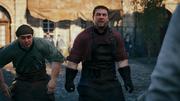 Hugo and Victor confronting Arno
 -
 Victor accusing Arno
 -
 Victor getting stuck in a wardrobe


Appearances[edit | edit source]
- Assassin's Creed: Unity (first appearance)
- Assassin's Creed Unity: Abstergo Entertainment – Employee Handbook(mentioned only)
References[edit | edit source]