
Venice
Venice (Italian: Venezia) was an island city in northern Italy and capital to the Serenissima Repubblica di Venezia. It is famous for its expansive canal system. Venice is the largest settlement in Assassin's Creed II, with 5 districts, San Polo, San Marco, Dorsoduro, Cannaregio and the Castello districts. Venice also appears in Assassin's Creed: Brotherhood as a multiplayer map, as well as in one of the Cristina missions.
History
During the 15th Century, Venice was capital of the Most Serene Republic of Venice (Venetian: (Serenìsima) Repùblica Vèneta or Repùblica de Venesia, Italian: Serenissima Repubblica di Venezia), often referred to as La Serenissima in reference to its title in Venetian, and largest city of the republic. Historically founded by refugees from the Hunnic and Germanic invasion of Padua, Aquileia, and Altino, Venice developed to become a major trade and naval power in southern Europe, and by the year 1499 was engaged in sporadic conflict with the Ottoman Empire[1].
Even during the 13th Century Venice had a notable Assassin presence, the area surrounding Venice was home to an assassin and his son – Domenico. Both enjoyed the patronage of the famed explorer Marco Polo, an ally of the Assassins[2]. Their presence continued on into the 15th Century, occupying positions of command amongst the thieves, mercenaries and courtesans of the city[1].
By the Renaissance Era, Venice was one of the richest cities in the world. It consisted of five districts. The San Polo District was the center of commerce, containing many markets, and was also the location of the Venetian Thieves' Guild. The San Marco District was the administrative center of the city, containing government buildings such as the Palazzo Ducale, the residence of the Doge. The Dorsoduro District attracted many artists, and was where many festivals in Venice, such as Carnevale, took place. The Castello District was largely centered around the Venetian military, and was where its powerful navy was based and maintained. The Canareggio District was a run-down area that eventually became Venice's ghetto, the area to which Jews were relegated, forbidden to go elsewhere in the city.
Following the Templar failure to capture Florence during the Pazzi conspiracy, Rodrigo Borgia and his allies – the Barbarigo family – step up their plans to take control of the city of Venice. Influencing powerful members of Venetian government, such as Carlo Grimaldi, the Knights Templar assassinated the Doge Giovanni Mocenigo and placed one of their own on the throne; Marco Barbarigo. By this time however, the Florentine assassin Ezio Auditore da Firenze had arrived in Venice and begun to counter the Templar plot[1].
Following the assassination of Marco Barbarigo and the ascension of his brother Agostino, an ally to the Assassins, Ezio Auditore chased down the last remaining Barbarigos' Silvio, cousin to Agostino, and his man servant Dante Moro to L'Arsenale di Venezia and liberated the city's military district. It was here that the assassin learned that the Templar plot to acquire Venice had merely been a distraction for the assassins', so that the Templar's might safely dispatch their vessel to Cyprus[1]. Between 1502 and 1503 Francesco Vecellio and his team of assassins traveled to Venice to poison the now corrupt and Borgia-influenced Agostino Barbarigo. Before they left he made sure that Agostino's sucessor was on the assassins side.
Landmarks
Like Florence, Venice was home to many notable landmarks; these included the Basilica, Piazza and Campanile di San Marco, the Palazzo Ducale, the Grand Canal, the Little Canal, and Ponte di Rialto. Annually, the city hosted the famed Carnevale in the south of the city. Typically, it was celebrated with fireworks, carnival performers and a series of games; the winner being awarded with a Golden Mask that permitted entrance to the Doge's personal party.
Basilica di San Marco
The Basilica di San Marco was a famous cathedral of the Roman Catholic Archdiocese of Venice. The most famous of the city's
churches and one of the best known examples of Byzantine architecture, it lay on the Piazza San Marco adjacent and connected to the Palazzo Ducale.
For its opulent design, gilded Byzantine mosaics, and its status as a symbol of Venetian wealth and power, from the 11th century on the building was known by the nickname Chiesa d'Oro (Church of Gold).
At some point in its history, the Basilica became home to one of six Assassin's Tombs hidden throughout northern Italy. The tomb was buried beneath the Basilica, and was accessible only after pulling four timed triggers.
Palazzo Ducale
The Palazzo Ducale di Venezia, or the Doge's Palace, was an opulent personal residence for the Doge of Venice, the ruler of La Serenissima Repubblica di Venezi.
Its high, blank walls made it unscalable from all sides, protecting the palace from intruders; within was a large courtyard flanked on all sides by an arched corridor. It was here that Ezio assassinates Carlo Grimaldi, who had in turn just assassinated the Doge, Giovanni Mocenigo.
Santa Maria dei Frari
Santa Maria dei Frari was a famous church in central Venice and an important Templar base in the city. Known most commonly simply as Frari, it's bell tower was considered

unscalable to all but the Guild of Thieves.
Assassination Targets
- Emilio Barbarigo; Corrupt Merchant of Venice (DNA Sequence 7)
- Carlo Grimaldi; Member of the Council of Ten (DNA Sequence 8)
- Marco Barbarigo; Doge of Venice (DNA Sequence 9)
- Silvio Barbarigo; Member of the Supreme Tribunal of Venice (DNA Sequence 10)
- Dante Moro; Personal Bodyguard of Marco Barbarigo (DNA Sequence 10)
Trivia
- Even after the events of the Carnevale, the citizens will continue to celebrate it for the remainder of the game, albeit without fireworks, in the district of Dorsoduro.
- The enemies in Venice are far more skilled than the enemies in Florence, and are better equipped.
- Venice is the only city where you can't use horses.
- On the border of San Polo and San Marco there are two painters who are looking out across the river yet they are painting a portrait of a person
- The southern area of Venice, La Guidecca, which resides on a separate island, is inaccessible to players during the course of the game.
Gallery
-
Map of Venice
-
Piazza San Marco, the principal square of Venice
-
 The Grand Canal, concept art during the Venetian Masquerade Carnival
 -
Inside of the Basilica di San Marco
-
The Arsenal Shipyard of Venice
-
 Basilica di San Marco, principally used as the 'chapel' for the Venetian rulers
 -
Ezio on the Rialto Bridge looking at the Grand Canal
-
Ezio performing a leap of faith beside a canal.
-
Ezio silently takes out a guard
-
Concept art of Venice with the Bascilia di San Marco in the background
-
Ezio diving into the water near the Palazzo Ducale
-
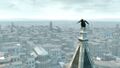 Venice viewed from a tower viewpoint


Appearances
- Assassin's Creed: Lineage
- Assassin's Creed II
- Assassin's Creed: Renaissance
- Assassin's Creed: Brotherhood
Notes and references
| ||||||||||||||||||||||||||||