


Napoleon Bonaparte

|
He who increaseth knowledge, increaseth sorrow. This article contains spoilers, meaning it has information and facts concerning recent or upcoming releases from the Assassin's Creed series. If you do not want to know about these events, it is recommended to read on with caution, or not at all. |

- "Ah, the bane of statesmen and generals everywhere: an individualist. I know the feeling. Men like us have a great advantage over most in the army: we can think for ourself."
- ―Napoleon Bonaparte to Arno Dorian, 1792.
Napoleon Bonaparte (15 August 1769 – 5 May 1821) was a Corsican military and political leader who ruled first as the First Consul of France from 1799 to 1804, then as Emperor from 1804 to 1815. He rose to power amidst the chaos and political turmoil of the French Revolution. He is also an acquaintance to the Assassin Arno Dorian.
Character Biography
Meeting Arno Dorian
- "You certainly don't look like a blood-crazed revolutionary. The hood... is a bit sinister though if you don't mind my saying."
- ―Napoleon, on his first encounter with Arno, 1792.
In 1792, Napoleon infiltrated Palais des Tuileries in order to acquire an Apple of Eden that had been placed in a chest and hidden in a secret vault by King Louis XVI of France in the latter's study. At the same time, the Palace was under attack by several revolutionary extremists led by Napoleon's subordinate Frédéric Rouille.
Arno Dorian too had infiltrated the palace to search for compromising documents by Mirabeau. As the Assassin entered the office, he was ambushed by Napoleon who held him at gun point. Initially hostile towards each other, the pair lowered their guards once they realise that they desired different prizes.
With Arno's Eagle Vision, they discovered the King's hidden vault. Distracted by destroying the documents, Arno failed to notice Napoleon sneaking away the casket containing the Apple of Eden. The pair then escaped the Palace with the help of Bonaparte's soldiers.
Collaboration with Arno
- "Life is more valuable than dignity. But this is what happens when you give command of the government to half-starved lunatics, and command of the army to bloodthirsty savages."
- ―Napoleon, regarding the turmoil of the French Revolution.
In September 1792, Napoleon was accosted by several revolutionaries, though they let him go once he proclaimed his allegience to the French Republic.
Later on, he assisted Arno in finding Rouille, whom Napoleon had unsuccessfully tried to transfer to a far-off garrison. Thanks to Bonaparte's information, Arno was successful in assassinating Rouille in Le Grand Chatelet prison.
Years later, Napoleon accompanied Arno to the Temple, where they discovered the skeletal remains of Francois-Thomas Germain. The pair then buried his body in the Parisian Catacombs.
For the next few years, Napoleon had a successful career during the siege of Toulon, the crushing of the 13 Vendémiaire uprising in Paris, an invasion of Italy and Egypt, and an upsurge in popularity. In 1799, in the Brumaire coup, Bonaparte seized power for himself as the "First Consul", soon to become the Emperor of France.
However, the last remaining royalists of the 13 Vendémiaire coup, led by a one-eyed royalist wounded by cannon fire, plotted to use "The Infernal Machine" against Napoleon. The Assassins were able to kill all of the snipers that fired on Napoleon's carriage as he headed to the opera in December 1800, and found out the conspirators' identities, killing the royalist leader and saving Napoleon's life.[1]
Napoleon was First Consul of France during the last few years of the Haitian Revolution as well. He saw Toussaint Louverture as a threat, and sent Charles Leclerc to remove him from power, as well as giving him orders to reinstate slavery in the colony. He succeeded, but later in the war, French troops were forced out of Saint-Domingue.[2]
Gallery
-
 Concept art of Napoleon
 -
 Napoleon ordering his men to fire
 -
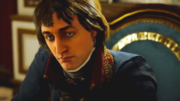 Closeup of Napoleon
 -
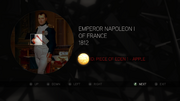 Napoleon with an Apple of Eden
 -
 An 1801 painting of Napoleon


Reference