


Mercenary
| This article is about the faction. You may be looking for other uses of the term. |
- "I fight at your side, any time!"
- ―A mercenary's greeting to Ezio.
Mercenaries were soldiers available for hire to take part in armed conflicts, often functioning as a third party, usually for private gain or material compensation. They were often hired by nations to take part in battles, or by private contractors to serve as personal protection.
During the 15th and 16th centuries, the high number of mercenaries in cities like Rome and Constantinople led to the creation of guilds, collaborating with each other as one large group and acting under a singular leader. These mercenary guilds were often notable allies of the Assassin Order, and their leaders sometimes were part of the Order themselves.
From the Colonial era, mercenaries continued to operate in the employ of various different bodies. Unlike the guilds of old however, these mercenaries were commonly used by the Colonial Rite of the Templar Order, although this was not an exclusive arrangement.
History
Mercenaries of Italy, as with other hired help, cost 150 florins and followed Ezio around, along with making comments after a fight. They wielded heavy weapons and fought like Brute guards. However, mercenaries that were encountered in missions were often free of cost and wielded longswords and maces. Due to their lack of armor, their effectiveness was drastically reduced, as they could be outmatched by two to three Pazzi guards. When needed, Ezio could order them to fight selected guards, providing a distraction for him to pass by areas unnoticed.[1]
In Rome, the mercenaries acted much as they did in the previous cities, and Bartolomeo d'Alviano and his wife Pantasilea Baglioni led them from their barracks. There, they actively participated in the fight against the Borgia and their French allies, led by Octavian de Valois. When Ezio completed all of the Mercenaries Guild challenges, he was awarded with Bartolomeo's Axe and the guild's crest, which could be located in the armor section in the Tiber Island headquarters.[2]
In 1754, several mercenaries were hired by Achilles Davenport's Assassins to obtain and guard William Johnson's research notes in an encampment in West Boston. Not long after, the camp was infiltrated by Haytham Kenway, Charles Lee and Thomas Hickey, who retrieved the notes. Also, Mercenaries of Indian tribes that sided with the French, under Achilles's student, Kesegowaase fought the British Army during the Siege of Fort William Henry and the attack on Albany. Hope Jensen's gangs also acted as mercenaries serving the Colonial Assassins, controlling several bureaus and cells in New York, Halifax and River Valley.
Several mercenaries were later used by the Templars themselves in the following decades, with a significant number protecting Benjamin Church following his desertion of the Templar Order.
Combat
Mercenaries were the most heavily armored of the three factions available, and they usually wielded heavy, two-handed weapons, fighting very similarly to Brutes in combat.
During the Colonial era, however, mercenaries fought much like British Regulars, using the same weapons and tactics as their professional counterparts.
Trivia
- Mercenaries cannot perform any form of freerunning. However, Mario Auditore, who behaves like a mercenary, is able to free-run.
- In Assassin's Creed II, mercenaries possess similar weapons to Brutes, but are easily defeated by them. In Assassin's Creed: Brotherhood, however, mercenaries can defeat Brutes with ease.
- In the Cannaregio District of Venice, Ezio can hire groups of six mercenaries, instead of the usual four.
- During the mission to assassinate Vieri de' Pazzi, Mario refers to his mercenaries as his brothers, a term usually reserved for fellow Assassins.
- While Ezio distributes Bartolomeo's men to specific spots throughout the Castello District as a distraction for Silvio Barbarigo, the mercenaries act like normal guards instead of Brutes, even being able to sprint.
- Ironically, Niccolò Machiavelli is portrayed as the leader of the Florentine mercenaries, when, historically, he strongly opposed the use of them.
- Regular mercenaries can break out of Ezio's grabs, though the ones in the Monteriggioni training grounds can't, unless he is training with them.
- In Assassin's Creed: Brotherhood, two mercenaries help Ezio operate Leonardo da Vinci's Tank in the memory Hell on Wheels.
- In Brotherhood, mercenaries are far more powerful and can take out several guards effectively since their health is as long as Brutes, as seen in fighting challenges in the barracks.
- If the player, as Ezio, attempts to loot a dead mercenary's corpse, no money can be found despite hiring them.
- It is possible to kill mercenaries if Ezio uses a lift when they are behind him, where the debris would crush them, killing them. This also happens to fellow thieves and courtesans.
- The mercenaries during the Siege of Monteriggioni, with some exceptions, function as regular guards and some are wielding weapons of the arquebusiers, but they are easily defeated by Borgia soldiers except those who accompany Ezio and wield heavy weapons.
- Fabrizio and Prospero Colonna are two notable mercenaries who are saved by Ezio during one of the Brotherhood's courtesan assignments.
- Mercenaries can be killed by Ezio's Apple of Eden if they are caught within range of its blast radius.
- If a minstrel attempts to play in front of Ezio while he is accompanied by mercenaries, they will push him away, and one will attempt to chase him before returning shortly afterward.
Gallery
-
 Concept art of a mercenary
 -
 A group of Mercenaries in Venice
 -
 Mario and his mercenaries cheering on Ezio
 -
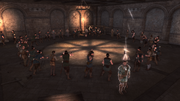 Mercenaries in the Caserma di Alviano's Fight Club
 -
 Ezio speaking with an Ottoman mercenary
 -
 A group of mercenaries in Boston
 -
 The Roman Mercenaries Guild insignia


References
| |||||||||||||||||||||||||||||||||||||
| |||||||||||||||||||||||||||||||||||||