

Gorgon

A Gorgon in Greek mythology is any member from the monstrous sisters Medusa, Stheno and Euryale who were described as having so dreadful an appearance that they would petrify onlookers. The antiquity authors Hesiod, Euripides, and Gaius Julius Hyginus all gave differing accounts of the Gorgons' parentage, but all agreed that only Medusa could be killed.[1]
In truth, stories of gorgons were born from a hybrid beast called the Writhing Dread that the Isu made as part of the Olympos Project.
History[edit | edit source]
According to legend, King Polydektes of Seriphos tasked the hero Perseus to slay the gorgon Medusa.[2] On Zeus' orders, Athena gifted Perseus with a bronze shield polished mirror-bright, while Hermes gave him a pair of winged sandals, Hades' cap of invisibility,[1] and a shining sickle[3] or harpe. Armed with these, Perseus succeeded in his task.[2]
During the Peloponnesian War, the Daughters of Artemis member Ligeia fell prey to a Gorgon's stare. The misthios Kassandra later defeated the creature at the request of Ligeia's lover, Bryce.[4]
Influence and legacy[edit | edit source]
By the 5th century BCE, the Greeks used gorgon imagery as a protective symbol to decorate houses and shields. It was also implemented in various statues of the goddess Athena as part of her Aegis.[5]
Certain weapons throughout antiquity were associated with gorgons: the mercenary Zetes the Retired wielded the spear Gorgon Slayer in the 5th century BCE, the Gorgoneion Xiphos was said to echo the voices of the Gorgon's victims,[6] and the Medjay Bayek of Siwa found the heavy weapon Medusa in Egypt during the 1st century BCE.[7]
Behind the scenes[edit | edit source]
The term gorgon is derived from the Greek γοργός (gorgós), meaning "grim, fierce, terrible".[8]
Gallery[edit | edit source]
-
 Gorgon's head used as an apotropaic device on a house
 -

-
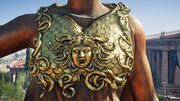
-
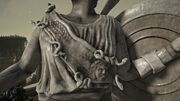 Gorgon as part of the Aegis on a marble statue of Athena


Appearances[edit | edit source]
- Assassin's Creed: Origins (first mentioned)
- Assassin's Creed: Odyssey (artwork)
- Assassin's Creed Roleplaying Game (mentioned only)
- Assassin's Creed: Mirage – Valley of Memory (mentioned in Database entry only) (indirect mention only)
- Discovery Tour: AlUla (mentioned in Database entry only)
References[edit | edit source]
- ↑ 1.0 1.1
 Gorgons on Wikipedia
- ↑ 2.0 2.1 Assassin's Creed: Odyssey – A Treasury of Legends
- ↑ Assassin's Creed II – Glyph #5: "Instruments of Power"
- ↑ Assassin's Creed: Odyssey – Writhing Dead
- ↑ Assassin's Creed: Odyssey
- ↑ Assassin's Creed: Odyssey – Gorgoneion Xiphos
- ↑ Assassin's Creed: Origins
- ↑
 γοργός on Wiktionary