


Merchant: Difference between revisions
imported>GuardDog m →Gallery: updating one |
|||
| Line 48: | Line 48: | ||
assassinscreed2-178.jpg|An art merchant. | assassinscreed2-178.jpg|An art merchant. | ||
AC2 Doctor.jpg|Ezio and Frederico talking to a doctor. | AC2 Doctor.jpg|Ezio and Frederico talking to a doctor. | ||
Blacksmither.jpg|Ezio trading with a Blacksmith | |||
475_large.jpg|Venetian Merchants | 475_large.jpg|Venetian Merchants | ||
</gallery> | </gallery> | ||
Revision as of 06:58, 16 September 2012

Merchants were citizens who sold various items in the many cities throughout the world.
High Middle Ages
The merchants in Altaïr's time period served to be a handy escape option, as he could dive through their stands to avoid running through a crowd of citizens.
Renaissance
Italy
Merchants became a vital part of Ezio's progression. Aside from some of their stalls providing escape routes, he could now purchase various items from them.
- Art merchants: Art merchants sold paintings, which increased Monteriggioni's value, and treasure maps, which specified where treasure chests could be found.
- Blacksmiths: Ezio could buy certain pieces of armor and weaponry from blacksmiths. They also sold various forms of ammunition (such as smoke bombs), and repaired broken armor.
- Doctors: Doctors could heal Ezio's wounds for a small fee. They also sold medicine vials and poison vials (for the poison blade).
- Fast travel booths: Fast travel booths allowed easy travel to different locations throughout Italy for a sum, and acted similarly to fast forwarding a memory in the Animus 1.28.
- Tailors: Tailors sold pouch upgrades to increase the ammunition carrying capacity. They also allowed Ezio to customize most of his armor by dyeing it with different colors.
Rome
Merchants played an even more important role than in the 15th century. Once in Rome, Ezio found out that the Borgia had ruthlessly commandeered the city; under the system of Borgia towers placed around the city, merchant shops had been forced to close and Rome had fallen into disrepair. Similar to the renovation of Monteriggioni, Ezio had the ability to revitalize the city of Rome over the course of time. After killing a region's Borgia Captain and burning his tower, Ezio could begin to renovate that region's buildings, including ancient ruins, underground tunnels, and merchant shops. These merchants included:
- Art merchants: Art merchants still sold paintings and treasure maps, but the selection of treasure maps had expanded to include Borgia flags and also feather locations.
- Banks: Banks performed the same role that Claudia did in during the renovation of Monteriggioni: keeping a record of restoration efforts, maintaining Ezio's bank account and allowing him to get his money.
- Blacksmiths: Blacksmiths sold armor, weaponry, and ammunition as well as repairing broken armor, much like in the 15th century. However, the crossbow was now available, allowing for silent, distant kills.
- Doctors: Just like before, doctors could heal Ezio's wounds or sold him vials of medicine or poison.
- Tailors: Also like previous tailors, they sold pouch upgrades to increase the amount of ammunition available at one time, and could dye his clothes in different colors. When Ezio started using parachutes, they also gave him the material to make these.
A new feature in Rome was the ability to sell items. Virtually any item that could be stolen or looted could be sold for a portion of its value. Of even greater importance were the new "shop quests". These involved trading a certain number of specific rare objects to merchants located on Tiber Island; in return, the merchant would offer an item for sale that was normally unavailable to Ezio. These items included:
- Vatican treasure map - Art merchant
- Seusenhofer armor pieces - Blacksmith
- Captain's Sword - Blacksmith
- Fast-acting poison - Doctor
- Large pouch for crossbow bolts - Tailor
Constantinople
During Ezio's time in the Ottoman Empire, shops in Constantinople were identical to those in Italy – though they could also provide ingredients for bombs – with one main exception:
- Book shops: Book shops were present instead of art merchants, selling books and treasure maps.
Stalls during the 16th century sold vegetables, spices, meat, plates and – in Rome – Venetian masks.
Trivia
- In the PC version of Assassin's Creed, there was also a secondary mission called "Merchant Stand Destruction", in which Altaïr must destroy a set number of merchant stands within a time limit. The explanation for this was that the targeted merchants were selling products that were causing illnesses. In the Xbox 360 version, there was an achievement for diving through twenty of them.
- Merchant stands could only be broken by throwing someone into them, destroying them (and the resident merchant) instantly. Vigilantes and scholars could not be killed however, and did not die from being thrown into a merchant stand.
- The merchant stands that could be traded with could not be broken.
- When Ezio climbed a merchant building, in Assassin's Creed II and Assassin's Creed: Brotherhood, the counter acted as a freerunning object.
- Should Ezio walk under the merchant's banner which indicated what merchant it was (blacksmith, tailor, etc.) the banner will move, even though Ezio was too short for his head to touch it.
Gallery
-
An art merchant.
-
Ezio and Frederico talking to a doctor.
-
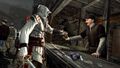 Ezio trading with a Blacksmith
 -
Venetian Merchants


| |||||||||||||||||||||||||||||||||||||
| |||||||||||||||||||||||||||||||||||||