


Maximilien de Robespierre: Difference between revisions
imported>The Forgotten Fragment |
imported>Bovkaffe No edit summary |
||
| Line 10: | Line 10: | ||
|appear = ''[[Assassin's Creed: Unity]]''<br>[[Assassin's Creed: Unity (novel)|''Unity'' novel]] | |appear = ''[[Assassin's Creed: Unity]]''<br>[[Assassin's Creed: Unity (novel)|''Unity'' novel]] | ||
|voice = [[Bruce Dinsmore]]}} | |voice = [[Bruce Dinsmore]]}} | ||
'''Maximilien François Marie Isidore de Robespierre''' (1758 – 1794) was a [[France|French]] lawyer, politician and | '''Maximilien François Marie Isidore de Robespierre''' (1758 – 1794) was a [[France|French]] lawyer, politician and notable figure of the [[French Revolution]] | ||
Initially a provincial lawyer, he was elected a deputy at the [[Estates-General of 1789]]. As the French Revolution broke out, he aligned himself with the increasingly radical [[Jacobins|Jacobin Club]] and was recruited into the [[Templars|Templar Order]] by [[Grand Master]] [[François-Thomas Germain]]. In late 1793, Robespierre and the newly-founded [[Committee of Public Safety]] started the [[Reign of Terror]], persecuting and often executing thousands of perceived counter-revolutionaries. Due to the rising tyranny of Robespierre, he and his supporters were overthrown and executed by [[guillotine]] in the [[Thermidorian Reaction]] of 1794. | |||
==Biography== | ==Biography== | ||
===Early life=== | ===Early life=== | ||
Robespierre was born in {{Wiki|Arras}} in 1758 as the eldest of four children. His mother died when he was six, and his father abandoned the family afterwards, forcing Robespierre to take on the responsibility of raising his siblings.<ref name="AE">''[[Assassin's Creed Unity: Abstergo Entertainment - Employee Handbook]]''</ref> In the meantine, he himself was raised in large part by the teachers at the Oratorian College of Arras which he attended. A hard-working pupil, he acquired a passion for [[Rome|Roman]] history, to which he would refer almost obsessively in his later speeches.<ref name="ACU">''[[Assassin's Creed: Unity]]''</ref> At the age of 11, he was given a scholarship at the {{Wiki|Lycée Louis le Grand}}, the most prestigious university in France.<ref name="AE"/> | |||
===Revolutionary beginnings=== | ===Revolutionary beginnings=== | ||
After completing his education as a lawyer, Robespierre was admitted to the Arras bar. Although he was seemingly destined for a modest life as a provincial lawyer, a financial crisis broke out in France, leading [[Louis XVI of France|King Louis XVI]] to convene the Estates-General. On 20 April 1789, he was elected the fifth out of eight Third Estate deputies for the province of {{Wiki|Artois}}.<ref name="ACU"/> Robespierre became a critic of the monarchy and advocated societal reform,<ref name="AE"/> and founded the [[National Assembly]] along with other deputies such as the [[Honoré Gabriel Riqueti, comte de Mirabeau|Comte de Mirabeau]], [[Emmanuel Joseph Sieyès]] and the [[Gilbert du Motier, Marquis de Lafayette|Marquis de Lafayette]]. During this period, he was also recruited into a radical faction of the Templar Order, led by François-Thomas Germain.<ref name="ACU"/> | |||
Germain's Templars plotted to instigate a widespread revolution across France. They sought to empower the middle class instead of the nobility, and by creating a | In 5 May 1789, Robespierre and his fellow Templars attended a private party at the [[Palace of Versailles]]. The party was secretly to host the induction of the [[Élise de la Serre|daughter]] of the Order's Grand Master, [[François de la Serre]], into the Order. On that same night however, de la Serre was murdered in a coup d'etat led by Germain. Germain's Templars plotted to instigate a widespread revolution across France. They sought to empower the middle class instead of the nobility, and by creating a capitalist society, it would be more easy for the Templars to control humanity.<ref name="ACU"/> | ||
At a Templar meeting at the Hotel de Beauvais, Robespierre was busy giving a speech to his fellow revolutionaries to abolish the death penalty. As such, he was unable to attend to the meeting. After the meeting was over, he met up with Germain and [[Aloys la Touche]]. La Touche was placed under Robespierre's services, where he was tasked to spread revolutionary terror in [[Versailles]]. | At a Templar meeting at the Hotel de Beauvais, Robespierre was busy giving a speech to his fellow revolutionaries to abolish the death penalty. As such, he was unable to attend to the meeting. After the meeting was over, he met up with Germain and [[Aloys la Touche]]. La Touche was placed under Robespierre's services, where he was tasked to spread revolutionary terror in [[Versailles]]. | ||
| Line 40: | Line 38: | ||
===Downfall=== | ===Downfall=== | ||
{{Quote|Monsieur Robespierre, | {{Quote|Monsieur Robespierre, take care that you do not allow your personal ambitions to come before the Great Work. That which we do, we do not for our own glory, but to remake the world in de Molay's image. |Germain in a letter to Robespierre, 1794.}} | ||
[[File:ACU The Supreme Being 9.png|thumb|250px|left|Robespierre giving a speech at the Festival of the Supreme Being]] | |||
In 1794, Robespierre hosted the Festival, attended by many citizens of Paris; it was here that Élise and the [[Assassins|Assassin]] [[Arno Dorian]] orchestrated Robespierre's downfall. As he gave a speech to the audience, Élise spiked Robespierre's drink with powdered ergot, causing Robespierre to experience random hallucinations and give the audience the belief that he was insane and unstable. | In 1794, Robespierre hosted the Festival, attended by many citizens of Paris; it was here that Élise and the [[Assassins|Assassin]] [[Arno Dorian]] orchestrated Robespierre's downfall. As he gave a speech to the audience, Élise spiked Robespierre's drink with powdered ergot, causing Robespierre to experience random hallucinations and give the audience the belief that he was insane and unstable. | ||
Revision as of 20:57, 4 February 2016

- "It is wisdom, above all, that our guilty enemies want to drive from the Republic. To wisdom alone does it belong to consolidate the prosperity of Empires. It is for her to guarantee the fruits of our courage."
- ―Maximilien de Robespierre, in a speech during the 'Festival of the Supreme Being', 1794.
Maximilien François Marie Isidore de Robespierre (1758 – 1794) was a French lawyer, politician and notable figure of the French Revolution
Initially a provincial lawyer, he was elected a deputy at the Estates-General of 1789. As the French Revolution broke out, he aligned himself with the increasingly radical Jacobin Club and was recruited into the Templar Order by Grand Master François-Thomas Germain. In late 1793, Robespierre and the newly-founded Committee of Public Safety started the Reign of Terror, persecuting and often executing thousands of perceived counter-revolutionaries. Due to the rising tyranny of Robespierre, he and his supporters were overthrown and executed by guillotine in the Thermidorian Reaction of 1794.
Biography
Early life
Robespierre was born in Arras in 1758 as the eldest of four children. His mother died when he was six, and his father abandoned the family afterwards, forcing Robespierre to take on the responsibility of raising his siblings.[1] In the meantine, he himself was raised in large part by the teachers at the Oratorian College of Arras which he attended. A hard-working pupil, he acquired a passion for Roman history, to which he would refer almost obsessively in his later speeches.[2] At the age of 11, he was given a scholarship at the Lycée Louis le Grand, the most prestigious university in France.[1]
Revolutionary beginnings
After completing his education as a lawyer, Robespierre was admitted to the Arras bar. Although he was seemingly destined for a modest life as a provincial lawyer, a financial crisis broke out in France, leading King Louis XVI to convene the Estates-General. On 20 April 1789, he was elected the fifth out of eight Third Estate deputies for the province of Artois.[2] Robespierre became a critic of the monarchy and advocated societal reform,[1] and founded the National Assembly along with other deputies such as the Comte de Mirabeau, Emmanuel Joseph Sieyès and the Marquis de Lafayette. During this period, he was also recruited into a radical faction of the Templar Order, led by François-Thomas Germain.[2]
In 5 May 1789, Robespierre and his fellow Templars attended a private party at the Palace of Versailles. The party was secretly to host the induction of the daughter of the Order's Grand Master, François de la Serre, into the Order. On that same night however, de la Serre was murdered in a coup d'etat led by Germain. Germain's Templars plotted to instigate a widespread revolution across France. They sought to empower the middle class instead of the nobility, and by creating a capitalist society, it would be more easy for the Templars to control humanity.[2]
At a Templar meeting at the Hotel de Beauvais, Robespierre was busy giving a speech to his fellow revolutionaries to abolish the death penalty. As such, he was unable to attend to the meeting. After the meeting was over, he met up with Germain and Aloys la Touche. La Touche was placed under Robespierre's services, where he was tasked to spread revolutionary terror in Versailles.
The Reign of Terror
- "My old friend, you are an enemy of the State. Look what Hanriot found among your papers..."
- ―Maximilien de Robespierre, to Georges Danton, 1794.
During his Reign of Terror, Robespierre was instrumental in the trials and executions of several leading figures, including King Louis XVI of France, his queen Marie Antoinette, fellow lawyer Georges Danton, the chemical pioneer Antoine Lavoisier, among countless other nobles, royals, and fellow politicians that the revolutionaries considered to be traitors. Robespierre then visited his former friend Danton, and taunted him with discovered letters, containing the names of Danton's supporters. However, by executing Danton who was considered a hero of the revolution, it had cost Robespierre his popularity.
While Danton's execution was ongoing, Robespierre was absent from his house, apparently ill. The guards believed that his illness was caused by the stress of having to execute his former friends, including Desmoulins. The Assassins took the opportunity to infiltrate Robespierre's house and steal Danton's confiscated letters.
When the Templars discovered incriminating evidence of Mirabeau's correspondences with the deceased King, Robespierre took the opportunity to expose this evidence to the public, coupled with other forms of slander. This publicly disgraced Mirabeau, and the Templars infiltrated the Pantheon to claim Mirabeau's relics, hoping to find any information on the Assassins.
Robespierre's personal spy, Didier Paton, soon became aware of the existence of the Templar Order, and its manipulation of the government. Paton then reported his findings to Robespierre. However, what Paton didn't know was that Robespierre was also a Templar, and had Paton arrested and sentenced to execution. Fortunately for Paton, he was rescued by the Assassins.
Aside from his revisions to France's political system, Robespierre also made changes to the religious system as well. On 7 May 1794, Robespierre supported a decree passed by the Convention that established an official religion, known historically as the Cult of the Supreme Being. He then hosted the Festival of the Supreme Being, whereby Robespierre's followers commemorated his Deist beliefs. According to Élise de la Serre, Robespierre's Deism was a loose interpretation of the Templar doctrine, serving merely as Templar propaganda.
Downfall
- "Monsieur Robespierre, take care that you do not allow your personal ambitions to come before the Great Work. That which we do, we do not for our own glory, but to remake the world in de Molay's image. "
- ―Germain in a letter to Robespierre, 1794.

In 1794, Robespierre hosted the Festival, attended by many citizens of Paris; it was here that Élise and the Assassin Arno Dorian orchestrated Robespierre's downfall. As he gave a speech to the audience, Élise spiked Robespierre's drink with powdered ergot, causing Robespierre to experience random hallucinations and give the audience the belief that he was insane and unstable.
At the same time, Arno stole letters containing the names of several members of the National Convention, who were to be victims of Robespierre's mass executions. He then snuck these letters to several of Robespierre's critics. Upon the discovery of the lists, the members of the National Convention deemed that Robespierre had gone too far.
On 27 July 1794, Robespierre was deposed and arrested by the Convention, who declared him and his followers outlaws, and were thus sentenced to execution. However, soldiers of the Jacobin Club freed Robespierre, allowing him to escape from his captors and flee to his hideout at the Hôtel de Ville with the rest of his collaborators. Unbeknownst to him, he was pursued by both Arno and Élise, who aimed to procure Germain's location from him. At his hideout, Robespierre desperately tried to contact Germain for safety. However, Germain believed that Robespierre and his Reign of Terror had served their purpose, instead abandoning his last follower.

Cornered, Robespierre was confronted by Arno, who attempted to coax the Grand Master's location from him, though Robespierre refused to talk, prompting a vengeful Élise to shoot him in the face with her pistol, shattering his jaw. Staggered and fearful of his life, Robespierre weakly wrote down Germain's location. As Arno and Elise made their escape, the French Army had overpowered the Jacobin soldiers and took the wounded Robespierre into custody once more.
Robespierre was executed the next day by the guillotine, bringing an end to his Reign of Terror.
Trivia
- The render of Robespierre used in the game is based largely on Madame Tussaud's mask (which also served as the basis of a widely criticized [3] 3D reconstruction, mostly because Tussaud's death masks are generally considered fakes). The actual Robespierre wore green glasses [4], powdered his face and dressed in flamboyant green and blue outfits.
Gallery
-
 Concept art of Robespierre
 -
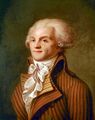 A portrait of Robespierre
 -
 Robespierre drinking wine spiked with powdered ergot
 -
 Robespierre protected by the Commune
 -
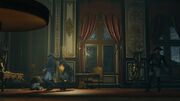 Robespierre is recaptured
 -
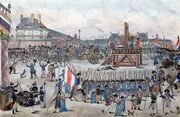 The execution of Robespierre
 -
 A copy of Robespierre's death mask


References
- ↑ 1.0 1.1 1.2 Assassin's Creed Unity: Abstergo Entertainment - Employee Handbook
- ↑ 2.0 2.1 2.2 2.3 Assassin's Creed: Unity
- ↑ https://revolutioninfiction.wordpress.com/2014/03/15/making-medical-myths-the-case-of-maximilien-robespierre-by-peter-mcphee/
- ↑ https://commons.wikimedia.org/wiki/File:MaxRobespierre_Best.jpg
