
Kanatahséton: Difference between revisions
imported>Darman36 Some sources, fixed page quote |
imported>Sol Pacificus No edit summary |
||
| Line 1: | Line 1: | ||
{{Era|Locations}} | {{Era|Locations}} | ||
{{Quote|We are caught between the need to act—and the knowledge that doing so endangers us.|Oiá:ner | {{Quote|We are caught between the need to act—and the knowledge that doing so endangers us.|Oiá:ner to Ratonhnhaké:ton, 1769.|Assassin's Creed III|Something to Remember}} | ||
[[File:ACIII-Kanatahseton.png|thumb|250px|Kanatahséton]] | [[File:ACIII-Kanatahseton.png|thumb|250px|Kanatahséton]] | ||
'''Kanatahséton''' was a [[Kanien'kehá:ka]] village that was located in the Mohawk Valley during the 18th century. It was built near the area of the [[Grand Temple]]'s entrance in order to keep it safe, meaning the inhabitants generally kept away from [[Iroquois]] affairs. The village was the birthplace of the [[Assassins|Assassin]] [[Ratonhnhaké:ton]]. | '''Kanatahséton''' was a [[Kanien'kehá:ka]] village that was located in the [[Kanièn:keh Nation Territory|Mohawk Valley]] during the 18th century. It was built near the area of the [[Grand Temple]]'s entrance in order to keep it safe, meaning the inhabitants generally kept away from [[Iroquois]] affairs. The village was the birthplace of the [[Assassins|Assassin]] [[Ratonhnhaké:ton]]. | ||
It consisted of six separate longhouses within its walls, as well as a spacious open area with log-seats and a fire. This clearing was used for skinning animals and pottery. The walls themselves had three different openings, two on the right (from the inside) and another at the front. These gates surrounded the entire village up to the water at the end. Near this lake were several canoes, presumably used for fishing purposes, and three small farm-like areas.<ref name="AC3">''[[Assassin's Creed III]]''</ref> | |||
==History== | ==History== | ||
Founded by the beginning of the 18th century, the village was occupied by the Kanien'kehá:ka people, who were a part of the Iroquois Confederacy. | Founded by the beginning of the 18th century,{{Fact|6 June 2023}} the village was occupied by the Kanien'kehá:ka people, who were a part of the Iroquois Confederacy.<ref name="Haudenosaunee">''[[Assassin's Creed III]]'' – [[Database: Haudenosaunee – People of the Longhouse]]</ref> Built near the ruins of the Grand Temple's entrance,<ref name="The Braddock Expedition">''[[Assassin's Creed III]]'' – [[The Braddock Expedition (memory)|The Braddock Expedition]]</ref> the people of Kanatahséton viewed it as their foremost duty to protect its secrets from outsiders and were therefore less inclined to join other Kanien'kehá:ka in external affairs, lest their activities draw undue attention onto themselves. The village also held a [[Piece of Eden]] known as the [[Crystal Balls|Crystal Ball]], which the people used to speak to [[Juno]] in the [[Nexus]].<ref name="Something to Remember">''[[Assassin's Creed III]]'' – [[Something to Remember]]</ref> | ||
===Conflicts with colonialists=== | |||
On 2 November 1760,<ref name="Smoke Leads To...">''[[Assassin's Creed: Initiates]]'' – [[Database: Smoke Leads To...]]</ref> Kanatahséton was razed to the ground<ref name="Hide and Seek">''[[Assassin's Creed III]]'' – [[Hide and Seek (III)|Hide and Seek]]</ref> just as the [[Seven Years' War]] was coming to a close,<ref name="Nichols 2014">Nichols, Roger L. (2014). "Living with Strangers, 1700–1783". In ''American Indians in U.S. History''. 2nd edition. Norman, OK: University of Oklahoma Press, pp. 41–59.</ref> The attack was preceded by a group of [[American Rite of the Templar Order|Colonial Templars]] assaulting a four-year-old Kanien'kehá:ka boy named [[Ratonhnhaké:ton]] as he was playing hide-and-seek with his friends. They spewed racial slurs at him and his people, and their leader, [[Charles Lee]], threatened him for directions to his village, where they intended to deliver an ultimatum for intelligence on the [[Isu|Precursor civilization]]. Shortly after, Kanatahséton was set ablaze, and many Kanien'kehá:ka perished in the conflagration, among them Ratonhnhaké:ton's mother [[Kaniehtí:io]]. Ratonhnhaké:ton, however, survived and would grow up viewing Charles Lee as an arch-nemesis.<ref name="Hide and Seek" /> | |||
Although the village was rebuilt, encroachment on Kanien'kehá:ka territory by British colonialists continued steadily throughout the 18th century.<ref name="Feathers and Trees">''[[Assassin's Creed III]]'' – [[Feathers and Trees]]</ref> Determined to resist the eventual expulsion of his people, Ratonhnhaké:ton met with [[Oiá:ner]] (i.e. his clan mother) for counsel in 1769 and was duplicitously<ref name="Chasing Lee">''[[Assassin's Creed III]]'' – [[Chasing Lee]]</ref> advised by the Isu [[Juno]] through a Crystal Ball that seeking out the [[Assassins]] was the path to saving his people.<ref name="Something to Remember" /> Ratonhnhaké:ton placed all his resolve into this journey and, at the age of 13, set out alone from his village to offer himself as a [[Assassin apprentice|pupil]] to [[Achilles Davenport]].<ref name="A Boorish Man">''[[Assassin's Creed III]]'' – [[A Boorish Man]]</ref> Under Achilles' tutelage, Ratonhnhaké:ton aligned himself with the [[Patriots]] in the [[American Revolution]], mistakenly hoping that their cause of liberty would extend to indigenous peoples as well.<ref name="Broken Trust">''[[Assassin's Creed III]]'' – [[Broken Trust]]</ref> During this time, he would return on occasion to the village to consult with Oiá:ner,<ref name="Floating conversations">''[[Assassin's Creed III]]'' – [[Floating conversations]]: "Oiá:ner"</ref> but a communication barrier in terms of political alliances nonetheless developed between him and his people.<ref name="Broken Trust" /> | |||
Because Ratonhnhaké:ton's father, [[Haytham Kenway]], was the [[Grand Master of the Templar Order|Grand Master Templar]] of the Colonial Rite, a confrontation between the two was inevitable. Yet as late as 1778, Haytham had not known about the torching of Kanatahséton in 1760 nor the fate of his former lover, Kaniehtí:io, having instructed his subordinates to cease the search for the Grand Temple.<ref name="The Foam and the Flames">''[[Assassin's Creed III]]'' – [[The Foam and the Flames]]</ref> In 1779, during a brief partnership with his son, he managed to implicate Commander-in-Chief [[George Washington]] of the [[Continental Army]] in the attack just as Washington had issued the orders for a [[Sullivan Expedition|genocidal campaign]] against the Kanien'kehá:ka for their alliance with the [[United Kingdom|British]]. Among the targets was Kanatahséton, and Washington admitted to having conducted a {{Wiki|Forbes Expedition|similar operation}} during the Seven Years' War. With no time to argue the details, Ratonhnhaké:ton cut ties with both Washington and Haytham and rushed to defend Kanatahséton.<ref name="Broken Trust" /> | |||
Unbeknownst to him, Charles Lee had falsely presented himself as a [[Loyalists|Loyalist]] to the people of Kanatahséton to mislead them that Ratonhnhaké:ton had sided with the Patriots' attack. Just outside the village, Ratonhnhaké:ton was ambushed by his childhood best friend [[Kanen'tó:kon]]. His pleas of a misunderstanding falling on deaf ears, Ratonhnhaké:ton was forced to kill Kanen'tó:kon in self-defence.<ref name="Broken Trust" /> Although Ratonhnhaké:ton did succeed his village from the ravages of war, the newly established [[United States|United States of America]] did not respect native sovereignty, notwithstanding his significant contributions to their cause. Within a year of the war's end, the U.S. government granted the land on which Kanatahséton sat to an American citizen as though it was their property to give and that the Kanien'kehá:ka nation did not already reside there. With white settler colonialism continuing unabated, the inhabitants of Kanatahséton were forced to abandon their home and migrate westward for safety.<ref name="Chasing Lee" /> | |||
==Alternate timeline== | ==Alternate timeline== | ||
[[File:ACIII-Warn 5.png|thumb|250px|left|Oiá:ner blaming Kaniehtí:io]] | [[File:ACIII-Warn 5.png|thumb|250px|left|Oiá:ner blaming Kaniehtí:io]] | ||
In an [[Calculations|alternate timeline]] where Kaniehtí:io never died and her son never joined the Assassins, Washington became an absolute monarch after recovering an [[Apple of Eden 3|Apple of Eden]] from {{Wiki|Yorktown, Virginia|Yorktown}}.<ref name="Tyranny">''Assassin's Creed III – [[The Tyranny of King Washington]]'' – [[Lucid Memory Fragments]]</ref> Kaniehtí:io attempted to steal the Apple, bringing his wrath to bear on the [[Frontier]].<ref name="Infamy">''Assassin's Creed III – [[The Tyranny of King Washington: The Infamy]]'' – {{Cite|17 Feb 2022 | In an [[Calculations|alternate timeline]] where Kaniehtí:io never died and her son never joined the Assassins, Washington became an absolute monarch after recovering an [[Apple of Eden 3|Apple of Eden]] from {{Wiki|Yorktown, Virginia|Yorktown}}.<ref name="Tyranny">''[[Assassin's Creed III]] – [[The Tyranny of King Washington]]'' – [[Lucid Memory Fragments]]</ref> Kaniehtí:io attempted to steal the Apple, bringing his wrath to bear on the [[Frontier]].<ref name="Infamy">''[[Assassin's Creed III]] – [[The Tyranny of King Washington: The Infamy]]'' – {{Cite|17 Feb 2022}}</ref> | ||
After defending [[Concord]] and [[Lexington]], Kaniehtí:io and her son returned to the village having learned Oiá:ner intended to brew the Tea of the [[Red Willow]] tree, which granted superhuman abilities to whoever drank it, but at the cost of their sanity. Kaniehtí:io argued they did not need it, but Oiá:ner responded that significantly more soldiers were coming to Kanatahséton than the ones who attacked the colonial towns.<ref name="Infamy"/> | After defending [[Concord]] and [[Lexington]], Kaniehtí:io and her son returned to the village having learned Oiá:ner intended to brew the Tea of the [[Red Willow]] tree, which granted superhuman abilities to whoever drank it, but at the cost of their sanity. Kaniehtí:io argued they did not need it, but Oiá:ner responded that significantly more soldiers were coming to Kanatahséton than the ones who attacked the colonial towns.<ref name="Infamy"/> | ||
| Line 22: | Line 27: | ||
Kaniehtí:io still refused to allow her son to drink the tea, and gave him his [[Haytham Kenway|father's]] [[Hidden Blade]]s instead. Washington and his troops arrived with his generals [[Israel Putnam]] and [[Benedict Arnold]].<ref name="Infamy"/> | Kaniehtí:io still refused to allow her son to drink the tea, and gave him his [[Haytham Kenway|father's]] [[Hidden Blade]]s instead. Washington and his troops arrived with his generals [[Israel Putnam]] and [[Benedict Arnold]].<ref name="Infamy"/> | ||
Ratonhnhaké:ton fought fiercely | Ratonhnhaké:ton fought fiercely and attacked Washington when the king used the Apple to end his mother's life. However, he was no match for the Apple's power, and the king proceeded to blast him with his pistols before stabbing him with a [[bayonets|bayonet]]. The villagers fled south to a cave, taking Ratonhnhaké:ton with them.<ref name="Infamy"/> | ||
==Behind the scenes== | ==Behind the scenes== | ||
Kanatahséton is the home village of [[Ratonhnhaké:ton]], better known as Connor, the main protagonist of ''[[Assassin's Creed III]]'' (2012), set during the [[American Revolution]] (1775–1783). | |||
Its destruction in the [[genetic memory|memory]] "[[Hide and Seek (III)|Hide and Seek]]", dated 1760 near the close of the [[Seven Years' War]] (1754–1763), is a major plot point in Connor's character arc, as it results in the death of his mother [[Kaniehtí:io]] and is preceded by his first hostile encounter with the story's antagonists, the [[Templars]]. The player, like Connor, are led to believe that the Templars are the culprits until the memory "[[Broken Trust]]" near the climax of the story, when [[Haytham Kenway]], as both leader of the Templars and Connor's father, forces [[George Washington]] to reveal that he was not only ordering [[Sullivan Expedition|genocide against the Iroquois]] but was also the one responsible for razing Kanien'kehá:ka villages in the earlier conflict. | |||
While later published material, such as ''[[Assassin's Creed: Initiates]]''<ref name="Smoke Leads to...">''[[Assassin's Creed: Initiates]]'' – [[Database: Smoke Leads To...]]</ref> and ''[[Assassin's Creed: Rebellion]]'',<ref name="Rebellion bio">''[[Assassin's Creed: Rebellion]]'' – [[Database: Ratonhnhaké:ton]]</ref> state that Washington burned the village, the game as the primary source leaves the perpetrators ambiguous because Washington's guilt is only established by Haytham as an {{wiki|unreliable narrator}} while Connor's eyewitness evidence heavily supports the Templars being responsible. In addition, there are contradictions in the chronology. Of note are the following points: | |||
*Haytham discounts that Templars were responsible because he had commanded his subordinates to relinquish their pursuit of the Grand Temple. His own testimony does not disprove the possibility that these subordinates defied his order or even destroyed a village without him knowing. "Hide and Seek" can be taken as an eyewitness account by Connor that [[Charles Lee]], [[William Johnson]], [[Thomas Hickey]], and [[Benjamin Church]] threatened his life for direction to the village and announced their intent to threaten the village in turn for information about the Grand Temple—moments before it was set ablaze. | |||
*The confession that Haytham extracts from Washington is indirect. He leads Washington into admitting to having burned indigenous villages in the Seven Years' War, resulting in the assumption by players and the characters alike that Kanatahséton must have been one of them—but this is never confirmed. Washington would have been referring to the {{wiki|Forbes Expedition}} of 1758, when Connor would have only been two-years-old and two years before the setting of "Hide and Seek". | |||
*Historically, George Washington resigned from military service in the Seven Years' War at the end of 1758.<ref name="Lengel 2005">Lengel, Edward G. "The Virginia Regiment". In ''General George Washington: A Military Life''. New York, NY: Random House Trade Paperbacks, pp. 63–80.</ref> Moreover, while the Seven Years' War officially ended in 1763 with the {{wiki|Treaty of Paris (1763)|Treaty of Paris}}, virtually all hostilities in the Americas had ceased by 1760<ref name="Nichols 2014" /> with the exception of the {{wiki|Conquest of New France (1758–1760)|conquest of New France}}.<ref name="Kamensky et al. 2019">Kamensky, Jane, et al. (2019). "The Ends of Empire, 1754–1774". In ''A People and a Nation: A History of the United States''. 11th edition. Boston, MA: Cengage Learning, pp. 118–145</ref> | |||
''Assassin's Creed: Initiates'' appears to have attempted to address this misalignment in the dates between the Forbes Expedition and destruction of Kanen'tó:kon with the database entry "[[Database: Smoke Leads To...|Smoke Leads To...]]". There, Washington is stated to have ordered the razing of Kanen'tó:kon on 2 November 1760, apparently from his own estate at [[Mount Vernon]] and apart from the Forbes Expedition. | |||
==Gallery== | ==Gallery== | ||
Revision as of 05:15, 7 June 2023

Kanatahséton was a Kanien'kehá:ka village that was located in the Mohawk Valley during the 18th century. It was built near the area of the Grand Temple's entrance in order to keep it safe, meaning the inhabitants generally kept away from Iroquois affairs. The village was the birthplace of the Assassin Ratonhnhaké:ton.
It consisted of six separate longhouses within its walls, as well as a spacious open area with log-seats and a fire. This clearing was used for skinning animals and pottery. The walls themselves had three different openings, two on the right (from the inside) and another at the front. These gates surrounded the entire village up to the water at the end. Near this lake were several canoes, presumably used for fishing purposes, and three small farm-like areas.[1]
History
Founded by the beginning of the 18th century, [citation needed] the village was occupied by the Kanien'kehá:ka people, who were a part of the Iroquois Confederacy.[2] Built near the ruins of the Grand Temple's entrance,[3] the people of Kanatahséton viewed it as their foremost duty to protect its secrets from outsiders and were therefore less inclined to join other Kanien'kehá:ka in external affairs, lest their activities draw undue attention onto themselves. The village also held a Piece of Eden known as the Crystal Ball, which the people used to speak to Juno in the Nexus.[4]
Conflicts with colonialists
On 2 November 1760,[5] Kanatahséton was razed to the ground[6] just as the Seven Years' War was coming to a close,[7] The attack was preceded by a group of Colonial Templars assaulting a four-year-old Kanien'kehá:ka boy named Ratonhnhaké:ton as he was playing hide-and-seek with his friends. They spewed racial slurs at him and his people, and their leader, Charles Lee, threatened him for directions to his village, where they intended to deliver an ultimatum for intelligence on the Precursor civilization. Shortly after, Kanatahséton was set ablaze, and many Kanien'kehá:ka perished in the conflagration, among them Ratonhnhaké:ton's mother Kaniehtí:io. Ratonhnhaké:ton, however, survived and would grow up viewing Charles Lee as an arch-nemesis.[6]
Although the village was rebuilt, encroachment on Kanien'kehá:ka territory by British colonialists continued steadily throughout the 18th century.[8] Determined to resist the eventual expulsion of his people, Ratonhnhaké:ton met with Oiá:ner (i.e. his clan mother) for counsel in 1769 and was duplicitously[9] advised by the Isu Juno through a Crystal Ball that seeking out the Assassins was the path to saving his people.[4] Ratonhnhaké:ton placed all his resolve into this journey and, at the age of 13, set out alone from his village to offer himself as a pupil to Achilles Davenport.[10] Under Achilles' tutelage, Ratonhnhaké:ton aligned himself with the Patriots in the American Revolution, mistakenly hoping that their cause of liberty would extend to indigenous peoples as well.[11] During this time, he would return on occasion to the village to consult with Oiá:ner,[12] but a communication barrier in terms of political alliances nonetheless developed between him and his people.[11]
Because Ratonhnhaké:ton's father, Haytham Kenway, was the Grand Master Templar of the Colonial Rite, a confrontation between the two was inevitable. Yet as late as 1778, Haytham had not known about the torching of Kanatahséton in 1760 nor the fate of his former lover, Kaniehtí:io, having instructed his subordinates to cease the search for the Grand Temple.[13] In 1779, during a brief partnership with his son, he managed to implicate Commander-in-Chief George Washington of the Continental Army in the attack just as Washington had issued the orders for a genocidal campaign against the Kanien'kehá:ka for their alliance with the British. Among the targets was Kanatahséton, and Washington admitted to having conducted a similar operation during the Seven Years' War. With no time to argue the details, Ratonhnhaké:ton cut ties with both Washington and Haytham and rushed to defend Kanatahséton.[11]
Unbeknownst to him, Charles Lee had falsely presented himself as a Loyalist to the people of Kanatahséton to mislead them that Ratonhnhaké:ton had sided with the Patriots' attack. Just outside the village, Ratonhnhaké:ton was ambushed by his childhood best friend Kanen'tó:kon. His pleas of a misunderstanding falling on deaf ears, Ratonhnhaké:ton was forced to kill Kanen'tó:kon in self-defence.[11] Although Ratonhnhaké:ton did succeed his village from the ravages of war, the newly established United States of America did not respect native sovereignty, notwithstanding his significant contributions to their cause. Within a year of the war's end, the U.S. government granted the land on which Kanatahséton sat to an American citizen as though it was their property to give and that the Kanien'kehá:ka nation did not already reside there. With white settler colonialism continuing unabated, the inhabitants of Kanatahséton were forced to abandon their home and migrate westward for safety.[9]
Alternate timeline

In an alternate timeline where Kaniehtí:io never died and her son never joined the Assassins, Washington became an absolute monarch after recovering an Apple of Eden from Yorktown.[14] Kaniehtí:io attempted to steal the Apple, bringing his wrath to bear on the Frontier.[15]
After defending Concord and Lexington, Kaniehtí:io and her son returned to the village having learned Oiá:ner intended to brew the Tea of the Red Willow tree, which granted superhuman abilities to whoever drank it, but at the cost of their sanity. Kaniehtí:io argued they did not need it, but Oiá:ner responded that significantly more soldiers were coming to Kanatahséton than the ones who attacked the colonial towns.[15]

Kaniehtí:io still refused to allow her son to drink the tea, and gave him his father's Hidden Blades instead. Washington and his troops arrived with his generals Israel Putnam and Benedict Arnold.[15]
Ratonhnhaké:ton fought fiercely and attacked Washington when the king used the Apple to end his mother's life. However, he was no match for the Apple's power, and the king proceeded to blast him with his pistols before stabbing him with a bayonet. The villagers fled south to a cave, taking Ratonhnhaké:ton with them.[15]
Behind the scenes
Kanatahséton is the home village of Ratonhnhaké:ton, better known as Connor, the main protagonist of Assassin's Creed III (2012), set during the American Revolution (1775–1783).
Its destruction in the memory "Hide and Seek", dated 1760 near the close of the Seven Years' War (1754–1763), is a major plot point in Connor's character arc, as it results in the death of his mother Kaniehtí:io and is preceded by his first hostile encounter with the story's antagonists, the Templars. The player, like Connor, are led to believe that the Templars are the culprits until the memory "Broken Trust" near the climax of the story, when Haytham Kenway, as both leader of the Templars and Connor's father, forces George Washington to reveal that he was not only ordering genocide against the Iroquois but was also the one responsible for razing Kanien'kehá:ka villages in the earlier conflict.
While later published material, such as Assassin's Creed: Initiates[16] and Assassin's Creed: Rebellion,[17] state that Washington burned the village, the game as the primary source leaves the perpetrators ambiguous because Washington's guilt is only established by Haytham as an unreliable narrator while Connor's eyewitness evidence heavily supports the Templars being responsible. In addition, there are contradictions in the chronology. Of note are the following points:
- Haytham discounts that Templars were responsible because he had commanded his subordinates to relinquish their pursuit of the Grand Temple. His own testimony does not disprove the possibility that these subordinates defied his order or even destroyed a village without him knowing. "Hide and Seek" can be taken as an eyewitness account by Connor that Charles Lee, William Johnson, Thomas Hickey, and Benjamin Church threatened his life for direction to the village and announced their intent to threaten the village in turn for information about the Grand Temple—moments before it was set ablaze.
- The confession that Haytham extracts from Washington is indirect. He leads Washington into admitting to having burned indigenous villages in the Seven Years' War, resulting in the assumption by players and the characters alike that Kanatahséton must have been one of them—but this is never confirmed. Washington would have been referring to the Forbes Expedition of 1758, when Connor would have only been two-years-old and two years before the setting of "Hide and Seek".
- Historically, George Washington resigned from military service in the Seven Years' War at the end of 1758.[18] Moreover, while the Seven Years' War officially ended in 1763 with the Treaty of Paris, virtually all hostilities in the Americas had ceased by 1760[7] with the exception of the conquest of New France.[19]
Assassin's Creed: Initiates appears to have attempted to address this misalignment in the dates between the Forbes Expedition and destruction of Kanen'tó:kon with the database entry "Smoke Leads To...". There, Washington is stated to have ordered the razing of Kanen'tó:kon on 2 November 1760, apparently from his own estate at Mount Vernon and apart from the Forbes Expedition.
Gallery
-
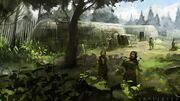 Art of Kanatahséton in Assassin's Creed: Initiates

Appearances
- Assassin's Creed III (first appearance)
- Assassin's Creed: Initiates (mentioned in Database entry only)
- Assassin's Creed: Forsaken (indirect mention only)
- Assassin's Creed: Rebellion (mentioned in Database entry only)
References
- ↑ Assassin's Creed III
- ↑ Assassin's Creed III – Database: Haudenosaunee – People of the Longhouse
- ↑ Assassin's Creed III – The Braddock Expedition
- ↑ 4.0 4.1 Assassin's Creed III – Something to Remember
- ↑ Assassin's Creed: Initiates – Database: Smoke Leads To...
- ↑ 6.0 6.1 Assassin's Creed III – Hide and Seek
- ↑ 7.0 7.1 Nichols, Roger L. (2014). "Living with Strangers, 1700–1783". In American Indians in U.S. History. 2nd edition. Norman, OK: University of Oklahoma Press, pp. 41–59.
- ↑ Assassin's Creed III – Feathers and Trees
- ↑ 9.0 9.1 Assassin's Creed III – Chasing Lee
- ↑ Assassin's Creed III – A Boorish Man
- ↑ 11.0 11.1 11.2 11.3 Assassin's Creed III – Broken Trust
- ↑ Assassin's Creed III – Floating conversations: "Oiá:ner"
- ↑ Assassin's Creed III – The Foam and the Flames
- ↑ Assassin's Creed III – The Tyranny of King Washington – Lucid Memory Fragments
- ↑ 15.0 15.1 15.2 15.3 Assassin's Creed III – The Tyranny of King Washington: The Infamy – [citation needed]
- ↑ Assassin's Creed: Initiates – Database: Smoke Leads To...
- ↑ Assassin's Creed: Rebellion – Database: Ratonhnhaké:ton
- ↑ Lengel, Edward G. "The Virginia Regiment". In General George Washington: A Military Life. New York, NY: Random House Trade Paperbacks, pp. 63–80.
- ↑ Kamensky, Jane, et al. (2019). "The Ends of Empire, 1754–1774". In A People and a Nation: A History of the United States. 11th edition. Boston, MA: Cengage Learning, pp. 118–145
Template:TOKW de:Kanatahséton es:Kanatahséton fr:Kanatahséton it:Kanatahséton pl:Kanatahséton pt-br:Kanatahséton ru:Ганадазедон zh:卡那泰圣顿