


Janissary: Difference between revisions
imported>GuardDog |
imported>Slate Vesper No edit summary |
||
| Line 1: | Line 1: | ||
{{Era|ACR|DYL| | {{Era|ACR|DYL|Rbook}} | ||
{{WP-REAL|Janissary}} | {{WP-REAL|Janissary}} | ||
{{Faction Infobox | |||
{{Faction | |||
|name = Janissaries | |name = Janissaries | ||
|image = Ottoman Janissary.png | |image = Ottoman Janissary.png | ||
| Line 10: | Line 9: | ||
|locations = [[Ottoman Empire]] | |locations = [[Ottoman Empire]] | ||
|related = [[Ottomans]] | |related = [[Ottomans]] | ||
|religion = | |religion = Islam | ||
|formed = 1363 | |formed = 1363 | ||
|collapsed = 1828 | |collapsed = 1828 | ||
|hidea = yes | |hidea = yes | ||
|notable = | |notable = [[Tarik Barleti]]}} | ||
The '''Janissaries''', also known as the '''Yeniçeri''', were specially trained elite soldiers of the [[Ottoman Empire]], serving as the private [[Guards|guard]] to the Sultan. | |||
The '''Janissaries''' | |||
==History== | ==History== | ||
===Formation=== | ===Formation=== | ||
Janissaries, created by Sultan Murad I, were young Christian boys from conquered countries (commonly [[Greece|Greek]]), who were converted to Islam and levied into the Devshirme system (or the "Collection of Children"). They were also nicknamed "slave soldiers", because of their method of capture. The strongest of the children were usually chosen to become Janissaries, whereas the more intelligent ones would become scientists or architects.<ref name=" | Janissaries, created by Sultan {{Wiki|Murad I}}, were young Christian boys from conquered countries (commonly [[Greece|Greek]]), who were converted to Islam and levied into the Devshirme system (or the "Collection of Children"). They were also nicknamed "slave soldiers", because of their method of capture. The strongest of the children were usually chosen to become Janissaries, whereas the more intelligent ones would become scientists or architects.<ref name="Devshirme">''{{Wiki|Devşirme|Wikipedia article: Devşirme}}''</ref> | ||
The Janissaries became the Ottoman Empire's first standing army, and were required to learn and convert to Islam. This elite sect of soldiers were also the mainstay of the [[Ottomans|Ottoman]] army during the 1453 invasion of Constantinople, led by Sultan | The Janissaries became the Ottoman Empire's first standing army, and were required to learn and convert to Islam. This elite sect of soldiers were also the mainstay of the [[Ottomans|Ottoman]] army during the 1453 invasion of Constantinople, led by Sultan [[Mehmed II]]. They were essentially infantry units that formed the Sultan's household troops and bodyguard. However, after the 17th century, they began to falter in importance and strength until they were eventually abolished by Sultan {{Wiki|Mahmud II}} in 1826, as a result of {{Wiki|The Auspicious Incident|the Auspicious Incident}}.<ref name="Devshirme"/> | ||
=== | ===Renaissance=== | ||
[[File:Eziojanissary.jpg|thumb|250px|Ezio in combat with the Janissaries.]] | [[File:Eziojanissary.jpg|thumb|250px|Ezio in combat with the Janissaries.]] | ||
In the 16th century, the Janissaries were led by [[Tarik Barleti]]. Due to the habit of some members terrorizing the populace of [[Constantinople]], they were widely feared by the [[civilians]]. | In the 16th century, the Janissaries were led by [[Tarik Barleti]]. Due to the habit of some members terrorizing the populace of [[Constantinople]], they were widely feared by the [[civilians]]. | ||
[[Ezio Auditore da Firenze | The [[Assassins|Assassin]] [[Ezio Auditore da Firenze]] used this to his advantage by paying [[heralds]] to incite a [[Riot at the Harbor of Theodosius|riot]] in the [[Harbor of Theodosius]], enabling him to sneak into the harbor and spy on a meeting between their commander, Tarik, and the [[Byzantines]] [[Manuel Palaiologos]] and [[Shahkulu]]. | ||
Under Prince [[Suleiman I|Suleiman]]'s orders, Ezio lured a Janissary into a hiding spot and killed him, then took his clothes in order to infiltrate the Janissary camp in the [[Constantine District]]. When Ezio assassinated Tarik, he discovered that he was not a traitor, merely secretly trying to infiltrate the Byzantine Templars. After Ezio escaped, the Janissaries began patrolling all of Constantinople and raised the [[Great Chain]] to prevent his departure. | Under Prince [[Suleiman I|Suleiman]]'s orders, Ezio lured a Janissary into a hiding spot and killed him, and then took his clothes in order to infiltrate the Janissary camp in the [[Constantine District]]. When Ezio assassinated Tarik, he discovered that he was not a traitor, merely secretly trying to infiltrate the Byzantine Templars. After Ezio escaped, the Janissaries began patrolling all of Constantinople and raised the [[Great Chain]] to prevent his departure. | ||
However, this ultimately failed, as Ezio destroyed the Great Chain with a [[Bombs|bomb]], and sank the ships blockading the [[Golden Horn]] by spraying them with [[Greek Fire]]. He then left Constantinople for [[Derinkuyu]] on a chartered ship | However, this ultimately failed, as Ezio destroyed the Great Chain with a [[Bombs|bomb]], and sank the ships blockading the [[Golden Horn]] by spraying them with [[Greek Fire]]. He then left Constantinople for [[Derinkuyu]] on a chartered ship, and when he returned, the Janissaries were on high alert, with them declaring a warrant for his capture.<ref>''[[Assassin's Creed: Revelations]]''</ref> | ||
==Statistics== | ==Statistics== | ||
{|border="1" cellpadding="1" cellspacing="1" style="width: 500px" | {|border="1" cellpadding="1" cellspacing="1" style="width: 500px" | ||
|+ | |+ | ||
| style="text-align: center"|Health | |style="text-align: center"|Health | ||
| style="text-align: center"|Strength | |style="text-align: center"|Strength | ||
| style="text-align: center"|Morale | |style="text-align: center"|Morale | ||
| style="text-align: center"|Melee | |style="text-align: center"|Melee weapon | ||
| style="text-align: center"|Ranged | |style="text-align: center"|Ranged weapon | ||
|- | |- | ||
| style="text-align: center"|84 | |style="text-align: center"|84 | ||
| style="text-align: center"|7 | |style="text-align: center"|7 | ||
| style="text-align: center"|2,000 | |style="text-align: center"|2,000 | ||
| style="text-align: center"| | |style="text-align: center"|[[Janissary Kijil]] or a mace | ||
| style="text-align: center"|Firearm | |style="text-align: center"|Firearm | ||
|} | |} | ||
==Trivia== | ==Trivia== | ||
* Janissaries | *Janissaries could not be instantly killed by counter-attacks and execution streaks from full health. However, they still took damage whenever one of the two was performed. | ||
** Despite Janissaries not being initially vulnerable to execution streaks, combo chains | **Despite Janissaries not being initially vulnerable to execution streaks, combo chains could still be continued by attacking another guard, and could also be started by counter-stealing from a Janissary instead. | ||
* Like [[Almogavars]], all Janissaries | *Like [[Almogavars]], all Janissaries wielded the same sword: the Janissary Kijil. | ||
* | *On some occasions, if Ezio was lacking in lethal or tactical bombs, looting or stealing from Janissaries will give him [[Splinter bombs|splinter]] or [[caltrop bombs]]. | ||
* Janissaries | *Janissaries were very resistant to gunfire, but were easily killed by bombs and [[poison]]. | ||
* In the [[Assassin's Creed: Revelations (novel)| | *In the [[Assassin's Creed: Revelations (novel)|novelization]] of [[Assassin's Creed: Revelations]], the Janissaries were depicted as wearing white armor instead of green. | ||
* Janissaries | *Janissaries were faster than Ezio, and could climb onto most buildings, which made them difficult to escape from. | ||
==Gallery== | ==Gallery== | ||
| Line 68: | Line 64: | ||
ACR_STORY_18.png|A group of Janissaries in Constantinople. | ACR_STORY_18.png|A group of Janissaries in Constantinople. | ||
JanVsEzio.png|A Janissary fights Ezio Auditore. | JanVsEzio.png|A Janissary fights Ezio Auditore. | ||
ACR Jannisary Camp.png|Overview of the | ACR Jannisary Camp.png|Overview of the Janissary camp. | ||
Honor lost won v 4.png|Entrance of the Janissary camp. | Honor lost won v 4.png|Entrance of the Janissary camp. | ||
</gallery> | </gallery> | ||
| Line 74: | Line 70: | ||
==References== | ==References== | ||
{{Reflist}} | {{Reflist}} | ||
{{ACR}} | {{ACR}} | ||
[[Category:Guards]] | [[Category:Guards]] | ||
Revision as of 01:29, 19 September 2012
The Janissaries, also known as the Yeniçeri, were specially trained elite soldiers of the Ottoman Empire, serving as the private guard to the Sultan.
History
Formation
Janissaries, created by Sultan Murad I, were young Christian boys from conquered countries (commonly Greek), who were converted to Islam and levied into the Devshirme system (or the "Collection of Children"). They were also nicknamed "slave soldiers", because of their method of capture. The strongest of the children were usually chosen to become Janissaries, whereas the more intelligent ones would become scientists or architects.[1]
The Janissaries became the Ottoman Empire's first standing army, and were required to learn and convert to Islam. This elite sect of soldiers were also the mainstay of the Ottoman army during the 1453 invasion of Constantinople, led by Sultan Mehmed II. They were essentially infantry units that formed the Sultan's household troops and bodyguard. However, after the 17th century, they began to falter in importance and strength until they were eventually abolished by Sultan Mahmud II in 1826, as a result of the Auspicious Incident.[1]
Renaissance
In the 16th century, the Janissaries were led by Tarik Barleti. Due to the habit of some members terrorizing the populace of Constantinople, they were widely feared by the civilians.
The Assassin Ezio Auditore da Firenze used this to his advantage by paying heralds to incite a riot in the Harbor of Theodosius, enabling him to sneak into the harbor and spy on a meeting between their commander, Tarik, and the Byzantines Manuel Palaiologos and Shahkulu.
Under Prince Suleiman's orders, Ezio lured a Janissary into a hiding spot and killed him, and then took his clothes in order to infiltrate the Janissary camp in the Constantine District. When Ezio assassinated Tarik, he discovered that he was not a traitor, merely secretly trying to infiltrate the Byzantine Templars. After Ezio escaped, the Janissaries began patrolling all of Constantinople and raised the Great Chain to prevent his departure.
However, this ultimately failed, as Ezio destroyed the Great Chain with a bomb, and sank the ships blockading the Golden Horn by spraying them with Greek Fire. He then left Constantinople for Derinkuyu on a chartered ship, and when he returned, the Janissaries were on high alert, with them declaring a warrant for his capture.[2]
Statistics
| Health | Strength | Morale | Melee weapon | Ranged weapon |
| 84 | 7 | 2,000 | Janissary Kijil or a mace | Firearm |
Trivia
- Janissaries could not be instantly killed by counter-attacks and execution streaks from full health. However, they still took damage whenever one of the two was performed.
- Despite Janissaries not being initially vulnerable to execution streaks, combo chains could still be continued by attacking another guard, and could also be started by counter-stealing from a Janissary instead.
- Like Almogavars, all Janissaries wielded the same sword: the Janissary Kijil.
- On some occasions, if Ezio was lacking in lethal or tactical bombs, looting or stealing from Janissaries will give him splinter or caltrop bombs.
- Janissaries were very resistant to gunfire, but were easily killed by bombs and poison.
- In the novelization of Assassin's Creed: Revelations, the Janissaries were depicted as wearing white armor instead of green.
- Janissaries were faster than Ezio, and could climb onto most buildings, which made them difficult to escape from.
Gallery
-
 Concept artwork of the Janissaries.
 -
 The database image of the Janissaries.
 -
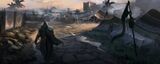 Concept of Ezio entering a Janissary camp.
 -
A group of Janissaries in Constantinople.
-
A Janissary fights Ezio Auditore.
-
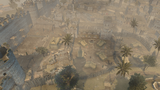 Overview of the Janissary camp.
 -
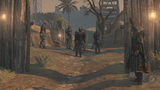 Entrance of the Janissary camp.


References
| |||||||||||||||||||||||||||||||||||||