


Iltani: Difference between revisions
imported>Amnestyyy No edit summary |
imported>The Wikia Editor No edit summary |
||
| Line 4: | Line 4: | ||
'''Iltani''' was a member of the [[Babylonian Assassins|Babylonian Brotherhood]] of [[Assassins]] during the {{Wiki|Argead Dynasty}}. | '''Iltani''' was a member of the [[Babylonian Assassins|Babylonian Brotherhood]] of [[Assassins]] during the {{Wiki|Argead Dynasty}}. | ||
During her lifetime, the [[Templars|Templar]] ally [[Alexander the Great]] conquered most of South-West [[Asia]] by using a [[Staves of Eden|Staff]], one of the [[Pieces of Eden]].<ref name="Encyclopedia">''[[Assassin's Creed Encyclopedia]]</ref><ref name="AC2"/> | During her lifetime, the [[Templars|Templar]] ally [[Alexander the Great]] conquered most of South-West [[Asia]] by using a [[Staves of Eden|Staff]], one of the [[Pieces of Eden]].<ref name="Encyclopedia">''[[Assassin's Creed Encyclopedia]]''</ref><ref name="AC2">''[[Assassin's Creed II]]''</ref> | ||
At some point during Alexander's conquest of Asia, Iltani tracked him to [[Herat]], [[Afghanistan]], where he was holed up in a mighty [[Herat Citadel|Citadel]]. She managed to infiltrate the Citadel, but soon realised she would not be able to take him out through force.<ref name=ACCI>''[[Assassin's Creed Chronicles: India]]''</ref> | At some point during Alexander's conquest of Asia, Iltani tracked him to [[Herat]], [[Afghanistan]], where he was holed up in a mighty [[Herat Citadel|Citadel]]. She managed to infiltrate the Citadel, but soon realised she would not be able to take him out through force.<ref name="ACCI">''[[Assassin's Creed Chronicles: India]]''</ref> | ||
Instead, when she suspected Alexander had become aware of her presence, she left Herat. She set out to find an | Instead, when she suspected Alexander had become aware of her presence, she left Herat. She set out to find an Achaemenid alchemist, hoping to expand her knowledge of poisons. After a perilous journey, she arrived in Babylon, where she found the alchemist and learned his secrets.<ref name="ACCI"/> | ||
Before going after Alexander to perform her planned assassination, she left messages for her fellow Assassins, including the recipe of the poison, in case she would not be successful.<ref name=ACCI /> | Before going after Alexander to perform her planned assassination, she left messages for her fellow Assassins, including the recipe of the poison, in case she would not be successful.<ref name="ACCI"/> | ||
On 13 June 323 BCE, Iltani infiltrated the palace of {{Wiki|Nebuchadnezzar II}}, poisoned Alexander the Great, who died as a result, and retrieved the Staff.<ref name="Initiates">''[[Assassin's Creed: Initiates]]''</ref><ref name="AC2"/> | On 13 June 323 BCE, Iltani infiltrated the palace of {{Wiki|Nebuchadnezzar II}}, poisoned Alexander the Great, who died as a result, and retrieved the Staff.<ref name="Initiates">''[[Assassin's Creed: Initiates]]''</ref><ref name="AC2"/> | ||
By the time of the [[Renaissance]], Iltani's sarcophagus had been moved to the [[Basilica di Santa Maria del Fiore]] in [[Florence]]. Fellow Assassin [[Ezio Auditore da Firenze]] explored her tomb and took the seal from her sarcophagus, which helped him to acquire the [[Armor of Altaïr|armor]] of [[Altaïr Ibn-La'Ahad]].<ref name="AC2" | By the time of the [[Renaissance]], Iltani's sarcophagus had been moved to the [[Basilica di Santa Maria del Fiore]] in [[Florence]]. Fellow Assassin [[Ezio Auditore da Firenze]] explored her tomb and took the seal from her sarcophagus, which helped him to acquire the [[Armor of Altaïr|armor]] of [[Altaïr Ibn-La'Ahad]].<ref name="AC2"/> | ||
By the [[Modern times|year 2000]], a statue of Iltani stood in [[Mentor (2000)|the Mentor]]'s office in [[Dubai]].<ref name="ACTF3">''[[Assassin's Creed: The Fall]]'' - Issue #3</ref> | By the [[Modern times|year 2000]], a statue of Iltani stood in [[Mentor (2000)|the Mentor]]'s office in [[Dubai]].<ref name="ACTF3">''[[Assassin's Creed: The Fall]]'' - Issue #3</ref> | ||
Revision as of 00:31, 3 March 2017
- "I have found the Achaemenid, and he gave me the secret of his poison. Not as fast as I would have hoped, but always fatal. Ironically, Alexander will die by the poison of those whom he had vanquished in battle."
- ―Iltani in a message for the Brotherhood.[src]

Iltani was a member of the Babylonian Brotherhood of Assassins during the Argead Dynasty.
During her lifetime, the Templar ally Alexander the Great conquered most of South-West Asia by using a Staff, one of the Pieces of Eden.[1][2]
At some point during Alexander's conquest of Asia, Iltani tracked him to Herat, Afghanistan, where he was holed up in a mighty Citadel. She managed to infiltrate the Citadel, but soon realised she would not be able to take him out through force.[3]
Instead, when she suspected Alexander had become aware of her presence, she left Herat. She set out to find an Achaemenid alchemist, hoping to expand her knowledge of poisons. After a perilous journey, she arrived in Babylon, where she found the alchemist and learned his secrets.[3]
Before going after Alexander to perform her planned assassination, she left messages for her fellow Assassins, including the recipe of the poison, in case she would not be successful.[3]
On 13 June 323 BCE, Iltani infiltrated the palace of Nebuchadnezzar II, poisoned Alexander the Great, who died as a result, and retrieved the Staff.[4][2]
By the time of the Renaissance, Iltani's sarcophagus had been moved to the Basilica di Santa Maria del Fiore in Florence. Fellow Assassin Ezio Auditore da Firenze explored her tomb and took the seal from her sarcophagus, which helped him to acquire the armor of Altaïr Ibn-La'Ahad.[2]
By the year 2000, a statue of Iltani stood in the Mentor's office in Dubai.[5]
Trivia
- Iltani is the feminine form of a Babylonian word meaning "lucky" or "favored by the god(dess)".
- It is also the Babylonian name for the north wind.
Gallery
-
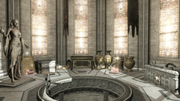 Iltani's statue and sarcophagus
 -
 The Seal of Iltani
 -
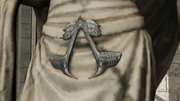 Iltani's insignia


